


If you insist on taking an Oscar Wilde comedy out of its natural habitat, the drawing room, please don't take it any farther than the adjoining climate-controlled hothouse where the carnivorous plants are waiting to be fed.
Don't even think of carrying it out of the country or of bringing it up to date. Wilde's twittering, hyperarticulate snobs swapping elegant bons mots belong to only one time, one place and one setting: the luxurious inner sanctums of upper-crust London in the late-late 19th century.
Alas, those cautions haven't prevented the director Mike Barker and the screenwriter Howard Himelstein from dragging Lady Windermere's Fan, the 1892 comedy that catapulted Wilde to glory, out of the house for a rugged seaside vacation on the Italian coast. Retitled A Good Woman and updated to 1930, this misbegotten Hollywood-minded screen adaptation turns three of the play's British characters into Americans abroad.
Why the Italian coast? It's scenic. And who would deny the universal benefits of fresh air, sunshine and exercise?
Wilde would. No champion of the great outdoors, the playwright remarked, "At twilight, nature is not without loveliness, though perhaps its chief use is to illustrate quotations from the poets."
A Good Woman teems with like-minded epigrams, many well known, and many more shoehorned in from other Wilde plays: "History is merely gossip. But scandal is gossip made tedious by morality." "I can resist everything except temptation." "Life is far too important a thing ever to talk seriously about." "Experience is the name everyone gives to their mistakes."
To hear these and other well-turned phrases strewn through the screenplay like shards of cut glass nestled in a haystack, you must listen closely. To coexist comfortably with the prosaic dialogue surrounding them, their cutting edges have been blunted, the hauteur of their delivery subdued. When put into the mouths of American actors with no feel for Wilde's high-toned repartee, they simply hang in the air and die.
There is an excruciating divide between the film's British actors (led by Tom Wilkinson and Stephen Campbell Moore), who are comfortable delivering Wilde's aphorisms (Moore gets the most), and its American marquee names, Helen Hunt and Scarlett Johansson. Those two stars' shrill, toneless performances bring to mind one of the play's most famous (and prescient) epigrams: "America is the only country that went from barbarism to decadence without civilization in between."
Hunt and Johansson have so little connection to the English language as spoken in the high Wildean style that you actually wonder if America's connection to Wilde's ideal of civilization as a refined, superliterate verbal testing ground is out of our reach. It wasn't always so.
Hunt, an actress who can win your heart when she plays it folksy, commonsensical and all-American, is disastrously miscast as Erlynne, an American femme fatale cutting a dangerous swath. Her eyes narrowed to slits, her gait gawky, her nervous piping voice pitched on the edge of hysteria, the actress seems so uncomfortable in her skin that you want to flee her presence.
An adventuress left penniless and driven out of New York by her lovers' angry wives, Erlynne descends on the Italian coast hellbent on what appears to be a new gold-digging expedition. No sooner has she arrived than she sets her sights on Robert Windermere (Mark Umbers), a young American businessman recently married to the luscious Rhode Island-born Meg (Johansson). Immediately, tongues wag. But appearances deceive.
Johansson is only marginally less uncomfortable as the increasingly suspicious Meg, courted by a silver-tongued playboy, Lord Darlington (Moore), who sees an opportunity to strike. Meanwhile, Erlynne is courted by Lord Augustus, aka Tuppy (Wilkinson), a wealthy, age-appropriate aristocrat who knows she doesn't love him but is nonetheless smitten. The disclosure of secrets and hidden agendas eventually leads us to re-evaluate Erlynne in a much more positive light.
A Good Woman never overcomes its stylistic disharmony. The solid performances of Wilkinson, Moore and the supporting British cast notwithstanding, the movie is so flat that it almost makes you grateful for Oliver Parker's recent flawed screen adaptations of Wilde, An Ideal Husband and The Importance of Being Earnest.
Those films also played fast and loose with Wilde (Earnest, which verged on farce, brought in gimmicks like helium balloons and found Reese Witherspoon struggling to appear authentically English), but nothing like this. Of course, it's understandable that filmmakers want to add color and texture to Wilde; the movies are such a visual medium. But it really shouldn't be necessary, if Wilde's language is allowed to do its tricks.
Photos: courtesy of Vie Vision Pictures

Last week Joseph Nye, the well-known China scholar, wrote on the Australian Strategic Policy Institute’s website about how war over Taiwan might be averted. He noted that years ago he was on a team that met with then-president Chen Shui-bian (陳水扁), “whose previous ‘unofficial’ visit to the US had caused a crisis in which China fired missiles into the sea and the US deployed carriers off the coast of Taiwan.” Yes, that’s right, mighty Chen caused that crisis all by himself. Neither the US nor the People’s Republic of China (PRC) exercised any agency. Nye then nostalgically invoked the comical specter
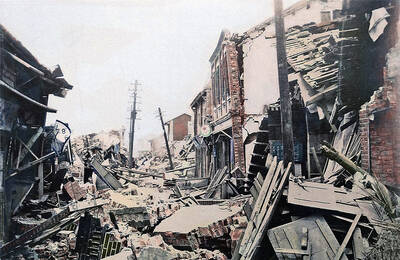
April 15 to April 21 Yang Kui (楊逵) was horrified as he drove past trucks, oxcarts and trolleys loaded with coffins on his way to Tuntzechiao (屯子腳), which he heard had been completely destroyed. The friend he came to check on was safe, but most residents were suffering in the town hit the hardest by the 7.1-magnitude Hsinchu-Taichung Earthquake on April 21, 1935. It remains the deadliest in Taiwan’s recorded history, claiming around 3,300 lives and injuring nearly 12,000. The disaster completely flattened roughly 18,000 houses and damaged countless more. The social activist and

Over the course of former President Ma Ying-jeou’s (馬英九) 11-day trip to China that included a meeting with Chinese Communist Party (CCP) leader Xi Jinping (習近平) a surprising number of people commented that the former president was now “irrelevant.” Upon reflection, it became apparent that these comments were coming from pro-Taiwan, pan-green supporters and they were expressing what they hoped was the case, rather than the reality. Ma’s ideology is so pro-China (read: deep blue) and controversial that many in his own Chinese Nationalist Party (KMT) hope he retires quickly, or at least refrains from speaking on some subjects. Regardless

Approaching her mid-30s, Xiong Yidan reckons that most of her friends are on to their second or even third babies. But Xiong has more than a dozen. There is Lucky, the street dog from Bangkok who jumped into a taxi with her and never left. There is Sophie and Ben, sibling geese, who honk from morning to night. Boop and Pan, both goats, are romantically involved. Dumpling the hedgehog enjoys a belly rub from time to time. The list goes on. Xiong nurtures her brood from her 8,000 square meter farm in Chiang Dao, a mountainous district in northern Thailand’s


 RSS
RSS