


Do these promises sound too good to be true? Well, they are. They are among hundreds of advertising claims and testimonials touted by sellers of over-the-counter weight-loss remedies. They appear in leading magazines and newspapers, on television infomercials and the Web. And millions of people succumb to the pie-in-the-sky promises every day, throwing away good money and, sometimes, their good health along with it.
More than $1.3 billion a year is spent on dietary supplements for weight loss, most of which have had little or no scientifically acceptable testing for effectiveness and safety, especially when used for months. More than 20 percent of women and nearly 10 percent of men have used nonprescription weight-loss supplements, the Centers for Disease Control and Prevention says.
"Over-the-counter dietary supplements to treat obesity appeal to many patients who desire a magic bullet for weight loss," Robert Saper and colleagues at the Harvard Medical School wrote in the journal American Family Physician in 2004. Those desperately seeking to lose unwanted kilograms can choose among more than 50 individual dietary supplements and more than 125 combination products, none of which meets medically acceptable criteria for recommended use, the experts wrote.
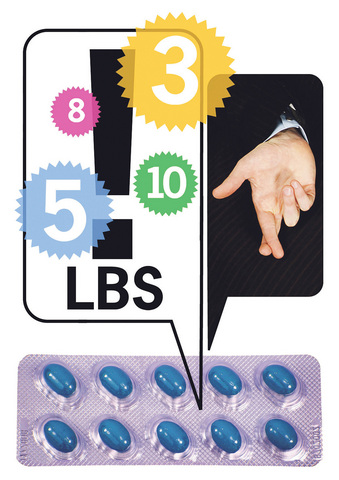
PHOTO ILLUSTRATION: NY TIMES NEWS SERVICE
In a telephone survey last year among 1,444 people trying to lose weight, by the Center for Survey Research and Analysis at the University of Connecticut, more than 60 percent mistakenly thought that all such supplements had been tested and proved safe and effective; 54 percent thought that the Food and Drug Administration approved the remedies. In fact, not one dietary supplement for weight loss has that kind of approval, although one licensed prescription drug, orlistat, has conditional approval for over-the-counter sale under the brand name Alli.
Before spending another cent on yet another nonprescription weight-loss remedy, ask yourself: "If there really was a miracle drug out there, wouldn't it drive out the competition? And wouldn't everyone know about it?" You shouldn't have to go online or ask a store clerk to find out.
If you wonder how we got into this mess of unsubstantiated claims, look no further than the US Congress, which in 1994 passed the Dietary Supplement Health and Education Act. That law permitted proliferation of supplements derived from natural products without first having to submit clinical evidence of their safety and effectiveness to the food and drug agency. That led to the weight-loss products derived from herbal or other botanical ingredients like aloe, ephedra, fiber and green tea; minerals like chromium and pyruvates; amino acids; enzymes; and tissues from organs or glands.
Millions of gullible people seem to believe that "if it's natural, it's got to be good." Judging from the growing supplement sales, few people learned from the fiasco with ephedra, an admittedly effective weight-loss supplement that the FDA banned in 2004 after it was linked to 10 deaths and 13 instances of permanent disability among 87 reports of serious adverse effects in less than two years.
Now products labeled ephedra-free, bitter orange among them, contain related chemicals that, like ephedra, may also raise blood pressure and disturb heart rhythms, possibly leading to heart attacks, strokes and death. The Mayo Clinic has warned that "people with existing heart disease, high blood pressure or other cardiovascular problems should avoid bitter orange." Note, however, that nine of the 23 crippling and fatal effects of ephedra occurred in people with no cardiovascular risk factors.
There is no way to know whether a dietary supplement off the shelf is safe or even pure. Until and unless a disaster like ephedra comes to federal attention, the industry is essentially self-regulated. Even the Federal Trade Commission, which can prosecute for false advertising, has been unable to keep up with the proliferation of products and undocumented claims.
Saper, among others, has examined popular supplements. A combined analysis of 11 trials of the soluble fiber guar gum showed no benefit. For chromium and ginseng, he found no scientifically structured trials that showed a difference in weight loss between the supplement and a placebo. And chronic use of chromium may cause kidney and muscle damage.
Supplements with HCA, from the tropical fruit mangosteen, reported to interfere with fat synthesis and speed fat breakdown, showed contradictory results in different human tests. CLA, a trans fatty acid that reduced fat deposition in mice, produced no change in body fat in a 12-week trial of 60 patients, but caused gastrointestinal distress and may raise cholesterol and worsen insulin resistance.
Chitosan seemed safe in short-term studies but "is likely ineffective for weight loss," Saper wrote, based on five clinical studies. It can cause constipation, bloating and other gastrointestinal symptoms, the Mayo Clinic reported.
One substance, pyruvate, showed a small benefit over a placebo, about 1.13kg in six weeks. It is frightfully expensive and takes a week or two before results are seen.
Green tea extract, said to speed metabolism and suppress appetite, is supported by limited evidence of effectiveness and can cause vomiting, bloating, indigestion and diarrhea, as well as jitteriness and palpitations from its caffeine.
In addition to possible risks associated with single-drug supplements, many products combine several ingredients that could interact to add hazards. Some ingredients in weight-loss supplements can interact with prescription and over-the-counter remedies, possibly resulting in toxic effects.
Hoodia, a supplement derived from a South African cactus, may indeed suppress appetite. But the real thing is very hard to obtain, and most of the products sold in stores and on the Web contain little or none of the effective extract.
The list could go on and on, but I think you get the point. There is no quick fix for weight loss using over-the-counter diet pills.
Several prescription drugs have received FDA approval. Orlistat, sold as Xenical, reduces the absorption of fat from foods. It can cause gastrointestinal distress and disrupt absorption of fat-soluble vitamins.
Sibutramine, sold as Meridia, revs up metabolism and energy levels and creates a feeling of fullness. Common side effects include dry mouth, constipation and insomnia. Meridia should not be used by people with cardiac risk factors and those who use bronchodilators, take decongestants or use MAO inhibitors or SSRI's for depression.
A number of products called sympathomimetics are approved for short-term use. All can raise blood pressure. They include phentermine, sold as Lonamin, Oby-Cap, Adipex and Fastin; mazindol, Mazanor and Sanorex; benzphetamine, Didrex; diethylpropion, Tenuate; and phendimetrazine, Adipost, Bontril, Melfiat, Plegine, Prelu-2 and Statobex. Any may help a dieter start, but because of side effects, long-term use is generally not recommended.

In late October of 1873 the government of Japan decided against sending a military expedition to Korea to force that nation to open trade relations. Across the government supporters of the expedition resigned immediately. The spectacle of revolt by disaffected samurai began to loom over Japanese politics. In January of 1874 disaffected samurai attacked a senior minister in Tokyo. A month later, a group of pro-Korea expedition and anti-foreign elements from Saga prefecture in Kyushu revolted, driven in part by high food prices stemming from poor harvests. Their leader, according to Edward Drea’s classic Japan’s Imperial Army, was a samurai

Approaching her mid-30s, Xiong Yidan reckons that most of her friends are on to their second or even third babies. But Xiong has more than a dozen. There is Lucky, the street dog from Bangkok who jumped into a taxi with her and never left. There is Sophie and Ben, sibling geese, who honk from morning to night. Boop and Pan, both goats, are romantically involved. Dumpling the hedgehog enjoys a belly rub from time to time. The list goes on. Xiong nurtures her brood from her 8,000 square meter farm in Chiang Dao, a mountainous district in northern Thailand’s

Located down a sideroad in old Wanhua District (萬華區), Waley Art (水谷藝術) has an established reputation for curating some of the more provocative indie art exhibitions in Taipei. And this month is no exception. Beyond the innocuous facade of a shophouse, the full three stories of the gallery space (including the basement) have been taken over by photographs, installation videos and abstract images courtesy of two creatives who hail from the opposite ends of the earth, Taiwan’s Hsu Yi-ting (許懿婷) and Germany’s Benjamin Janzen. “In 2019, I had an art residency in Europe,” Hsu says. “I met Benjamin in the lobby

April 22 to April 28 The true identity of the mastermind behind the Demon Gang (魔鬼黨) was undoubtedly on the minds of countless schoolchildren in late 1958. In the days leading up to the big reveal, more than 10,000 guesses were sent to Ta Hwa Publishing Co (大華文化社) for a chance to win prizes. The smash success of the comic series Great Battle Against the Demon Gang (大戰魔鬼黨) came as a surprise to author Yeh Hung-chia (葉宏甲), who had long given up on his dream after being jailed for 10 months in 1947 over political cartoons. Protagonist


 RSS
RSS