


In the fall of 2003 a boisterous crowd filled the Brooklyn Academy of Music as the Merce Cunningham Dance Company concluded its 50th anniversary season.
Onstage Cunningham presided over several rolls of dice to determine the order of music, decor, costumes and lighting for the premiere of Split Sides, which would prove to be marvelous. Former New York mayor Michael Bloomberg was on hand, as were the Cunningham collaborators Jasper Johns and Robert Rauschenberg and the former company dancer Carolyn Brown.
The ceremony felt ritualistic — nostalgic, even — with viewers primed for the grand theatricality of it all. You could imagine the spirit of John Cage, Cunningham's longtime partner, hovering gleefully over the proceedings.
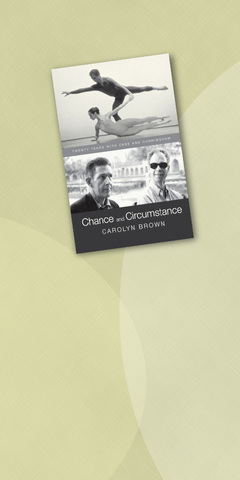
Cunningham's methods have not always seemed so cuddly. Half a century ago his modern, experimental aesthetic, in which movement is meant to speak for itself, was more likely to provoke catcalls and cold shoulders from audiences, critics and choreographers ill-prepared to deal with his art and ideas. (The world is still grappling with the philosophies and possibilities presented by Cunningham, Cage and their peers.) Brown, an original and celebrated company member who stayed for 20 years, was there to witness it all. And now, finally, her memoir has arrived. It was only a decade more in the making than her tenure with Cunningham.
Thankfully the book, Chance and Circumstance: Twenty Years With Cage and Cunningham, doesn't feel labored. Not even close. Brown has relied heavily on diary entries and letters written during her time with the company, and these vivid words anchor the book's rambling vitality. She rockets from the heady excitements of New York's burgeoning art scene in the 1950s to the fraught relationships between the modern "Biggies" (including Martha Graham, Jose Limon and Doris Humphrey) at the American Dance Festival to tour descriptions that suggest she would make a fine travel writer, though one prone to moments of outrageous romanticism. (In India, during the company's 1964 world tour, she even inquires about adopting a "curly-haired beggar child.")
If Brown were interested only in offering detail-rich snapshots of the company's first two decades, her memoir would certainly be an entertaining read, as well as an invaluable resource for scholars. (This is particularly true with regard to Cunningham, about whom there is not a particularly extensive literature.) But she is far too feisty to produce an agenda-free historical document. As she writes in the preface, her memoir is just one telling of this story, and "surely there are as many other versions as there were people involved — plus that impossible, truly objective one." After this charmingly disingenuous disclaimer, she turns to setting the record straight.
Nowhere is she more fervent than in her feeling that Cunningham's work is often clumsily understood, aided by his own obfuscations. "I'll state once again," she writes, "as I intend to do throughout this book, that the meaning of and in Merce's dances was never merely the steps, and that even if he and John Cage intended them to be (and I am convinced Merce did not), it's impossible for human bodies placed together in time and space not to reek with secret and not-so-secret meaning."
Later she describes telling Cunningham, waiting in the wings before a performance, that she had lost the "quality" of Scramble, so long had it been since they danced it. He responded, "There is no quality to lose." Thirty years later she tartly counters, "Well, I beg to differ."
Her physical knowledge of Cunningham's work gives her assertions a distinct authority, and her descriptions of the choreography are fascinating. The same cannot be said for everything here; once in awhile — say, after the umpteenth description of lost luggage, inadequate theaters and turista traumas — you wish for a bit more economy of detail. But how to decide what should go? Most pages contain absolute gems, like this description of a 1965 performance in New York, excerpted from Brown's journal:
"State Theater programs were an absolute gas! That is, I had a glorious time!!! God, what intoxication it is to perform in a theater like that. The space is so marvelously HUGE, it makes me giddy with delight."
"When it was over," she continues, "and we took curtain calls, I felt like some member of a tiny minority group that the whole world hated and was booing. We ran on stage — the six of us — as though electrified with strength, defiance, courage, and belief in what we were doing ... and the people shrieked, booed and hissed. And other people cheered and bravoed."
Brown's romantic relationships are documented, including her marriage to the composer Earle Brown, but the true love story here is an artistic one. She fell early and hard for Cunningham's choreography, for the vigor of Rauschenberg's riotously creative contributions and for the holistic art-and-life philosophy embodied most fully by Cage. Like any true love affair between complex, often difficult people, it produced deeply felt, wildly varying emotions. No matter the length, a book can offer only glimpses of such relationships. But what glimpses.

In late October of 1873 the government of Japan decided against sending a military expedition to Korea to force that nation to open trade relations. Across the government supporters of the expedition resigned immediately. The spectacle of revolt by disaffected samurai began to loom over Japanese politics. In January of 1874 disaffected samurai attacked a senior minister in Tokyo. A month later, a group of pro-Korea expedition and anti-foreign elements from Saga prefecture in Kyushu revolted, driven in part by high food prices stemming from poor harvests. Their leader, according to Edward Drea’s classic Japan’s Imperial Army, was a samurai
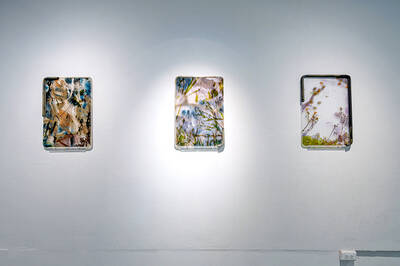
Located down a sideroad in old Wanhua District (萬華區), Waley Art (水谷藝術) has an established reputation for curating some of the more provocative indie art exhibitions in Taipei. And this month is no exception. Beyond the innocuous facade of a shophouse, the full three stories of the gallery space (including the basement) have been taken over by photographs, installation videos and abstract images courtesy of two creatives who hail from the opposite ends of the earth, Taiwan’s Hsu Yi-ting (許懿婷) and Germany’s Benjamin Janzen. “In 2019, I had an art residency in Europe,” Hsu says. “I met Benjamin in the lobby
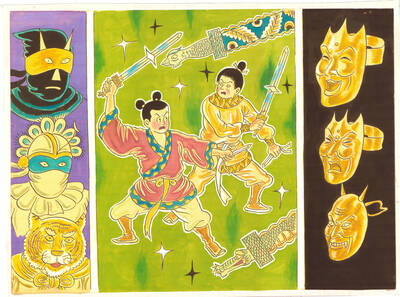
April 22 to April 28 The true identity of the mastermind behind the Demon Gang (魔鬼黨) was undoubtedly on the minds of countless schoolchildren in late 1958. In the days leading up to the big reveal, more than 10,000 guesses were sent to Ta Hwa Publishing Co (大華文化社) for a chance to win prizes. The smash success of the comic series Great Battle Against the Demon Gang (大戰魔鬼黨) came as a surprise to author Yeh Hung-chia (葉宏甲), who had long given up on his dream after being jailed for 10 months in 1947 over political cartoons. Protagonist

Peter Brighton was amazed when he found the giant jackfruit. He had been watching it grow on his farm in far north Queensland, and when it came time to pick it from the tree, it was so heavy it needed two people to do the job. “I was surprised when we cut it off and felt how heavy it was,” he says. “I grabbed it and my wife cut it — couldn’t do it by myself, it took two of us.” Weighing in at 45 kilograms, it is the heaviest jackfruit that Brighton has ever grown on his tropical fruit farm, located


 RSS
RSS