


According to legend, the slate found in the mountainous region around Wutai (霧台) possesses either male or female characteristics. Rukai (魯凱) craftsman say soft slate is "feminine," making it ideal for carving and relief work, while the hard stones are "masculine" and are used as foundations for roads and houses.
A natural insulator during the cold winter months and cool in the summer, slate is an important building material for the Rukai, who are expert at cutting, carving and setting the stone. The village has used its artisans to great effect as the streets are laid with these large flat stones, both plain and decorative.
The manner with which the Rukai people classify the stone is similar to the traditional lifestyle led by the tribe where hunters hunt in the mountains while women stay at home caring for the children and making colorful clothing from cotton or linen.

PHOTO: NOAH BUCHAN, TAIPEI TIMES
Wutai is perched 1,000m above sea level at the southern tip of the Central Mountain Range and is home to the West Rukai Group (西魯凱群) of Aboriginal people. The tribe's homes are built using the black slate and shale found in the rivers and streams close to the village.
The village is currently undergoing a renaissance of sorts: It is being refashioned using materials that are unique to its environment. Little cement can be found here, the flat stone is increasingly the primary material used on the streets that wind around the mountain.
Such renewal is seen as a boost for tourism. A number of recently constructed guesthouses and an ongoing project by the local government to renovate the village, means Wutai is an ideal getaway, a haven of Aboriginal culture with artisans selling handicrafts from slate booths: Coach loads of tourists have yet to descend on this picturesque village, though.
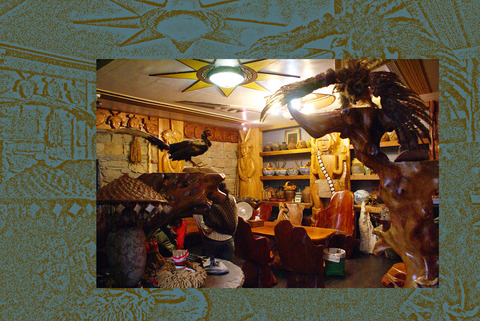
PHOTO: NOAH BUCHAN, TAIPEI TIMES
The expertly laid streets and laneways are ideal for long strolls through Wutai. Interspersing the "masculine" stones lining the roads are larger slate pieces that stand vertically 1.5m off the ground and adorned with scenes from a famous hunt or of flora.
The wide variety and colors of the motifs sculpted, carved or painted onto the laneways and houses create a vivid narrative of the group's lifestyle and history.
As the Rukai are a tribe of hunters, it's common to see the eves of houses lined with the skulls or jaws of mountain boar, trophies that signify a hunter's acumen in the bush.
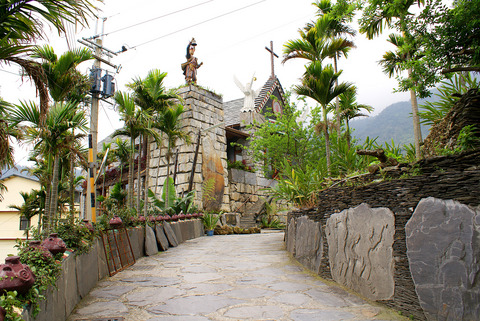
PHOTO: NOAH BUCHAN, TAIPEI TIMES
One guesthouse is fashioned entirely by the hands of the hunter who owns it, with the external walls made entirely of flat stone and the interior fashioned from wood taken from the surrounding forest. The guesthouse is a veritable taxonomic museum with stuffed birds and other small animals filling the hand-built shelves in the living room.
This remote place boasts orderly and neat streets, and lifestyles that have changed little over the past century.
The village is well over a century old and became notorious in 1914 when the Rukai revolted against their Japanese colonial rulers. Several barrack-style buildings, built during the Martial Law era when the Chinese Nationalist Party-government banned collecting slate, remain. Some roads are still paved with cement, though in recent years, as the government has liberalized the ban on collecting slate, a limited amount is being used to refashion the streets.
It seems the ban on gathering slate was replaced by a ban on littering, though this may have something to do with the fact that Wutai has yet to be swamped by tourists.
The Rukai people are also known for their skilled woodcarving. The central beams supporting the slate roofs of the renovated houses are intricately carved with each family's history. The Rukai believe they are descended from a mythical hundred pace snake and images of the snake are ubiquitous throughout the village.
With all the hiking that can be done through the village and on the surrounding mountain roads, travelers are bound to become weary and fatigued. No problem. One architectural flourish of Rukai construction is the installation of slate benches, which are placed in areas where scenes of the mountain valley below lend themselves to lengthy contemplation.
Getting there: Wutai is about an hour's drive east from Sandimen (三地門) village, itself a 30-minute drive east from Pingtung City (屏東市). Take the number 24 highway from Pingtung passing through Sandimen, from where Wutai is a 60-minute drive. As there are no buses, the only access to the village is by scooter or car.
Accommodations: A complete list of guest houses (民宿) can be found in Chinese at www.e-tribe.org.tw/WUTAI/.

Last week Joseph Nye, the well-known China scholar, wrote on the Australian Strategic Policy Institute’s website about how war over Taiwan might be averted. He noted that years ago he was on a team that met with then-president Chen Shui-bian (陳水扁), “whose previous ‘unofficial’ visit to the US had caused a crisis in which China fired missiles into the sea and the US deployed carriers off the coast of Taiwan.” Yes, that’s right, mighty Chen caused that crisis all by himself. Neither the US nor the People’s Republic of China (PRC) exercised any agency. Nye then nostalgically invoked the comical specter

Relations between Taiwan and the Czech Republic have flourished in recent years. However, not everyone is pleased about the growing friendship between the two countries. Last month, an incident involving a Chinese diplomat tailing the car of vice president-elect Hsiao Bi-khim (蕭美琴) in Prague, drew public attention to the People’s Republic of China’s (PRC) operations to undermine Taiwan overseas. The trip was not Hsiao’s first visit to the Central European country. It was meant to be low-key, a chance to meet with local academics and politicians, until her police escort noticed a car was tailing her through the Czech capital. The
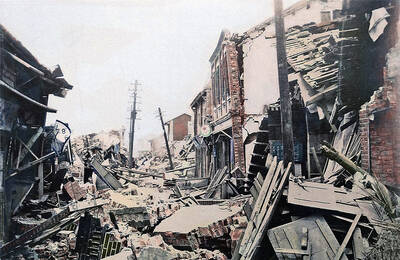
April 15 to April 21 Yang Kui (楊逵) was horrified as he drove past trucks, oxcarts and trolleys loaded with coffins on his way to Tuntzechiao (屯子腳), which he heard had been completely destroyed. The friend he came to check on was safe, but most residents were suffering in the town hit the hardest by the 7.1-magnitude Hsinchu-Taichung Earthquake on April 21, 1935. It remains the deadliest in Taiwan’s recorded history, claiming around 3,300 lives and injuring nearly 12,000. The disaster completely flattened roughly 18,000 houses and damaged countless more. The social activist and

Over the course of former President Ma Ying-jeou’s (馬英九) 11-day trip to China that included a meeting with Chinese Communist Party (CCP) leader Xi Jinping (習近平) a surprising number of people commented that the former president was now “irrelevant.” Upon reflection, it became apparent that these comments were coming from pro-Taiwan, pan-green supporters and they were expressing what they hoped was the case, rather than the reality. Ma’s ideology is so pro-China (read: deep blue) and controversial that many in his own Chinese Nationalist Party (KMT) hope he retires quickly, or at least refrains from speaking on some subjects. Regardless


 RSS
RSS