


Shimon Peres, now 83, finds himself, yet again, facing an election. Once more he is in the humiliating position of wanting to be president of Israel and unsure whether those in the Knesset who say they support him will then vote against him in secret.
It happened last in July 2000, when Moshe Katsav, a relatively unknown Likud machine politician, shocked everyone by beating Peres for the presidency. Katsav, now charged with rape and sexual misconduct, is expected to resign soon, and Peres has made it clear that he wants the job.
Peres is one of the defining figures of the still-young Israeli state, often abroad speaking on its behalf. His contradictions are encapsulated in his two largest accomplishments: he was crucially responsible both for the Israeli nuclear weapons program and for the 1993 Oslo accords, for which he shared a Nobel Peace Prize with Yitzhak Rabin and Yasser Arafat.
But Peres is also one of Israel's most mocked figures, considered an eternal loser and dreamer who has harmed his career and reputation through selfishness, timidity, vanity and political deafness.
Israelis will gleefully volunteer that Peres, who was elected to head a Socialist youth group in 1945, has never won another election in his own right, though he has been prime minister twice.
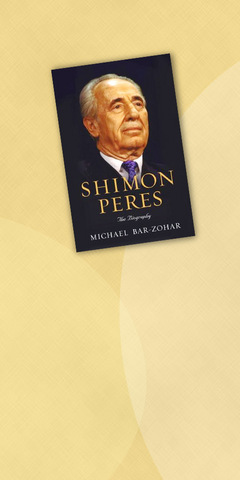
Michael Bar-Zohar's Shimon Peres: The Biography is an effort by a friend and former assistant to give a more balanced and judicious picture of this complicated politician, who has spent most of his life working for Israel's defense and is best known for failed efforts to reach peace. Peres cooperated fully with Bar-Zohar, providing diary material and long interview sessions.
But Peres deserves better, and so do we.
Bar-Zohar, a noted biographer of David Ben-Gurion, first wrote this book in Hebrew with the title Like the Phoenix, and it was published in Israel in December 2005. He has apparently translated it himself and tried to adjust it for a non-Israeli audience.
In English the the book is indifferently written and oddly unbalanced. It spends too much time on Peres' youth in prewar Poland and his fumbling efforts to fit into kibbutz life (including changing his name from Persky to Peres, meaning a kind of bearded vulture).
Bar-Zohar diligently details Peres' various jobs as a young man — most interestingly, working for Ben-Gurion and buying arms overseas — and his decision not to volunteer to fight, as even his wife did, in the war of independence, the war that created Israel and, even more important, created "Israelis." Peres felt he was serving the nation in a more important way; to his credit, Bar-Zohar calls this "one of the worst mistakes in his life."
Peres had a large role in securing vital military equipment from France and in building Israel's defense and aerospace industry, as well as its nuclear capability, by doing deals with right-wing governments in France and apartheid South Africa. Bar-Zohar both overestimates Peres' importance to the state and rarely steps back to assess his performance.
Oddly, the book essentially concludes in 1996, after the extraordinary triumph of the Oslo accords and the Nobel Peace Prize ended so abruptly with the assassination of Rabin and Peres' failure, once again, to win the prime ministership in his own right.
A four-page chapter — really a postscript in a book of around 500 pages — tries to cover the next decade, when Peres lost the presidency to Katsav, lost the Labor Party leadership to Amir Peretz in another shocking result, became a crucial ally to his old friend Ariel Sharon in the pullout from Gaza and then left the Labor Party altogether to join the new Kadima.
These are important, poignant and scarring events, for Peres as well as for the nation. To avoid them is a kind of cheating. Especially in The Biography.
The book's virtues are considerable for those interested in Peres and the early days of Israel. There are wonderful vignettes about his relationships with outsize, founding personalities: his awe of Ben-Gurion, his unrequited love for Moshe Dayan, his sour exchanges with Golda Meir (when told that Peres was a very gifted man, she responded, "So was Al Capone!"), and his nasty rivalry with Rabin, who saw him as a schemer and detested his insincerity and self-absorption.
But in general Bar-Zohar is coy with his criticism of Peres. For example, Peres played an important role, in the mid-1970s, in getting government support for Jewish settlement in the occupied territories. To some degree, Bar-Zohar suggests, Peres just wanted to be liked by those he considered "the new Zionists" of the Gush Emunim settler movement.
For a colder and more objective look at his involvement, see Gershom Gorenberg's Accidental Empire: Israel and the Birth of the Settlements, 1967-1977, just out in paperback.
It's telling that the most incisive passages about Peres in this book come from the novelist Amos Oz. Oz, who is probably closer to Peres than Bar-Zohar, is nonetheless better able to achieve critical distance.
It is Oz who best articulates the combination of childishness, optimism, curiosity and lust for power that has defined Peres.
"I know two kinds of adults," Oz tells Bar-Zohar. "One carries inside himself the dead child that he once was. The other is a very rare kind of adult, who carries inside himself a living child — curious, thirsty for love, thirsty for knowledge. This is Shimon."
I once asked Peres why he didn't retire. "How can I retire?" he asked, then said with a kind of charming self-knowledge: "I'm a narcissist!"
Given his fluency, optimism, renown and experience, let alone his age, Peres would seem to be a perfect candidate for Israel's essentially powerless and symbolic presidency. That he may yet be denied it seems to say more about the country's petty politics than about Peres.

In late October of 1873 the government of Japan decided against sending a military expedition to Korea to force that nation to open trade relations. Across the government supporters of the expedition resigned immediately. The spectacle of revolt by disaffected samurai began to loom over Japanese politics. In January of 1874 disaffected samurai attacked a senior minister in Tokyo. A month later, a group of pro-Korea expedition and anti-foreign elements from Saga prefecture in Kyushu revolted, driven in part by high food prices stemming from poor harvests. Their leader, according to Edward Drea’s classic Japan’s Imperial Army, was a samurai

The following three paragraphs are just some of what the local Chinese-language press is reporting on breathlessly and following every twist and turn with the eagerness of a soap opera fan. For many English-language readers, it probably comes across as incomprehensibly opaque, so bear with me briefly dear reader: To the surprise of many, former pop singer and Democratic Progressive Party (DPP) ex-lawmaker Yu Tien (余天) of the Taiwan Normal Country Promotion Association (TNCPA) at the last minute dropped out of the running for committee chair of the DPP’s New Taipei City chapter, paving the way for DPP legislator Su
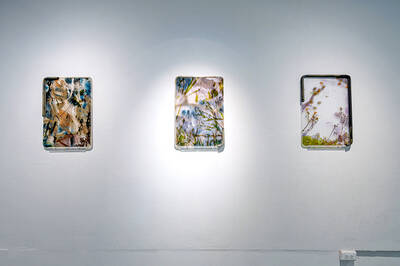
Located down a sideroad in old Wanhua District (萬華區), Waley Art (水谷藝術) has an established reputation for curating some of the more provocative indie art exhibitions in Taipei. And this month is no exception. Beyond the innocuous facade of a shophouse, the full three stories of the gallery space (including the basement) have been taken over by photographs, installation videos and abstract images courtesy of two creatives who hail from the opposite ends of the earth, Taiwan’s Hsu Yi-ting (許懿婷) and Germany’s Benjamin Janzen. “In 2019, I had an art residency in Europe,” Hsu says. “I met Benjamin in the lobby

It’s hard to know where to begin with Mark Tovell’s Taiwan: Roads Above the Clouds. Having published a travelogue myself, as well as having contributed to several guidebooks, at first glance Tovell’s book appears to inhabit a middle ground — the kind of hard-to-sell nowheresville publishers detest. Leaf through the pages and you’ll find them suffuse with the purple prose best associated with travel literature: “When the sun is low on a warm, clear morning, and with the heat already rising, we stand at the riverside bike path leading south from Sanxia’s old cobble streets.” Hardly the stuff of your


 RSS
RSS