


In the slimiest — and perhaps costliest — case of mistaken identity in modern biology, hundreds of scientific papers and years of research could be thrown into doubt, for they may have been based on experiments carried out on the wrong leech.
Three species of bloodthirsty invertebrate have been passing themselves off as the right leech, a discovery that adds powerfully to the shock and confusion.
The evidence of this innocent error, published in a British scientific review, Proceedings of the Royal Society B, could provoke a cascade of consequences in hospitals and pharmaceutical companies around the world, the authors say.
For decades scientists have used what they thought was the Hirudo medicinalis, or "medicinal leech," to develop dozens of new compounds and drugs. Some help thin blood and others are harnessed in the search to fight viral infections, from HIV to hepatitis C.
The leech can, of course, lay claim to a far more venerable place in medicine, as a blood-letter.
It fell out of fashion in this role at the end of the 19th century, but has recently wormed its way back in — this time as the means to ease blood pressure in body parts that have been reattached or traumatized by restorative plastic surgery.
The leeches and the compounds they yield work wonders, but there's still a problem, according to Mark Siddall, a zoologist at the American Museum of Natural History who has crawled over the evidence.
"What has been sold and used as Hirudo medicinalis is usually another species, Hirudo verbana," explained Siddall, who led an international team of researchers in examining dozens of specimens procured from leech farms in Europe and the US.
"Indeed, we have never received a true medicinalis from a commercial supplier," he said in an interview, adding that a few leeches from a third species, H. orientalis, from Turkey or Azerbaijan, may also have crept into the mix.
To the naked eye, even a highly trained one, H. medicinalis and H. verbana seem identical in size and coloration.
Fully grown adults of both species weigh in at about 80g and measure up to 15cm when fully extended.
"The ones we ship to hospitals are a lot smaller," explained Carl Peters, assistant manager of Britain-based Biopharm Leeches, one of the world's two or three largest suppliers of medicinal bloodsuckers.
That's probably a good thing, because leeches — equipped with three mouths and three hundred razor-sharp teeth — can easily siphon off in a single sitting six times their body weight in blood, enough to keep them chubby and happy for half a year.
Leeches deliver built-in anaesthesia, so the incision is painless.
And because of anti-coagulants in their saliva, bleeding continues for six to 10 hours, draining off enough blood to fill half a wine glass.
"In micro-surgery you can suture the two ends of an artery together because they have thick walls," explained Siddall. "But veins are thin-walled and very difficult to reattach, which creates blood congestion and the risk of tissue dying. That's where leeches work best."
No one has accused leech farms of fobbing off fakes on to the world market, and Peters is not terribly concerned about the brouhaha over authenticity, though he does acknowledge that there could be a problem with the US.
The US Food and Drug Administration (FDA) approved the medical use of leeches in 2004, specifying though that H. medicinalis is the only authorized species.
If the US government cracks down, different species from Biopharm and other suppliers could suddenly become contraband.
That still leaves healthy markets in Europe and Asia, Peters said. "Koreans more readily accept the use of leeches, whereas in Britain they are still seen as a last resort."
The real worry stemming from the mislabelling of leeches lies in a large body of scientific research. "The implications of our findings are far-reaching," said Siddall.
Development biologists and neurobiologists "are grappling" with the fact that certain results in their experiments are possibly due to the fact that they were working — without knowing it — with two, or possibly even three, species rather than one.
There are at least 115 bioactive ingredients that have been isolated from what was sold as H. medicinalis, mainly anticoagulants, antistasins and protease inhibitors used to block the reproduction of viruses.
Finding out which of these wonder compounds is attributable to which species may well be a nightmare.
But there is a silver lining, insisted Siddall. "With three species rather than one, there may three times as many interesting compounds to be discovered and harnessed."

In late October of 1873 the government of Japan decided against sending a military expedition to Korea to force that nation to open trade relations. Across the government supporters of the expedition resigned immediately. The spectacle of revolt by disaffected samurai began to loom over Japanese politics. In January of 1874 disaffected samurai attacked a senior minister in Tokyo. A month later, a group of pro-Korea expedition and anti-foreign elements from Saga prefecture in Kyushu revolted, driven in part by high food prices stemming from poor harvests. Their leader, according to Edward Drea’s classic Japan’s Imperial Army, was a samurai

The following three paragraphs are just some of what the local Chinese-language press is reporting on breathlessly and following every twist and turn with the eagerness of a soap opera fan. For many English-language readers, it probably comes across as incomprehensibly opaque, so bear with me briefly dear reader: To the surprise of many, former pop singer and Democratic Progressive Party (DPP) ex-lawmaker Yu Tien (余天) of the Taiwan Normal Country Promotion Association (TNCPA) at the last minute dropped out of the running for committee chair of the DPP’s New Taipei City chapter, paving the way for DPP legislator Su
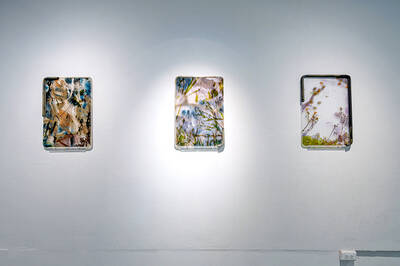
Located down a sideroad in old Wanhua District (萬華區), Waley Art (水谷藝術) has an established reputation for curating some of the more provocative indie art exhibitions in Taipei. And this month is no exception. Beyond the innocuous facade of a shophouse, the full three stories of the gallery space (including the basement) have been taken over by photographs, installation videos and abstract images courtesy of two creatives who hail from the opposite ends of the earth, Taiwan’s Hsu Yi-ting (許懿婷) and Germany’s Benjamin Janzen. “In 2019, I had an art residency in Europe,” Hsu says. “I met Benjamin in the lobby
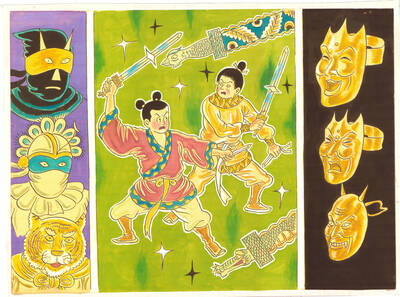
April 22 to April 28 The true identity of the mastermind behind the Demon Gang (魔鬼黨) was undoubtedly on the minds of countless schoolchildren in late 1958. In the days leading up to the big reveal, more than 10,000 guesses were sent to Ta Hwa Publishing Co (大華文化社) for a chance to win prizes. The smash success of the comic series Great Battle Against the Demon Gang (大戰魔鬼黨) came as a surprise to author Yeh Hung-chia (葉宏甲), who had long given up on his dream after being jailed for 10 months in 1947 over political cartoons. Protagonist


 RSS
RSS