


Jennifer Chang Chernick landed what many women dream of: a top job at Chanel. After graduating from Columbia University in 1997, the multilingual Chernick — she is fluent in Mandarin, French and English — quickly climbed her way up the corporate ladder and in 2000 found herself overseeing the fashion giant's Taiwan and China markets.
But just when Chernick was at the pinnacle of her career she traded it all in and staked her future on an obscure Chinese brocade whose history dates back thousands of years.
Known as Shu Brocade (蜀錦), Chernick says she immediately fell in love with the fabric's variety of patterns, weaving and embroidery. She was also captivated by the quality of the silk and the intricately sewn pagodas and weeping willows that are emblems of Chengdu, the city of the brocade's origin.

PHOTO: NOAH BUCHAN, TAIPEI TIMES
"I was astounded by it because I had never seen any fabric of this quality and, in a way, this antique," she said.
"Brocades elsewhere [are] much more loose and you can't see the patterns as clearly. I find the technology combined with the silk makes this much a more versatile and durable brocade compared with others in China."
Her fascination with the brocade led her to a large factory located in the western part of the city, a sprawling complex of buildings where most of Chengdu's Shu Brocade had been produced for over a century. However, though the city celebrated its name — Chengdu is also known as Brocade City (錦城) — Chernick's inquiries soon led her to realize that the factory's days were numbered.
"The factory was just a dinosaur [and] the government wasn't interested in keeping it up anymore," she said.
Due to poor management — and by extension poor quality products — and a global fashion culture obsessed with minimalist design, only a handful of the original 2000 workers remained employed.
"When I went to the factory I discovered there were only a few workers and the government was planning on shutting it down and using the real estate … to pay debts and the workers."
News of the factory's imminent closure caused a media frenzy in Chengdu. The unpaid workers looted the factory and sold what they could on the black market. With the aim of saving the remaining fabric from the same fate, Chernick went to the factory's managers and pleaded with them to allow her to purchase the remaining inventory, less than 15,000m.
The management relented and with a huge store of the elegant fabric, Chernick quit her job at Chanel and started her own label, Persimmon Lane (www.persimmonlane.com).
Though Chernick was responsible for Chanel's Asia office, the frenetic work schedule coupled with an increasing interest in Asia left her feeling that she wanted to move in a different direction.
"I went to all these cities, I went to department stores then to hotels, to meetings and then hotels. I never really got a chance to travel and enjoy the culture and enjoy my heritage," she said.
Breathing new life into an ancient art
Recognizing that Japanese consumers are no longer interested in kimonos and silk jackets have gone out of style in China, Chernick decided to take her designs in a different direction.
"Basically my inspiration comes not only from the designs of the textiles themselves but also from a practical standpoint for modern living," she said.
She added, "Most of the designs are vibrantly colored and very bold [whereas] most homes are more minimalist and you just want an accent of this kind of [design]. So, I've decided to make cushions and shawls and handbags, with their accents in contrasting blacks and golds."
In addition to the products she sells, Chernick also collaborates with architects and designers, who put the fabric between acrylic panels or sliding glass doors, or use it as a decorative wall textile.
"There are lots of innovative ways of using it," she said.
With clients hailing from as far a field as Paris, Hong Kong and San Francisco, Chernick has enjoyed considerable success with her designs — so much so that she has had high-end fashion houses banging down her door for the fabric.
"I was approached by a sourcing agent for Prada. They wanted to purchase the Shu Brocade to use it as lining for jackets. But I couldn't do it. I feel the beauty of the material should be on the outside, not on the inside," she said.
The history of sericulture in China can be traced back to Sichuan — known in ancient times as Shu and from which the brocade is named — almost 4,000 years ago. Together with Song Brocade of Suzhou, Yun Brocade of Nanjing and Zhuang Brocade from Guangxi, Shu Brocade is China's oldest; it is the basis from which the other three are derived.
Up until the Qing Dynasty, Shu Brocade was considered the official textile for the imperial household where the material would be used to frame important paintings and scrolls and upholster sofas and other household furniture; it was also used for curtains.
The textile was also used as gifts to countries China had relations with, especially Japan.
During the Qing Dynasty, the imperial house loosened its control over Shu Brocade and an industry formed. Shu embroidery became more elegant and covered a wider range with landscapes, paintings by masters, flowers and birds added to the more traditional motifs of dragons and phoenixes.
The factory from which Chernick bought the brocade was built at the end of the nineteenth century and became famous because it serviced Japan's kimono industry and was the main textile used to produce silk coats and other products domestically.
"When the Shu Brocade factory came into existence it was half hand loomed, [using] a system of Jacquard print, and half industrialized, with the design woven onto the silk itself and then processed by hand for the finishing touches," said Chernick.
Today, only one building from the original factory remains and it has been converted into a museum where tourists can observe a few artisans working at looms using the traditional process for making the brocade.
"The factory has been unwilling to continue the [production of] brocade as it was. The factory shut down and they [constructed] a museum with six to seven old masters at the loom making small pieces for demonstration, some of which are for sale at a very high price."
But if the production process remains the same the motifs and patterns have changed.
"What they have in production now are Chinese opera masks and also Siddhartha sitting in the lotus position but we can't really call it Shu Brocade because the designs are not associated with what Shu brocade is traditionally known for," she said.
Sadly, with the factory's demise and local artisans focusing on kichty designs for tourists, Chernick's inventory of Shu Brocade represents the last of the traditional fabric.
"Shu brocade is one of the many examples of crafts and arts that are disappearing in China," she said.
For more information, visit www.persimmonlane.com.

Last week Joseph Nye, the well-known China scholar, wrote on the Australian Strategic Policy Institute’s website about how war over Taiwan might be averted. He noted that years ago he was on a team that met with then-president Chen Shui-bian (陳水扁), “whose previous ‘unofficial’ visit to the US had caused a crisis in which China fired missiles into the sea and the US deployed carriers off the coast of Taiwan.” Yes, that’s right, mighty Chen caused that crisis all by himself. Neither the US nor the People’s Republic of China (PRC) exercised any agency. Nye then nostalgically invoked the comical specter

Relations between Taiwan and the Czech Republic have flourished in recent years. However, not everyone is pleased about the growing friendship between the two countries. Last month, an incident involving a Chinese diplomat tailing the car of vice president-elect Hsiao Bi-khim (蕭美琴) in Prague, drew public attention to the People’s Republic of China’s (PRC) operations to undermine Taiwan overseas. The trip was not Hsiao’s first visit to the Central European country. It was meant to be low-key, a chance to meet with local academics and politicians, until her police escort noticed a car was tailing her through the Czech capital. The
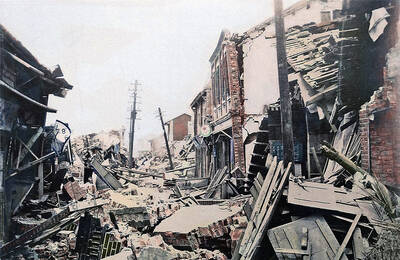
April 15 to April 21 Yang Kui (楊逵) was horrified as he drove past trucks, oxcarts and trolleys loaded with coffins on his way to Tuntzechiao (屯子腳), which he heard had been completely destroyed. The friend he came to check on was safe, but most residents were suffering in the town hit the hardest by the 7.1-magnitude Hsinchu-Taichung Earthquake on April 21, 1935. It remains the deadliest in Taiwan’s recorded history, claiming around 3,300 lives and injuring nearly 12,000. The disaster completely flattened roughly 18,000 houses and damaged countless more. The social activist and

Over the course of former President Ma Ying-jeou’s (馬英九) 11-day trip to China that included a meeting with Chinese Communist Party (CCP) leader Xi Jinping (習近平) a surprising number of people commented that the former president was now “irrelevant.” Upon reflection, it became apparent that these comments were coming from pro-Taiwan, pan-green supporters and they were expressing what they hoped was the case, rather than the reality. Ma’s ideology is so pro-China (read: deep blue) and controversial that many in his own Chinese Nationalist Party (KMT) hope he retires quickly, or at least refrains from speaking on some subjects. Regardless


 RSS
RSS