


The story of Albert Einstein's life calls for a protean biographer, not to mention a fearless one. Conveying the magnitude of Einstein's scientific achievements is tough enough, but that's just the start. His geopolitics, faith, cultural impact, philosophy of science, amorous affairs, powers of abstraction and superstar reputation are all part of this subject. So are the two world wars through which Einstein lived and the internecine physics-world struggles in which he became embroiled.
Then there are the odd quirks and the pricelessly prophetic anecdotes, as when one Zurich classmate of the budding genius went home to tell his parents that "this Einstein will one day be a great man." Many of these need to be included, and matters of scale make this job dauntingly difficult too. Einstein's earth-shaking concept of general relativity is directly juxtaposed, in Walter Isaacson's confidently authoritative Einstein: His Life and Universe, with a set of household rules that the great man wrote to keep his first wife at bay. "You will stop talking to me if I request it," this document asserted. "You will not expect any intimacy from me, nor will you reproach me in any way."
Isaacson deals clearly and comfortably with the scope of Einstein's life. If his highly readable and informative book has an Achilles' heel, it's in the area of science. Isaacson had the best available help (most notably the physicist Brian Greene) in explicating the series of revelations Einstein brought forth in his wonder year, 1905, and the subsequent problems with quantum theory and uncertainty that would bedevil him.
But these sections of the book are succinctly abbreviated. Paradoxically that makes them less accessible than they would have been through longer, more patient explication. Still, the cosmic physics would be heavy sledding in any book chiefly devoted to Einstein's life and times, and Isaacson acknowledges that. "OK, it's not easy," he writes, "but that's why we're no Einstein and he was."
In his introduction to Einstein, Isaacson sounds dangerously as if he is again trumpeting the virtues of a founding father (his last book was a biography of Benjamin Franklin). "Tyranny repulsed him, and he saw tolerance not simply as a sweet virtue but as a necessary condition for a creative society," he proclaims. Whiffs of a textbook tone are similarly alarming. ("Einstein would become a supporter of world federalism, internationalism, pacificism, and democratic socialism, with a strong devotion to individual liberty and freedom of expression.") But overall this is a warm, insightful, affectionate portrait with a human and immensely charming Einstein at its core.
"Oh my! That Johnnie boy!/So crazy with desire/While thinking of his Dollie/His pillow catches fire." That was a poem written by the love-struck future patent clerk of Bern, Switzerland (he would spend seven years in that job while writing his greatest scientific papers) to Mileva Maric, the first of two women he would marry. (To dissolve this union, the ever-confident Einstein offered Maric the money from a Nobel Prize he had not yet won.) It reveals a different side of Einstein than his famous "On a Heuristic Point of View Concerning the Production and Transformation of Light" did.
But in Isaacson's artfully seamless account, the genius and the flirt are remarkably well reconciled. And that first marriage was based on both. "I can already imagine the fun we will have," he wrote to Maric about a prospective vacation. "And then we'll start in on Helmholtz's electromagnetic theory of light."
Isaacson does a similarly graceful job of integrating Einstein's science with his broader philosophical concerns, especially the global worries that plagued him with the approach of World War II. Even as a committed pacifist he remained primarily a scientist and revised his opinions as fate required. "For a scientist, altering your doctrines when the facts change is not a sign of weakness," Isaacson underscores.
The man who had once listed his religion as "Mosaic" when applying for a professorship in Prague became much more thoughtful about Judaism in later years. Whatever Einstein's precise faith, Isaacson says, "his beliefs seemed to arise from the sense of awe and transcendent order that he discovered through his scientific work."
With the help of many witty, candid letters, Isaacson offers a wonderfully rounded portrait of the ever-surprising Einstein personality. Equally important is the Einstein myth, and the material on this subject is even more entertaining. Einstein horrified his colleagues by enjoying his vast celebrity. ("Einstein's personality, for no clear reasons, triggers outbursts of a kind of mass hysteria," the German consul reported to Berlin as the great man made one of his rock-star visits to New York.)
He also stymied the press in its efforts to keep up with his accomplishments. Isaacson has great fun with the reportorial frenzy that surrounded each new pearl of Einsteinian wisdom. Among the headlines that appeared in the New York Times: "Unintelligible to Laymen" and "Stars Not Where They Seemed or Were Calculated to Be, but Nobody Need Worry."
Isaacson is also keenly attuned to the intellectual crises hidden by the hoopla. As Einstein aged, he changed from a fierce young iconoclast to a pillar of science, resistant to advances in the very quantum ideas that he himself had brought forth. "The intellect gets crippled," he said of growing older, "but glittering renown is still draped around the calcified shell." Here as throughout the book Isaacson asks the right questions. ("So what made Einstein cede the revolutionary road to younger radicals and spin into a defensive crouch?") And he answers them with the clear, broad grasp of complex issues that make this book an illuminating delight.
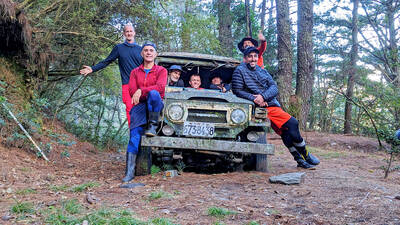
The year was 1991. A Toyota Land Cruiser set out on a 67km journey up the Junda Forest Road (郡大林道) toward an old loggers’ camp, at which point the hikers inside would get out and begin their ascent of Jade Mountain (玉山). Little did they know, they would be the last group of hikers to ever enjoy this shortcut into the mountains. An approaching typhoon soon wiped out the road behind them, trapping the vehicle on the mountain and forever changing the approach to Jade Mountain. THE CONTEMPORARY ROUTE Nowadays, the approach to Jade Mountain from the north side takes an

Last week Joseph Nye, the well-known China scholar, wrote on the Australian Strategic Policy Institute’s website about how war over Taiwan might be averted. He noted that years ago he was on a team that met with then-president Chen Shui-bian (陳水扁), “whose previous ‘unofficial’ visit to the US had caused a crisis in which China fired missiles into the sea and the US deployed carriers off the coast of Taiwan.” Yes, that’s right, mighty Chen caused that crisis all by himself. Neither the US nor the People’s Republic of China (PRC) exercised any agency. Nye then nostalgically invoked the comical specter
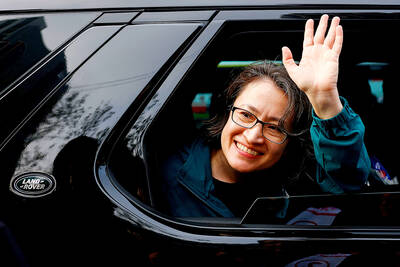
Relations between Taiwan and the Czech Republic have flourished in recent years. However, not everyone is pleased about the growing friendship between the two countries. Last month, an incident involving a Chinese diplomat tailing the car of vice president-elect Hsiao Bi-khim (蕭美琴) in Prague, drew public attention to the People’s Republic of China’s (PRC) operations to undermine Taiwan overseas. The trip was not Hsiao’s first visit to the Central European country. It was meant to be low-key, a chance to meet with local academics and politicians, until her police escort noticed a car was tailing her through the Czech capital. The
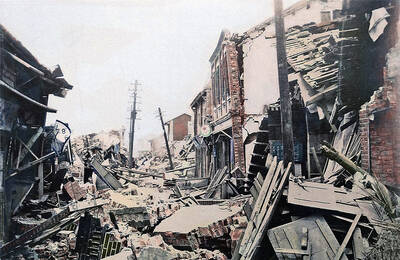
April 15 to April 21 Yang Kui (楊逵) was horrified as he drove past trucks, oxcarts and trolleys loaded with coffins on his way to Tuntzechiao (屯子腳), which he heard had been completely destroyed. The friend he came to check on was safe, but most residents were suffering in the town hit the hardest by the 7.1-magnitude Hsinchu-Taichung Earthquake on April 21, 1935. It remains the deadliest in Taiwan’s recorded history, claiming around 3,300 lives and injuring nearly 12,000. The disaster completely flattened roughly 18,000 houses and damaged countless more. The social activist and


 RSS
RSS