


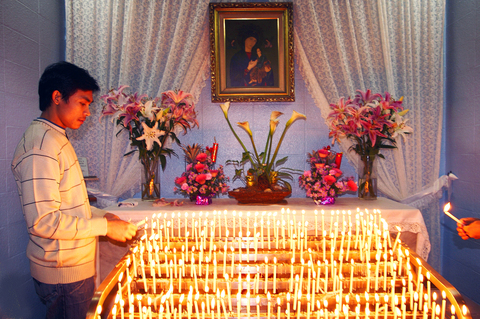
Lynda loves Sunday because she's free, at last, from her employer's constant beck and call. The Filipina caregiver gets up early, puts on her best clothes and a little makeup before taking the one-hour bus ride to Taipei's Zhongshan North Road. The service at St. Christopher's Church often moves her to tears and she lights a candle to pray for her family and a better life.
She likes to spend the rest of the day chatting to friends and window-shopping. She sends money or a parcel home to her mother and she eats at a restaurant that serves Filipino food. She might even go to one of the basement discos that open in the afternoon, but will always make it back to the suburb of Neihu where she lives by her 9pm curfew. Until she gets another Sunday off, usually twice a month, she belongs to the family that employs her.
Like many other Asian workers the pretty 35-year-old, who asks that only her Christian name is used, says she would be lost if there was no "Little Manila." The colorful community near the intersection of Nongan Street and Zhongshan North Road springs to life on the Christian day of rest. It is a place to meet compatriots and browse at the Won Won Department Store (萬萬百貨公司), with its beauty parlors and specialist stores.

PHOTOS: JULES QUARTLY, TAIPEI TIMES
Food shops sell tins of arroz caldo, bagoong fish paste and even Spam with cheese. International phone cards are sold cheaply and the newsstands are racked with Philippine gossip magazines like Yes! Hi! and the Precious Hearts Romance series of novels. Women buy cheap whitening creams and moisturizers called "love in the night." Outside, banks open so workers can send home their remittances and freight store workers stack boxes of electrical goods. Vendors spread out cloths on the pavement to sell cheap watches, trinkets and clothes.
Take a 10-minute bus ride to Taipei Main Station and there are thousands of Indonesians, Thais and Vietnamese sitting on the tiled floors, or outside. Unlike Filipinos, they do not generally revolve their life around church, so they settle near the station because this is an easy place to get to. To cater for these foreign workers, there used to be small businesses on the second floor of the station, but it was shut down a year ago and is being redeveloped.
"Little Jakarta" is tucked behind the train station in the lanes off Zhongxiao East Road. It froths with life around dusk, when mostly Indonesian and Thai workers gather to eat at the restaurants and party at the simple bars and karaoke halls. Some women wear hijabs, most wear disco outfits from the 1980s, with tiny tops, flared jeans and platform shoes. Men stare and drink. There are a few black and white faces. Occasionally the police flash by on motorcycles, checking IDs and chasing runaway maids, some of whom earn money through prostitution.
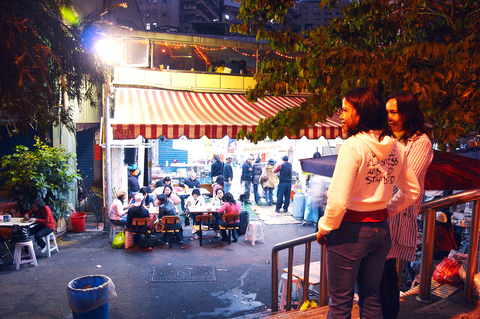
In the same way that Chinatowns function for Chinese and Taiwanese in other countries, Little Manila and Little Jakarta are homes from home for tens of thousands of Asian workers in Taipei. The difference is that whereas Chinatowns have become fixtures on the maps of many cities around the world, Asian migrants in Taipei are actively prevented from settling in Taipei.
They are not allowed to operate businesses, rent or buy stores, unless they become citizens. Usually, marrying a local or having dual nationality can only achieve this. Many of the businesspeople at the Won Won Department Store are hua chiao (華僑), or Taiwanese from the Philippines. Equally, many of the store or restaurant owners in Little Jakarta are Taiwanese from Indonesia or Thailand.
"You would think Chinese [Taiwanese] would understand the idea of a hometown community abroad and would like to see Little Manila and Little Jakarta further established but it is not so easy," says Wu Jing-ru (吳靜如), executive director of the non-governmental organization, Taiwan International Workers Association (台灣國際勞工協會).
"Basically we treat the workers who have built Taipei 101 and the Taiwan High Speed Rail and who have looked after our children and elderly as disposable. We want their contributions but we don't want to treat them as humans and we don't want them here," Wu says, adding laws in Hong Kong and Singapore allow migrants to stay longer if locals sponsor them.
TIWA is campaigning for a Household Services Act that will provide a legal basis for domestic workers to stay in Taiwan, guaranteeing days off and minimum conditions. It is also seeking to lift a ban on them staying in Taiwan over six years. Presently domestic workers are allowed to sign contracts for a maximum of three years, which are renewable just once.
Council of Labor Affairs (CLA) Department of Vocational Training and Foreign Affairs Director Tsai Meng-liang (蔡孟良) agrees the development of Little Manila and Little Jakarta is a positive cultural experience. But, he says, immigration for Asian workers is a thornier problem and allowing them to stay in the country longer than six years would be "complex. We don't encourage immigration because Taiwan is small and densely populated. Every country is different."
Wu says though Taiwan claims to have an international outlook this usually refers to white people and Western culture. They are able to apply for permanent residency after seven years, in certain cases. Conversely, she argues, there is "a lot of negative opinion" against Asian migrants and you can see this from the country's laws and the way people look down at the foreign workers who congregate around Taipei Main Station and Little Manila on Sunday.
"We are planning to make culture maps of these areas to introduce Taiwanese to Asian workers' leisure lives: where they go, what they eat and what they buy, so they can understand their culture. Most of the reason why locals have a bad opinion of these people is because of ignorance. If they knew them, their daily lives, they would understand they are just like us," Wu says.
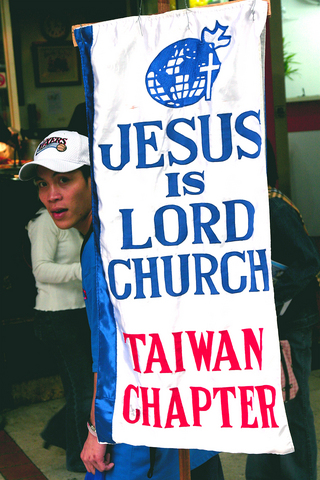
Taipei's Little Manila was born in the 1980s when mostly Catholic Filipinos started congregating around St. Christopher's Church, to pray and to seek support for domestic or employment disputes. The government allowed "six industries and 15 professions" to apply for foreign labor in 1991 and the number and nationality of workers has expanded since then, despite initiatives to put the breaks on.
According to a recent CLA Bureau of Employment and Vocational Training report there are presently around 338,755 migrant workers, or over 2.5 percent of the labor force and 1.5 percent of the entire population. The Philippines, Indonesia and Thailand each supply around 90,000 workers, while Vietnam sends 70,000. The government balances the relative numbers of Asian workers so as not to depend on one country and because of the occasional political spat. Also, workers from some nations are cheaper than others.
"Indonesians, Vietnamese, Sri Lankans, Pakistanis, these countries' workers are willing to work for less than us. China is also preparing its caregivers with all kinds of skills," says Father Romeo Velos, of St Christopher's Church.
This has caused a reduction in the number of Filipinos and a hollowing out of Little Manila. Four years ago the area was a lot busier, says cargo company owner Raymond Rodriguez (李偉郵). He wistfully recalls that it used to be so crowded on Sundays in the Won Won Department Store, where he has his business, people couldn't move.
If the CLA has its way this situation will continue as fresh policies to implement the "consensus about gradually decreasing foreign care workers" are implemented.
"The only thing we Filipinos can do is upgrade our skills by enrolling on courses. Then maybe go to Canada or elsewhere. We must think of Taiwan as a stepping stone," Velos says.
There are positive aspects to the Asian foreign worker experience here. Filipina caregiver Lynda says wages (NT$17,000 per month) compare favorably with Singapore (about NT$10,000 after deductions). Also, the Taipei city and national governments have improved conditions with new laws to prevent abuse and make workers welcome, for instance, by celebrating Christian, Moslem and Thai holidays.
Even so, Velos says "these beautiful laws and policies are not always implemented" and he is pessimistic about the future of Little Manila, or Little Jakarta, because the government is determined to reduce the number of foreign workers and resist Asian immigration.
Manila Economic and Cultural Office labor representative Reynaldo Gopez notes that some of the oldest Chinatowns in the world are in Manila, Bangkok and Indonesia. At the same time as Taiwan began importing foreign labor in the 1980s local emigrants were settling in the US, particularly Monterey Park in California, which became known as "Little Taipei." Here, expatriates shop for their favorite foods from home, buy Mando-pop albums and pearl milk tea from businesses set up by Taiwanese.
"We are talking about reciprocity. Well, it is a beautiful idea. Zhongshan North Road is like Little Manila, but the reality is that it would be difficult to organize development with the laws as they are since people need rights to set up businesses. I would say that is not possible now because most workers have curfews and the only time they have off is a Sunday. But of course, we would like it to happen and we are all working for that," Gopez says.

Last week Joseph Nye, the well-known China scholar, wrote on the Australian Strategic Policy Institute’s website about how war over Taiwan might be averted. He noted that years ago he was on a team that met with then-president Chen Shui-bian (陳水扁), “whose previous ‘unofficial’ visit to the US had caused a crisis in which China fired missiles into the sea and the US deployed carriers off the coast of Taiwan.” Yes, that’s right, mighty Chen caused that crisis all by himself. Neither the US nor the People’s Republic of China (PRC) exercised any agency. Nye then nostalgically invoked the comical specter
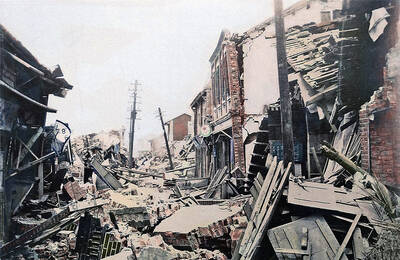
April 15 to April 21 Yang Kui (楊逵) was horrified as he drove past trucks, oxcarts and trolleys loaded with coffins on his way to Tuntzechiao (屯子腳), which he heard had been completely destroyed. The friend he came to check on was safe, but most residents were suffering in the town hit the hardest by the 7.1-magnitude Hsinchu-Taichung Earthquake on April 21, 1935. It remains the deadliest in Taiwan’s recorded history, claiming around 3,300 lives and injuring nearly 12,000. The disaster completely flattened roughly 18,000 houses and damaged countless more. The social activist and

Over the course of former President Ma Ying-jeou’s (馬英九) 11-day trip to China that included a meeting with Chinese Communist Party (CCP) leader Xi Jinping (習近平) a surprising number of people commented that the former president was now “irrelevant.” Upon reflection, it became apparent that these comments were coming from pro-Taiwan, pan-green supporters and they were expressing what they hoped was the case, rather than the reality. Ma’s ideology is so pro-China (read: deep blue) and controversial that many in his own Chinese Nationalist Party (KMT) hope he retires quickly, or at least refrains from speaking on some subjects. Regardless

Approaching her mid-30s, Xiong Yidan reckons that most of her friends are on to their second or even third babies. But Xiong has more than a dozen. There is Lucky, the street dog from Bangkok who jumped into a taxi with her and never left. There is Sophie and Ben, sibling geese, who honk from morning to night. Boop and Pan, both goats, are romantically involved. Dumpling the hedgehog enjoys a belly rub from time to time. The list goes on. Xiong nurtures her brood from her 8,000 square meter farm in Chiang Dao, a mountainous district in northern Thailand’s


 RSS
RSS