


I remember fondly a joy-filled childhood in which we came home from school, gobbled down a snack and ran out to play until dark. We made up games, taught each other to roller skate and ride bicycles, ran and jumped, climbed and fell, fought and negotiated, and generally had lots of fun without adults telling us what to do.
In playgrounds, we climbed high slides, going up the ladder and the slide itself; soared on swings; swung from monkey bars; and seesawed, carefully balancing weight by moving up or down on the seat.
Play has taken on new forms in these "modern" times. Adults hover over preschoolers, "helping" them play nicely and preventing them from hurting themselves or others. For first graders and beyond, if they have any free time at all, most playgrounds have become so safe as to be utterly boring.
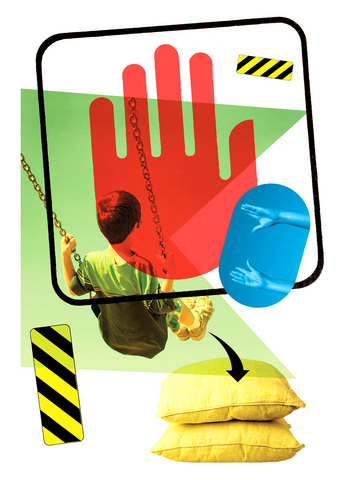
PHOTO: NY TIMES NEWS SERVICE
Unfettered playtime is more and more consumed, in school and at home, by academic programs, electronic media and games, and adult-organized activities at the expense of children's physical, emotional and social development, say experts on play and its role in child development.
Schools are eliminating recess and physical education to cram in lessons on reading and math to meet nationally prescribed academic standards. Over-programmed children are under stress to perform, perform, perform, with few or no outlets for that stress. Many children who lack adult supervision at home are stuck "safely" indoors after school.
"From a child development perspective, children need access to an environment that allows them to play out what is natural to them -— physical, dramatic, constructive and spontaneous games," Joe Frost, an emeritus professor of education at the University of Texas who is an expert on play and playgrounds around the world, said in an interview. "But in our high-tech society, children go indoors right after school and eat junk food and play video games."
No wonder this nation is suffering from an epidemic of childhood depression and obesity.
THE VALUE OF PLAY
A report in the journal Pediatrics in January by Dr. Kenneth R. Ginsburg and two committees of the American Academy of Pediatrics summed up the importance of free play to a child's development. It made these points:
— Play allows children to use their creativity while developing their imagination, dexterity and physical, cognitive and emotional strength.
— Play is important to brain development.
— Play allows children to create and explore a world they can master, conquering their fears while practicing adult roles.
— Play helps children develop new competencies that lead to enhanced confidence and the resiliency they will need to face challenges.
— Undirected play allows children to learn how to work in groups, to share, to negotiate and to resolve conflicts.
— Some play must remain child-driven, with parents either not present or as passive observers. When play is child-driven, children practice decision-making, move at their own pace, discover their own areas of interest and ultimately engage fully in the passions they wish to pursue.
— When play is controlled by adults, children acquiesce to adult rules and concerns and lose some benefits of play, particularly in developing creativity, leadership and group skills.
— In contrast to passive entertainment, play builds active, healthy bodies.
— Above all, play is a simple joy that is a cherished part of childhood.
ALLOWING REASONABLE RISKS
Franklin Stone, a lawyer, community activist and former director of the nonprofit public policy group Common Good, is concerned about the effects that litigation is having on children's access to free play.
"For fear of lawsuits, we've created a bubble-wrapped society," Stone said. "Fear of litigation has resulted in the 'dumbing down' of playgrounds and the closing of sledding hills and hiking trails. We've made playgrounds immensely safe for 3-, 4- and 5-year-olds, but they're boring for 8-, 9- and 10-year-olds, who are on the streets with their skateboards.
"New playgrounds today have only bucket swings for babies, no monkey bars or high slides or seesaws," Stone added. "Yet children are much more likely to be injured from almost everything else — from beds, pots and pans, TVs, organized sports — than they are in a playground.
"We need to re-evaluate safety guidelines to see if we've gone too far. And we need to consider legal protection for those who offer opportunities for play — the schools, churches and community organizations who are now afraid of being sued if a child gets hurt."
Children have to learn to take reasonable physical and social risks if they are to become the confident grown-ups parents want them to be. If children are constantly being told not to do things because it's too dangerous or they might get hurt, parents are teaching them that they are weak, Stone said.
Last year my grandson, who was 5, broke his arm when he fell from a climbing structure in the schoolyard. As soon as his arm healed, he was back climbing, even standing on the top of the structure. I remembered when his father (my son) was just a year or two older and fell out of a tree, scraped his chest and said not a word to his parents. The next day, he was back in the tree.
Susan G. Solomon, author of American Playgrounds: Revitalizing Community Space, said: "Children need a chance to take acceptable risks, learn cause and effect, make choices and see consequences. If they don't learn to take risks, we'll lose a generation of entrepreneurs and scientists."
NEW VS. OLD IDEAS
A recent proposal to create playgrounds in New York City that offer sand and water and various portable objects that are overseen by a trained play worker revives a concept that prevailed here in the 1920s and is still practiced in Europe. But it has drawn some devastating criticism from parents and others who say children don't need adults "directing" their play.
Rhonda Clements, a professor of education at Manhattanville College in Purchase, New York, and the author of nine books on children's play, called it an exciting and much-needed concept.
The idea, she said, has been misunderstood. Play workers don't tell children how to play. Rather, they provide the equipment for imaginative play that gives children of different ages, ethnic backgrounds and skill levels a chance to interact with and learn from one another, unlike traditional playgrounds that are more isolating.
Also crucial, the authors of the Pediatrics report wrote, is more parent-child playtime. Some of the best interactions occur when parents work on a hobby or play sports with their children or become fully immersed in child-centered play.
The results can be surprising. In addition to having fun, my grandsons, now in first grade, have learned how to multiply and divide by playing Monopoly with their father.

In late October of 1873 the government of Japan decided against sending a military expedition to Korea to force that nation to open trade relations. Across the government supporters of the expedition resigned immediately. The spectacle of revolt by disaffected samurai began to loom over Japanese politics. In January of 1874 disaffected samurai attacked a senior minister in Tokyo. A month later, a group of pro-Korea expedition and anti-foreign elements from Saga prefecture in Kyushu revolted, driven in part by high food prices stemming from poor harvests. Their leader, according to Edward Drea’s classic Japan’s Imperial Army, was a samurai

Located down a sideroad in old Wanhua District (萬華區), Waley Art (水谷藝術) has an established reputation for curating some of the more provocative indie art exhibitions in Taipei. And this month is no exception. Beyond the innocuous facade of a shophouse, the full three stories of the gallery space (including the basement) have been taken over by photographs, installation videos and abstract images courtesy of two creatives who hail from the opposite ends of the earth, Taiwan’s Hsu Yi-ting (許懿婷) and Germany’s Benjamin Janzen. “In 2019, I had an art residency in Europe,” Hsu says. “I met Benjamin in the lobby
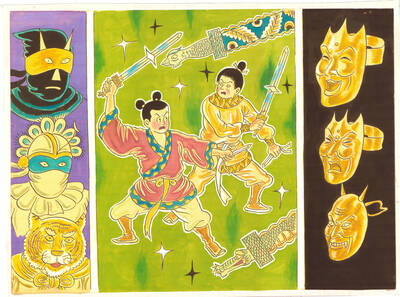
April 22 to April 28 The true identity of the mastermind behind the Demon Gang (魔鬼黨) was undoubtedly on the minds of countless schoolchildren in late 1958. In the days leading up to the big reveal, more than 10,000 guesses were sent to Ta Hwa Publishing Co (大華文化社) for a chance to win prizes. The smash success of the comic series Great Battle Against the Demon Gang (大戰魔鬼黨) came as a surprise to author Yeh Hung-chia (葉宏甲), who had long given up on his dream after being jailed for 10 months in 1947 over political cartoons. Protagonist

Peter Brighton was amazed when he found the giant jackfruit. He had been watching it grow on his farm in far north Queensland, and when it came time to pick it from the tree, it was so heavy it needed two people to do the job. “I was surprised when we cut it off and felt how heavy it was,” he says. “I grabbed it and my wife cut it — couldn’t do it by myself, it took two of us.” Weighing in at 45 kilograms, it is the heaviest jackfruit that Brighton has ever grown on his tropical fruit farm, located


 RSS
RSS