


I didn't expect to enjoy this book about Douglas MacArthur (discussed in parallel with Japan's Emperor Hirohito). He was, after all, a die-hard right-winger in politics, a gutsy military commander given to wading ashore under enemy fire wherever he had the opportunity, and giving rise to endless variations on his "Old soldiers never die" aphorism.
But this new general survey, written without footnotes and aiming for a popular readership, turns out to be a remarkably compulsive read. This is partly because it proves the truth of something I've always believed — that there are no black and whites in human nature, only endless shades of gray, plus a huge range of idiosyncracies.
But why a new book on MacArthur now? No new information appears to have emerged, and the answer instead probably lies in the author's relentless energy. He's already written books about the rise and fall of communism, a perceived drift to global disorder, the US War of Independence, Latin America's struggles for independence, Greater Japan's rise and fall, the life and death of Clive of India, and much else — 11 substantial books in all. Clearly life for Robert Harvey is a nightmare when he's not poring over stacks of historical volumes and then tapping away into the night on his computer.
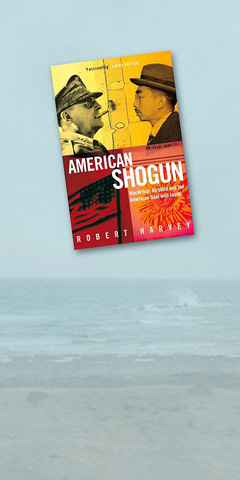
MacArthur was both adored and loathed. He seemed bigger than presidents, and was notorious for ignoring their orders. He was already US chief of staff in the 1930s, left to take up a comic-opera position in the Philippines under Manuel Quezon, then was recalled by Washington to mastermind the entire US war in the Pacific. From there he became, in 1945, effective leader of an occupied Japan, and the only American ever to have ruled, as a species of proconsul, a temporarily subject people.
Nor was this the end. In 1950 he again led US forces, nominally under UN control, in the resistance to North Korea's invasion of the south, carrying out an amphibious landing behind enemy lines at Inchon, considered one of the most audacious actions in all military history. It was equaled, experts believe, only by his masterly retreat onto the Bataan Peninsula following the Japanese invasion of the Philippines. (His famous promise "I will return" came after he was ordered to leave for Australia while his men were marched away to prison camps).
In some ways MacArthur lurched from one extreme to another. In 1932 he confronted WWI veterans who'd encamped in Washington DC to claim early payment of a promised bonus (known as the Bonus Marchers). It was the time of the Great Depression, but MacArthur's high-handed approach (against former servicemen, no less) almost led to killings by the military of US citizens on US soil. On the other hand, he was alone in the US high command to oppose the dropping of atom bombs on Hiroshima and Nagasaki. He'd been against a land invasion too, believing that a naval blockade would quickly and bloodlessly bring an exhausted and dispirited Japan to its knees.
Again, in the Korean War he called for a policy of hot-pursuit of Chinese Communist forces across the Yalu River into China, and even proposed the laying of nuclear waste to seal off the Korean peninsula. But on the other hand, as military ruler of Japan after 1945 — and the "shogun" of the book's title — he astonished the Japanese by his conciliatory policies (in fact dictated by the Truman administration in Washington). Far from punishing a nation that had caused untold US deaths in four years of terrible warfare, he promoted democracy, women's rights, the marginalization of the military, and the eventual emergence of the world's second largest economy. "At least 200,000 Japanese came to see MacArthur depart," writes Harvey, "many of them openly crying."
American Shogun is less interesting on the Japanese emperor. Herbert Bix's hostile 2000 book Hirohito and the Making of Modern Japan perhaps casts too long a shadow. If anything, Harvey tries to see things from the emperor's point of view, presenting him as politically weak but not uncharitable in himself, and very much a puppet, first of his own military, then of the American desire to build up postwar Japan as a bulwark against Communism in Asia. Like MacArthur, Hirohito was a great survivor.
Taiwan features, most importantly in MacArthur's 1950 visit to Taipei to meet Chiang Kai-shek. What they discussed isn't known, but it may have been the possibility of Taiwanese forces attacking the mainland as a diversionary tactic during the Korean War. Truman vetoed all such ideas as likely to bring the Chinese Communists into Korea, but in the event they went in anyway.
Reading this book, I kept thinking of parallels between MacArthur and Antony in Shakespeare's Antony and Cleopatra — unpopular with the political leadership (Octavius there, Truman here) but the bigger man nonetheless, and finding his true home away from the political heartland. MacArthur's Egypt was the Philippines he so loved, and his Cleopatra could be seen as the 16-year-old Isabel Rosario Cooper he had an affair with (though it should be noted that Cleopatra was 38 when Antony became involved with her). MacArthur never quite handed out kingdoms "as plates [coins] dropped from his pocket," as Cleopatra dreamt of Antony as doing. He wielded power over a huge number of subject citizens nonetheless.
But modern life doesn't allow for such grandiose visions. It's polluted by horrors such as people being melted down by radioactive explosions. MacArthur isn't really the stuff of dreams, and this comprehensive and readable book is wise not to attempt to portray him as such.

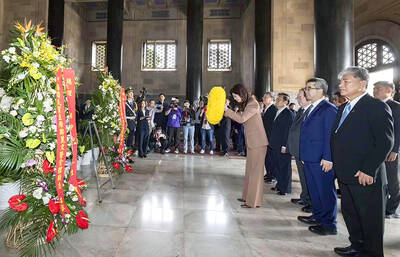
The problem with Marx’s famous remark that history repeats itself, first as tragedy, the second time as farce, is that the first time is usually farce as well. This week Chinese Nationalist Party (KMT) Chair Cheng Li-wun (鄭麗文) made a pilgrimage to the People’s Republic of China (PRC) “to confer, converse and otherwise hob-nob” with Chinese Communist Party (CCP) officials. The visit was an instant international media hit, with major media reporting almost entirely shorn of context. “Taiwan’s main opposition leader landed in China Tuesday for a rare visit aimed at cross-strait ‘peace’”, crowed Agence-France Presse (AFP) from Shanghai. Rare!
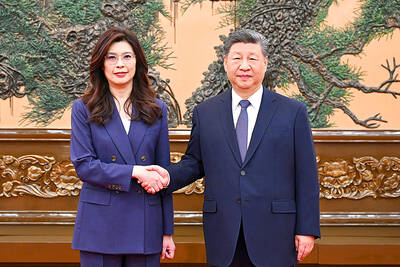
What is the importance within the Chinese Nationalist Party (KMT) of the meeting between Xi Jinping (習近平), the leader Chinese Communist Party (CCP), and Cheng Li-wun (鄭麗文), the leader of the KMT? Local media is an excellent guide to determine how important — or unimportant — a news event is to the public. Taiwan has a vast online media ecosystem, and if a news item is gaining traction among readers, editors shift resources in near real time to boost coverage to meet the demand and drive up traffic. Cheng’s China trip is among the top headlines, but by no means
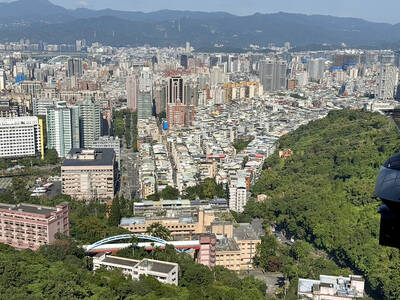
A recent report from the Environmental Management Administration of the Ministry of Environment highlights a perennial problem: illegal dumping of construction waste. In Taoyuan’s Yangmei District (楊梅) and Hsinchu’s Longtan District (龍潭) criminals leased 10,000 square meters of farmland, saying they were going to engage in horticulture. They then accepted between 40,000 and 50,000 cubic meters of construction waste from sites in northern Taiwan, charging less than the going rate for disposal, and dumped the waste concrete, tile, metal and glass onto the leased land. Taoyuan District prosecutors charged 33 individuals from seven companies with numerous violations of the law. This
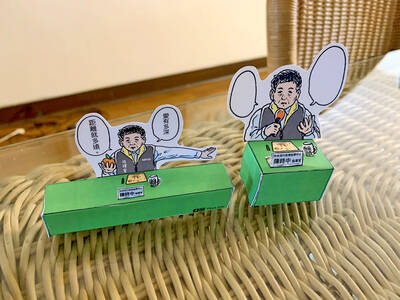
Sunflower movement superstar Lin Fei-fan (林飛帆) once quipped that the Democratic Progressive Party (DPP) could nominate a watermelon to run for Tainan mayor and win. Conversely, the DPP could run a living saint for mayor in Taipei and still lose. In 2022, the DPP ran with the closest thing to a living saint they could find: former Minister of Health and Welfare Chen Shih-chung (陳時中). During the pandemic, his polling was astronomically high, with the approval of his performance reaching as high as 91 percent in one TVBS poll. He was such a phenomenon that people printed out pop-up cartoon


 RSS
RSS