


The bold, flowing, multicolor gowns that add to Colonel Muammar Qaddafi's reputation for flamboyant and quirky behavior may actually make a subtle point.
They are, in fashion terms, what some people would like to see Libya become — a blending of the traditional and the modern. Rabia Ben Barka knows because, she said, she often designs clothes for the colonel, known here as Brother Leader.
Ben Barka, a slight, cautious woman, has waited a lifetime to have the chance to combine the styles she learned in the capitals of Europe with the traditions of Libya, her North African homeland. But Libya was not always open to Ben Barka; it was not open to anyone who sought to pierce its isolation.
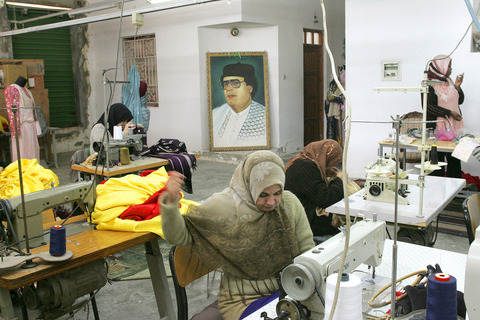
PHOTO: NY TIMES NEWS SERVICE
Or to recover family assets seized by the state.
Ben Barka began life lucky, born into a very rich family. Her father owned eight textile factories in Tripoli. Her uncles owned buildings and hotels.
Then she wasn't lucky. Or rich.
Qaddafi (he was a captain at the time) and a small group of officers staged a coup d'etat in 1969 and ousted the monarchy. Once in power, the colonel (he promoted himself) nationalized almost everything on his way to establishing a socialist-style economy. The government took the eight factories, the hotels and the other buildings.
Ben Barka was abroad at the time, attending an elite boarding school in Switzerland. She moved on from there to Rome, w here she studied with leading fashion designers. In 1976, when she was 26, she said, she won a regional fashion show in Egypt, defeating better known Egyptian and Lebanese designers.
But her career never took off, she said, because she could not work from her home in Tripoli and pursue her passion of combining traditional Libyan dress with modern Western styles. "I missed many years," she said.
Instead she did work for others, designing lines in Rome while trying to slip in her own Libyan-inspired flourishes. But her heart was always in Libya, and her aim was to return.
Ultimately, she said, the ticket back came through the family that took everything away: the Qaddafis.
First, though, a note of caution. Ben Barka may not like what Libya has become under the rule of Brother Leader, but she will not say it. She may not like that her family's assets were stripped and her life's work stalled, but she will not talk about that either.
She has made a mental accommodation with what Libya is under Qaddafi. It is much like the accommodation many intellectuals and artists have made to work, or simply live, in authoritarian states like Iraq under Saddam Hussein or the Soviet Union.
"They call me the ambassadress of Libyan fashion," she said. "I am an artist. I have nothing to do with politics."
She said the door to Tripoli was first cracked open for her by Qaddafi's daughter, Aisha, who apparently liked Ben Barka's designs. It was during the 1980s, and Ben Barka was coming in and out of the country, traveling between her temporary home in Rome and her birthplace, Tripoli. Over time, she built up enough contacts that she was able to open her own firm.
She does not want to alienate her most important client in any way, so the details of her climb to success are thin and come slowly. But she says that eventually, she moved from daughter, to wife, to Brother Leader himself.
"I was the leader's designer," she finally allowed.
Ben Barka's studio is in downtown Tripoli, off a busy traffic circle and not very far from where Qaddafi lives. The road in front of is unpaved, littered and rutted.
But it is a thrill for her, because the studio is in one of her father's old textile factories; through her work and relations with the first family, she said, she was able to convince officialdom to return at least something that once belonged to the family business.
Inside it is cold and dank like a factory, with cement floors, walls and ceilings. There are four or five sewing machines in the work space. There is a large picture of Brother Leader leaning against one wall, and racks of clothing that speak to her goal of fashioning Libyan identity in a modern context.
"We cannot pretend to be European or American," she said, as she flipped through racks of clothing as though gently turning the pages of an old family photo album. Libyan clothing reflects the country's Islamic, African and desert identities, all of which she plays with and builds on.
For both men and women there are bold stripes and intricate embroidered patterns. She sometimes uses materials woven with strands of gold and silver. For women there can also be pants, often beneath a traditional flowing veil that extends to the shoulders, like a shawl.
For men there are Western-style suits, livened up with embroidery on the sleeves, chest and waist. There are plays on traditional color patterns; black and white, for example, where tradition calls for only white.
"I didn't want to lose our character," she said.
Though her work was a shock to some Libyan traditionalists, over the years, she said, she has won a following here, dressing foreign diplomats and their spouses, staging fashion shows for visiting delegations and, of course, continuing her work for the first family. Now, she said, she grapples with another problem: bootleggers copying her designs.
But still, as Libya feels its way between isolation and integration, her audience is limited, her opportunities stunted. The country has begun to move toward economic reform, while preserving Qaddafi's political system. She cannot, for example, manufacture new clothing for every show, because the gold and silver threads are costly. She has been unable to figure out how to show her work in the US.
Few people can actually wear the haute couture of Europe off the runway. High-end outfits are for fashion shows and the Academy Awards. Ben Barka's clothing would also be tough to wear for a day at the office, or even a night out on the town. But Qaddafi is not afraid to wear a powder-blue jumper or lime-green robes.
It is impossible in Libya to get a fix on the colonel's thinking, so what he sees in the designs remains a mystery. But Ben Barka's idea is that his clothing represents a marriage of where Libya was and where she would like to see it go.
Standing in her studio, she held up a shiny suit with narrow black and gold stripes. The cut was Western and the pattern Libyan. A visiting friend pushed her to acknowledge that she had made one just like it for Qaddafi.
But she demurred. That was as far as she would go about her famous client.

In late October of 1873 the government of Japan decided against sending a military expedition to Korea to force that nation to open trade relations. Across the government supporters of the expedition resigned immediately. The spectacle of revolt by disaffected samurai began to loom over Japanese politics. In January of 1874 disaffected samurai attacked a senior minister in Tokyo. A month later, a group of pro-Korea expedition and anti-foreign elements from Saga prefecture in Kyushu revolted, driven in part by high food prices stemming from poor harvests. Their leader, according to Edward Drea’s classic Japan’s Imperial Army, was a samurai

The following three paragraphs are just some of what the local Chinese-language press is reporting on breathlessly and following every twist and turn with the eagerness of a soap opera fan. For many English-language readers, it probably comes across as incomprehensibly opaque, so bear with me briefly dear reader: To the surprise of many, former pop singer and Democratic Progressive Party (DPP) ex-lawmaker Yu Tien (余天) of the Taiwan Normal Country Promotion Association (TNCPA) at the last minute dropped out of the running for committee chair of the DPP’s New Taipei City chapter, paving the way for DPP legislator Su

It’s hard to know where to begin with Mark Tovell’s Taiwan: Roads Above the Clouds. Having published a travelogue myself, as well as having contributed to several guidebooks, at first glance Tovell’s book appears to inhabit a middle ground — the kind of hard-to-sell nowheresville publishers detest. Leaf through the pages and you’ll find them suffuse with the purple prose best associated with travel literature: “When the sun is low on a warm, clear morning, and with the heat already rising, we stand at the riverside bike path leading south from Sanxia’s old cobble streets.” Hardly the stuff of your

Located down a sideroad in old Wanhua District (萬華區), Waley Art (水谷藝術) has an established reputation for curating some of the more provocative indie art exhibitions in Taipei. And this month is no exception. Beyond the innocuous facade of a shophouse, the full three stories of the gallery space (including the basement) have been taken over by photographs, installation videos and abstract images courtesy of two creatives who hail from the opposite ends of the earth, Taiwan’s Hsu Yi-ting (許懿婷) and Germany’s Benjamin Janzen. “In 2019, I had an art residency in Europe,” Hsu says. “I met Benjamin in the lobby


 RSS
RSS