


John Baldessari, the conceptual artist who has long made his home here, for years gave his college art students one piece of advice when they graduated: Go to New York, the capital of the art world.
Now, however, Baldessari has a different view. "I don't think it matters," he said recently. "More and more young artists leave school and stay here. The opportunities are better, and the cost of living is cheaper. People involved in art regularly come to LA. It really doesn't matter if they live in New York or LA."
Two decades after Los Angeles emerged as the nation's second art capital, the city is reaping the benefits of a migration of artists, galleries, dealers and curators. In recent years more than two artists have moved to this city for every one that moved away, a net rate of gain that is higher than in any metropolitan area in the country, according to an analysis of Census Bureau statistics by Ann Markusen, a professor at the University of Minnesota.
PHOTOS: NY TIMES NEWS SERVICE
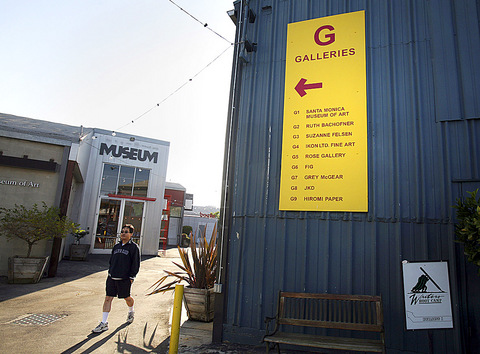
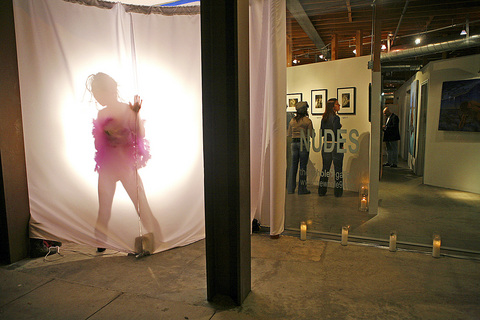
In the process new centers of gravity have emerged for contemporary art and artists in a city that has suffered for years because of its lack of a central arts district. Now there is not one such geographic center but several: downtown, where a thriving gallery district operates in what used to be a nighttime ghost town, as well as in former industrial areas in Culver City and Santa Monica. And a new generation of curators have been lured to the major museums here. The Los Angeles County Museum of Art, the J. Paul Getty Museum and the Hammer Museum have each attracted energizing new talent in recent years.
Of course the city has long since emerged as an important center for the performing arts as well. The Los Angeles Philharmonic, regarded as one of the country's most dynamic orchestras, gained added allure with its move to Frank Gehry's 2003 Disney Hall on Grand Avenue, and the Los Angeles Opera is preparing for its first-ever Ring cycle next door at the Dorothy Chandler Pavilion.
In architecture Los Angeles has been an incubator not just for Gehry but for the rising star Thom Mayne, and high-profile commissions by Renzo Piano at the Los Angeles County Museum of Art and Steven Holl at the Natural History Museum of Los Angeles County are proceeding apace. And the boom in television and film production in Hollywood has created new opportunities for visual artists and dancers, many of whom also work for companies that perform in or have close ties to Pacific Rim countries.
Yet the city is still struggling to attract cultural tourists. While New York, London and Paris each attract 10 million to 15 million such visitors per year, Los Angeles draws only about 2.5 million, according to a 2004 study by the Los Angeles County Economic Development Corp.
"Why is that?" asked the philanthropist Eli Broad, the city's most visible and generous champion of the arts. "Perception. We have not promoted cultural travel. That's going to start happening, and that's going to get the city more and more attention."
Whereas 40 percent of visitors to New York and London take part in some sort of cultural activity — a museum visit, a theatrical performance or the like — and 85 percent of visitors to Paris do so, only about one in 10 tourists to Los Angeles visit a cultural site.
To remedy that Broad and other civic leaders are bargaining on their investment in the commercial and cultural districts that are taking shape downtown, like the Grand Avenue Project and LA Live, efforts that include hotels, restaurants, shops and entertainment centers.
"It will mean a big boost to the economy, and a big boost to how our city is viewed internationally," Broad said. "It's not simply sunshine, beaches and Hollywood here."
But that effort hasn't been easy. Two years ago Broad tried to raise US$10 million in public financing to promote the arts here. While the city promised US$2 million, officials at the county, state and federal levels balked, arguing in part that more private money should be raised for that purpose. For now the effort has stalled, although Mayor Antonio R. Villaraigosa said in an interview that he would like to create a public-private partnership to accomplish what Broad proposed.
Broad (whose name rhymes with road) has generated a fair amount of resentment in some corners here for his outsized presence on the art scene. His devotion to downtown projects have been criticized as ignoring pockets of the city that have less access to the arts, like the largely Hispanic sections of East Los Angeles and the areas south of downtown that have large African-American populations. And some of the resistance he faced in his most recent fundraising effort came from people who wondered why a billionaire was asking for money from taxpayers to promote museums on whose boards he sits.
Ever an optimist, Broad dismisses those criticisms, saying he prefers to discuss why, despite the relative lack of major corporations here, he still believes that new money can flow to the art world. As evidence, he cited a US$25 million donation announced this month by BP, the energy company, to the Los Angeles County Museum to finance a new entrance pavilion.
If it has been hard to attract investment and government support for cultural activities, the city's vibrant visual arts scene might be seen as its own best advertisement.
"The rest of the world is promoting the city as well or better than LA does," said Gary Garrels, the chief curator at the Hammer Museum, who moved here two years ago from the Museum of Modern Art in New York. "All of the curators and galleries that are dynamic are coming to Los Angeles and looking at what's going on here."
Downtown, which not too long ago was little more than a ghost town after 5pm on weekdays, now bustles with activity around Fifth and Spring streets on Friday and Saturday nights, when art galleries typically schedule their openings of new shows. Similar scenes unfold around more established galleries on Wilshire Boulevard and among emerging contemporary galleries in Santa Monica and Culver City, the incorporated area south of Interstate 10.
Last year Los Angeles and its artists were the focus of a major show at the Pompidou Center in Paris, Los Angeles 1955-1985: The Birth of an Art Capital. This month the Hammer Museum here will feature 15 contemporary Los Angeles artists in a show exploring what it means to create here, playfully titled Eden's Edge.
As a career art seems more realistic to graduate art students than ever before, said Patrick Painter, who owns a gallery in Santa Monica. "Students graduate here with a feeling they can live in LA and make a living in LA," he said. "LA will never be more important than New York, but it will be equal."
And naturally some artists adopt Los Angeles precisely because it is not New York. Max Jansons, a Los Angeles painter who is a New York native, graduated from UCLA, then returned to Columbia University for a master's degree. He now lives in Santa Monica.
"I like having time to be in my studio without being surrounded by tons of different voices and seeing all these different shows and being part of that activity," Jansons said. "There's something very focused about your time here in the studio that I never really had in New York when I was there."
Last week Joseph Nye, the well-known China scholar, wrote on the Australian Strategic Policy Institute’s website about how war over Taiwan might be averted. He noted that years ago he was on a team that met with then-president Chen Shui-bian (陳水扁), “whose previous ‘unofficial’ visit to the US had caused a crisis in which China fired missiles into the sea and the US deployed carriers off the coast of Taiwan.” Yes, that’s right, mighty Chen caused that crisis all by himself. Neither the US nor the People’s Republic of China (PRC) exercised any agency. Nye then nostalgically invoked the comical specter
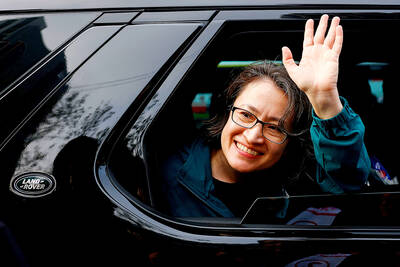
Relations between Taiwan and the Czech Republic have flourished in recent years. However, not everyone is pleased about the growing friendship between the two countries. Last month, an incident involving a Chinese diplomat tailing the car of vice president-elect Hsiao Bi-khim (蕭美琴) in Prague, drew public attention to the People’s Republic of China’s (PRC) operations to undermine Taiwan overseas. The trip was not Hsiao’s first visit to the Central European country. It was meant to be low-key, a chance to meet with local academics and politicians, until her police escort noticed a car was tailing her through the Czech capital. The
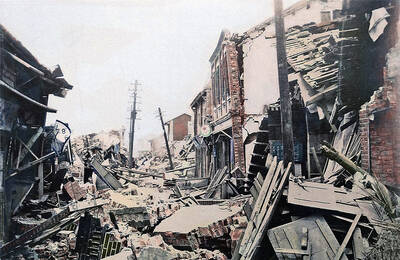
April 15 to April 21 Yang Kui (楊逵) was horrified as he drove past trucks, oxcarts and trolleys loaded with coffins on his way to Tuntzechiao (屯子腳), which he heard had been completely destroyed. The friend he came to check on was safe, but most residents were suffering in the town hit the hardest by the 7.1-magnitude Hsinchu-Taichung Earthquake on April 21, 1935. It remains the deadliest in Taiwan’s recorded history, claiming around 3,300 lives and injuring nearly 12,000. The disaster completely flattened roughly 18,000 houses and damaged countless more. The social activist and

Over the course of former President Ma Ying-jeou’s (馬英九) 11-day trip to China that included a meeting with Chinese Communist Party (CCP) leader Xi Jinping (習近平) a surprising number of people commented that the former president was now “irrelevant.” Upon reflection, it became apparent that these comments were coming from pro-Taiwan, pan-green supporters and they were expressing what they hoped was the case, rather than the reality. Ma’s ideology is so pro-China (read: deep blue) and controversial that many in his own Chinese Nationalist Party (KMT) hope he retires quickly, or at least refrains from speaking on some subjects. Regardless


 RSS
RSS