


Jo Yirrell will never forget the moment her son Harry stepped off the plane from Ghana. "His feet were filthy, but otherwise he was the picture of health," she says. "The first thing he said was, 'Mum, as soon as I can raise the money I want to go back.'"
Harry had been teaching English in a small fishing village. "Many of the children at the school had malaria," says Jo. "Harry couldn't bear to see them suffer so he gave his pills away. He told me he didn't get malaria so he didn't think it mattered. It was the most stupid thing he ever did."
Harry spent three months in Ghana and eight days after his return to the UK he developed a headache and what he thought were flu-like symptoms. Less than a week later, the strapping 1.78m rugby player was dead, following a massive infection with falciparum malaria, the deadliest form of the parasitical disease. He was just 20 years old.
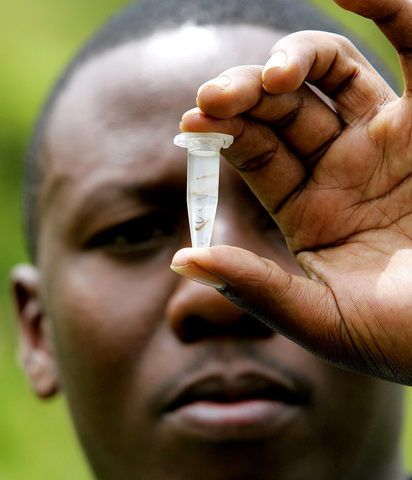
PHOTO: AP
In 2005, there were 1,754 cases of imported malaria in the UK — 94 more than in 2004 — and 11 deaths, 10 of which were caused by falciparum. Nearly every case could have been avoided if the travelers had followed a course of malaria prophylaxis. Yet while travel to Africa, India and south-east Asia has soared in the past decade, surveys show that half of those jetting off to the tropics take no medical advice at all before leaving, while many, like Harry, fail for one reason or another to take their prescribed medication.
To educate the public about the very real dangers of malaria, Harry's mother has now become an ambassador for a new Malaria Hotspots campaign. "The medical profession needs to be much blunter about the dangers of malaria," says Jo. "They need to say, 'This thing can kill you if you don't take your medication. At the moment, that's not happening nearly enough.'"
There are many myths about malaria, but perhaps the biggest of all is that westerners do not need to worry about a disease that claims 3,000 lives every day in sub-Saharan Africa and is responsible for an estimated three million deaths worldwide every year. A common argument is that because no anti-malarial medicine is 100 percent effective and many types have unpleasant side-effects, there is no point in taking a prophylactic if you are going to be in the tropics for prolonged periods.
In fact, although there is growing evidence that parasites are becoming resistant to drugs in some parts of south-east Asia and Africa, prophylactics such as Lariam (mefloquine) and Malarone (atovaquone/proguanil) are between 90 percent and 100 percent effective when used with bite-avoidance measures, such as covering up at night when the mosquitoes are most active, and sleeping under a permethrin-treated mosquito net. And although it is true that in rare cases Lariam has been associated with depression and psychosis, the disease is still far worse than the cure. Ask Alex Beard, another ambassador for Malaria Hotspots.
Two years ago, Beard, now 22 and a freelance journalist, also traveled to Ghana and contracted malaria. Before leaving the UK she had taken medical advice and was given a course of prophylactics. She also bought a mosquito net. But within weeks of arriving at student digs at the University of Ghana, in Accra, she discarded the net because of the heat.
Four months later she set off with two friends across West Africa. En route to Burkina Faso she must have forgotten to take her medication for on arrival in the south of the country she fell ill. "It began with a pain in my stomach," she says. "The next thing I knew, I was having difficulty lifting a glass to my mouth."
Beard was rushed to the local vet — the only person in the area equipped to give blood tests — but even after she received the diagnosis she couldn't believe it. "He gave me a big bag of pills and told me to take 15 a day for three days. At the end of three days, he said, I would know whether or not the pills had worked."
Luckily for Beard, they did, but she will never forget the alternating chills and sweats accompanied by delirium as she battled against the parasite coursing through her body. At one point she was so cold that she put on a sweatshirt and wrapped herself up in the bedsheets only to wake up a few hours later in the shower fully clothed with the water running. "I must have been burning up and climbed into the shower to cool down. I have no recollection of how I got there."
Although Beard recovered sufficiently to continue her travels, for weeks afterwards she had trouble keeping her food down. Since her return to Britain she has also experienced recurrent cramps and dizzy spells as well as minor neurological problems.
"If I was to go again, I'd sleep every night under a net and religiously take my pills. It's so simple and yet your life depends on it."
In Harry's case, of course, it is too late for such advice, but Jo is determined that others should learn the lessons of his death. In hindsight, she says, she would have made sure he was better informed about the symptoms of malaria and what the dangers were so that he would not have been tempted to give away his pills. She would also like to see better training for doctors and nurses in the UK in recognizing the symptoms of malaria.
When Jo called her local GP to say that Harry had just returned from Ghana and she was worried about his symptoms, she was told it was "unlikely he had malaria" and to monitor him overnight. When his condition deteriorated the following day and she took him to her local accident and emergency department, they said, "Come back tomorrow."
It was only when she insisted on a blood test that malaria was diagnosed, and Harry was rushed to hospital for specialist treatment. There, he was given intravenous quinine but although the drug killed the malaria parasites, by now his body had suffered a massive shock and his lungs had begun to fill with fluid. He was hooked up to a breathing machine and his condition steadily improved. Then, a few days later, he suffered a sudden relapse. The cause of death was given as "adult respiratory distress syndrome". However, Jo has no doubt that it was the malaria that killed Harry.
"They threw the kitchen sink at him, but his system was just shot to pieces. People need to understand that, with malaria, time is of the essence — a few hours can make all the difference."
Despite her experience, Jo says she will not stand in the way of her other three sons, all of whom want to travel to the tropics. "My advice to them is the same advice I give to everyone: don't be complacent, take your malaria medication, and enjoy your life."

In late October of 1873 the government of Japan decided against sending a military expedition to Korea to force that nation to open trade relations. Across the government supporters of the expedition resigned immediately. The spectacle of revolt by disaffected samurai began to loom over Japanese politics. In January of 1874 disaffected samurai attacked a senior minister in Tokyo. A month later, a group of pro-Korea expedition and anti-foreign elements from Saga prefecture in Kyushu revolted, driven in part by high food prices stemming from poor harvests. Their leader, according to Edward Drea’s classic Japan’s Imperial Army, was a samurai

Located down a sideroad in old Wanhua District (萬華區), Waley Art (水谷藝術) has an established reputation for curating some of the more provocative indie art exhibitions in Taipei. And this month is no exception. Beyond the innocuous facade of a shophouse, the full three stories of the gallery space (including the basement) have been taken over by photographs, installation videos and abstract images courtesy of two creatives who hail from the opposite ends of the earth, Taiwan’s Hsu Yi-ting (許懿婷) and Germany’s Benjamin Janzen. “In 2019, I had an art residency in Europe,” Hsu says. “I met Benjamin in the lobby

April 22 to April 28 The true identity of the mastermind behind the Demon Gang (魔鬼黨) was undoubtedly on the minds of countless schoolchildren in late 1958. In the days leading up to the big reveal, more than 10,000 guesses were sent to Ta Hwa Publishing Co (大華文化社) for a chance to win prizes. The smash success of the comic series Great Battle Against the Demon Gang (大戰魔鬼黨) came as a surprise to author Yeh Hung-chia (葉宏甲), who had long given up on his dream after being jailed for 10 months in 1947 over political cartoons. Protagonist

A fossil jawbone found by a British girl and her father on a beach in Somerset, England belongs to a gigantic marine reptile dating to 202 million years ago that appears to have been among the largest animals ever on Earth. Researchers said on Wednesday the bone, called a surangular, was from a type of ocean-going reptile called an ichthyosaur. Based on its dimensions compared to the same bone in closely related ichthyosaurs, the researchers estimated that the Triassic Period creature, which they named Ichthyotitan severnensis, was between 22-26 meters long. That would make it perhaps the largest-known marine reptile and would


 RSS
RSS