


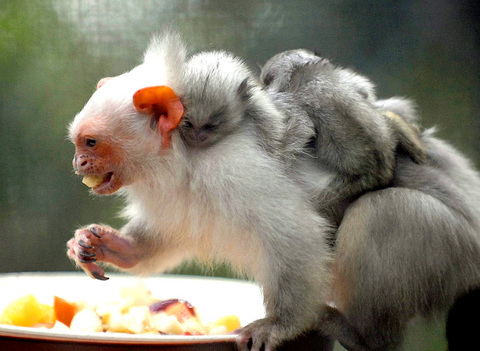
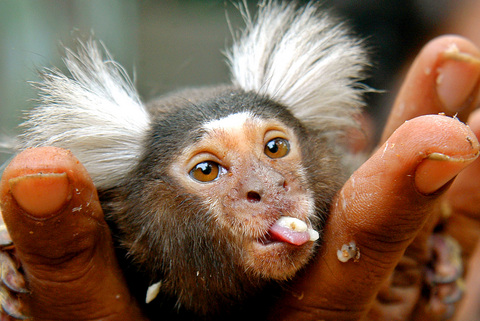
"Well, I'll be a monkey's uncle" has now taken on a new meaning. Scientists studying marmosets have discovered that over half the males carry their brother's sperm. Marmosets, small monkeys that live in South America, have long been a genetic enigma. Marmoset mothers almost always give birth to fraternal twins, which develop from two eggs and are thus genetically distinct. In 1962, scientists at Dartmouth Medical School discovered that almost all marmosets carry some blood-generating stem cells that began in their twin sibling.
Animals that carry cells from another individual are known as chimeras. Aside from marmosets, chimeras have been discovered in humans, cats and cows. But scientists have long thought that chimerism was a rare fluke.
Marmosets were different. Almost all of them had chimeric blood, and they were all healthy. It appears that they swap cells so often because of their peculiar development. In the womb, their placentas grow quickly and fuse, creating a network of blood vessels through which cells can travel from one twin to the other.
PHOTOS: AGENCIES
In 1991, Jeffrey French, a primatologist at the University of Nebraska, Omaha, set up a colony of marmosets. He and his colleagues have tracked their family history ever since. Recently one of his graduate students, Corinna Ross, set out to find a paternity test for marmosets. She developed a method much like the test used to identify human fathers. Small regions of DNA known as microsatellites are very prone to mutating, creating a kind of genetic fingerprint that's different from one family to another.
"We were hoping that we could use hair for paternity analysis, but that's not quite how it worked out," Ross said. "The initial results were very odd."
Different hairs from the same marmoset had different genetic fingerprints. Some of it matched the DNA of the marmoset's twin.
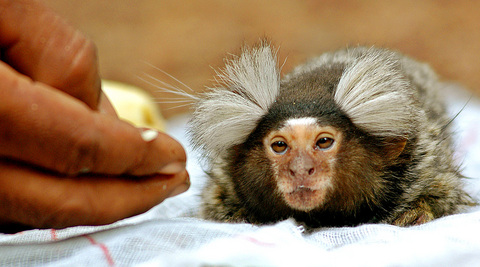
Working with French and Guillermo Orti, a University of Nebraska geneticist, Ross then studied other tissues from marmosets. "We found chimerism throughout everything," she said.
The pattern was different from one marmoset to the next. "A single individual might be chimeric for hair and liver, for example, and not for anything else," Ross said.
One of the most surprising results of the study is that over half of male marmosets have chimeric sperm. Ross and her colleagues discovered cases in which the DNA of male marmosets turned up in babies supposedly fathered by their fraternal twins. In other words, the sperm came from one male, but it had the DNA of the male's brother. A paternity test would show that the baby's genetic father was actually its uncle. The scientists were not able to isolate DNA from marmoset eggs, but they did find that two out of 21 marmoset ovaries were chimeric. It's possible that a female marmoset can give birth to nephews and nieces.
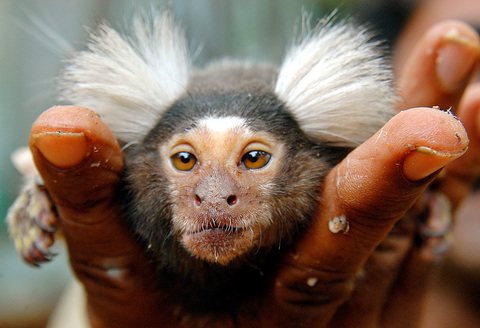
The discovery of rampant chimerism in marmosets led the Nebraska scientists to wonder if it affected how parents treated their children. Primates can recognize their offspring by distinctive odors. But a marmoset with chimeric skin would give off two odors — its own, and that of its twin sibling.
The scientists found that mothers carried babies with chimeric skin less than they carried babies with only one set of skin cells. Fathers, on the other hand, carried chimeras over twice as much as non-chimeras.
Scientists have long noted that marmo-sets are unusual among primates for their doting fathers. Chimeras may be the source of their attention. It's possible, Ross suggests, that chimeras give off a wider range of odors that signify that they are related to a father, increasing his attention.
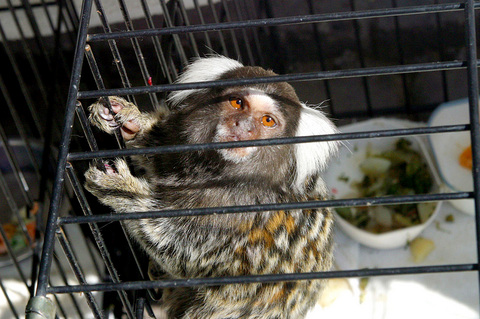
The results of the marmoset study appeared last week in The Proceedings of the National Academy of Sciences.
"It's potentially a really interesting finding," said David Haig, an evolutionary biologist at Harvard. Haig is particularly intrigued by the genetic relatedness of chimeric twins. On average, two normal fraternal twins would share about half their genes. Marmoset twins are more closely related because they have more genes in common.
That common bond might drive the evolution of unusual kinds of behavior. Haig notes that in a band of marmosets, only the oldest female can reproduce, while the younger individuals help raise her offspring.
Ross, who now works at the South Texas Centers for Biology in Medicine, is continuing to study the marmosets to understand the effects of chimerism. The questions she hopes to answer are not just scientific, but philosophical.
"This changes how we think of marmosets as individuals, but it also changes how we think of the term at all," she said. A male mates with a female, who gives birth to his brother's offspring. "But most of his body also has his brother's genes. So what is he as an individual?"

Last week Joseph Nye, the well-known China scholar, wrote on the Australian Strategic Policy Institute’s website about how war over Taiwan might be averted. He noted that years ago he was on a team that met with then-president Chen Shui-bian (陳水扁), “whose previous ‘unofficial’ visit to the US had caused a crisis in which China fired missiles into the sea and the US deployed carriers off the coast of Taiwan.” Yes, that’s right, mighty Chen caused that crisis all by himself. Neither the US nor the People’s Republic of China (PRC) exercised any agency. Nye then nostalgically invoked the comical specter

April 15 to April 21 Yang Kui (楊逵) was horrified as he drove past trucks, oxcarts and trolleys loaded with coffins on his way to Tuntzechiao (屯子腳), which he heard had been completely destroyed. The friend he came to check on was safe, but most residents were suffering in the town hit the hardest by the 7.1-magnitude Hsinchu-Taichung Earthquake on April 21, 1935. It remains the deadliest in Taiwan’s recorded history, claiming around 3,300 lives and injuring nearly 12,000. The disaster completely flattened roughly 18,000 houses and damaged countless more. The social activist and

Over the course of former President Ma Ying-jeou’s (馬英九) 11-day trip to China that included a meeting with Chinese Communist Party (CCP) leader Xi Jinping (習近平) a surprising number of people commented that the former president was now “irrelevant.” Upon reflection, it became apparent that these comments were coming from pro-Taiwan, pan-green supporters and they were expressing what they hoped was the case, rather than the reality. Ma’s ideology is so pro-China (read: deep blue) and controversial that many in his own Chinese Nationalist Party (KMT) hope he retires quickly, or at least refrains from speaking on some subjects. Regardless

Approaching her mid-30s, Xiong Yidan reckons that most of her friends are on to their second or even third babies. But Xiong has more than a dozen. There is Lucky, the street dog from Bangkok who jumped into a taxi with her and never left. There is Sophie and Ben, sibling geese, who honk from morning to night. Boop and Pan, both goats, are romantically involved. Dumpling the hedgehog enjoys a belly rub from time to time. The list goes on. Xiong nurtures her brood from her 8,000 square meter farm in Chiang Dao, a mountainous district in northern Thailand’s


 RSS
RSS