


A banned Chinese director plans to make an Arabic movie about a Palestinian who is abandoned by his wife after being jailed by Israel, in a rare collaboration between artists from the two regions.
Director Lou Ye (婁燁) is currently raising money to make The Last Hour, based on a play written by Palestinian writer Mazen Saadeh.
Saadeh, who makes documentaries, is also writing the screenplay.
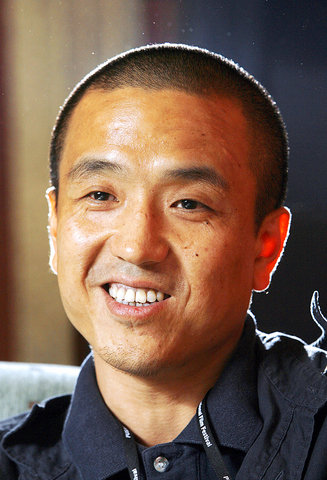
The Last Hour, which Lou aims to start shooting next year, would be the director's first movie since China's Film Bureau banned him from making films in his home country for five years after he screened his movie Summer Palace (頤和園) at the Cannes Film Festival last year without government approval.
Lou said earlier he plans to defy the ban.
Summer Palace, a sexually charged movie about the coming-of-age of Chinese university students, depicts the pro-democracy protests in 1989 based in Beijing's Tiananmen Square which the military dispersed by force, killing hundreds in the process.
The Last Hour grew out of Lou and Saadeh's friendship when they both attended an extended workshop at the University of Iowa last year. Saadeh said he greeted Lou at the airport and ended up living across the hall from him.
"We drank a lot of wine and whiskey together," Saadeh said in an e-mail.
"Instantly, he and I became good friends. Really we have much in common, as we are both filmmakers, and writers with a similar foundation by way of stylistic concepts,'' he said.
"I watched his movies and he watched mine, and we felt we could totally communicate," Lou said.
The Last Hour describes the inner turmoil of a Palestinian prisoner who becomes impotent after spending 10 years in an Israeli jail and is abandoned by his wife.
Lou said he liked Saadeh's story because it focused on the characters and not the backdrop of the Israeli-Palestinian conflict.
"I want to make a movie set in that area which isn't full of symbolism," the director said.
"Movies provide a very narrow perspective. They can't thoroughly explain religion, politics and history," he said.
Saadeh said he hopes Lou will breathe a new perspective into The Last Hour. "While this is a Palestinian story, it is also a human story, which all persons can relate to," Saadeh said.
"My point of view will be Palestinian, but with Lou Ye, his perspective will be wider, making this film suitable for an international audience," he said.
Lou has only raised US$300,000 of a US$2.7 million budget but said producers and distributors showed interest in the movie in Hong Kong.
The Last Hour, which Lou plans to shoot on location, also offers the director a convenient way to avoid violating the Chinese ban, although he says he didn't intentionally choose a foreign project.
No fewer than four Chinese films about the Nanjing massacre are planned for this year, the 70th anniversary of Japan's capture of China's former capital, Xinhua news agency reported.
The latest film, Nanjing! Nanjing! (南京!南京!), had been approved by China's censors and would start shooting in April, Xinhua said, the same month that Chinese Premier Wen Jiabao (溫家寶) embarks upon an ice-breaking visit to Japan.
"We've spent two years collecting historical documents about the massacre," Xinhua quoted the film's director, Lu Chuan (陸川), as saying.
"I will try to make history clear and explain it in the movie, rather than expose the sorrow between nations," Lu said.
The US$26 million film would feature a scene in which 40,000 people were killed, Xinhua said.
China says invading Japanese troops slaughtered 300,000 men, women and children in Nanjing, then known as Nanking. An Allied tribunal after World War II put the death toll at about 142,000.
Post-war ties between China and Japan have been overshadowed by what Beijing says has been Tokyo's refusal to admit to atrocities committed by Japanese soldiers in the country between 1931 and 1945.
Japanese Prime Minister Shinzo Abe, under fire for denying government involvement in forcing women to serve as wartime sex slaves, said on Monday he was "apologizing here and now as the prime minister."
In January, China condemned plans by a Japanese group backed by ultra-nationalist figures to make The Truth about Nanjing, a documentary denying Japanese atrocities.
On a lighter note, the trio of young British actors who have brought Harry Potter to the screen — Daniel Radcliffe, Rupert Grint and Emma Watson — are remaining loyal to Harry Potter, the US production firm Warner Brothers Pictures said Monday.

The year was 1991. A Toyota Land Cruiser set out on a 67km journey up the Junda Forest Road (郡大林道) toward an old loggers’ camp, at which point the hikers inside would get out and begin their ascent of Jade Mountain (玉山). Little did they know, they would be the last group of hikers to ever enjoy this shortcut into the mountains. An approaching typhoon soon wiped out the road behind them, trapping the vehicle on the mountain and forever changing the approach to Jade Mountain. THE CONTEMPORARY ROUTE Nowadays, the approach to Jade Mountain from the north side takes an

Relations between Taiwan and the Czech Republic have flourished in recent years. However, not everyone is pleased about the growing friendship between the two countries. Last month, an incident involving a Chinese diplomat tailing the car of vice president-elect Hsiao Bi-khim (蕭美琴) in Prague, drew public attention to the People’s Republic of China’s (PRC) operations to undermine Taiwan overseas. The trip was not Hsiao’s first visit to the Central European country. It was meant to be low-key, a chance to meet with local academics and politicians, until her police escort noticed a car was tailing her through the Czech capital. The

Last week Joseph Nye, the well-known China scholar, wrote on the Australian Strategic Policy Institute’s website about how war over Taiwan might be averted. He noted that years ago he was on a team that met with then-president Chen Shui-bian (陳水扁), “whose previous ‘unofficial’ visit to the US had caused a crisis in which China fired missiles into the sea and the US deployed carriers off the coast of Taiwan.” Yes, that’s right, mighty Chen caused that crisis all by himself. Neither the US nor the People’s Republic of China (PRC) exercised any agency. Nye then nostalgically invoked the comical specter

Katsu, donburi and onigiri are among 23 Japanese words added to the Oxford English Dictionary (OED) in its latest update. More than half of the borrowed words relate to food or cooking. Santoku, a knife with a short, flat blade that curves down at the tip, and okonomiyaki, a type of savory pancake, were both added. Okonomiyaki is derived from okonomi, meaning “what you like,” combined with yaki, meaning “to fry, to sear.” Katsu — a piece of meat, seafood or vegetable, coated with flour, egg and panko breadcrumbs, deep-fried, and cut into strips — is considered a boomerang word,


 RSS
RSS