


This summer, a new kind of passenger might make an appearance on cruise ships in Alaska: rangers whose job is to make sure the vessels are not polluting the state's waters. The Alaskan state program, which includes plans to have as many as 60 monitors inspect ships' waste disposal methods, is one of the latest examples of state and federal efforts to keep billions of liters of cruise ship waste from affecting coastal waters.
Industry groups contend that cruise lines have substantially improved their waste disposal practices in recent years, making this program and other proposed laws unnecessary. In 2006, a panel of researchers organized by the nonprofit group Conservation International and the International Council of Cruise Lines, an industry group, said purified wastewater from ships in motion had negligible environmental impact.
Still, the growth in the cruise industry worries many experts. The number of passengers has grown from about 500,000 in 1970 to more than 12 million last year, according to the cruise lines group. From 2000 to the end of this year, 88 new ships will have been introduced. The vessels have grown larger as well. The Royal Caribbean's Freedom of the Seas entered the fleet last June with the largest passenger capacity yet — 3,634 — double that of large ships a decade ago.
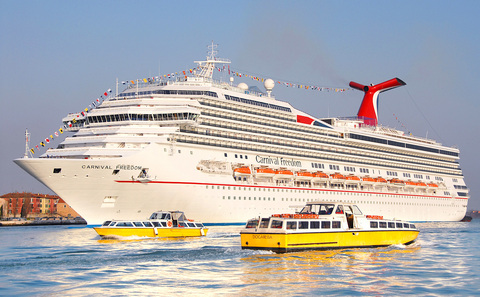
PHOTO: AGENCIES
All this has raised concerns about the impact ship waste could have on coastal waters. "Imagine how you would feel about 1,000 families tossing garbage onto your front lawn for a week," a California state senator, Joe Simitian, said.
On average, a cruise ship generates 529,957 to 794,936 liters of sewage and 3.8 million liters of wastewater from sinks, showers, and laundries each week, the US Commission on Ocean Policy reported in 2004. Sewage carries germs that can contaminate shellfish beds and harm other life, while phosphates, nitrates, and other wastewater compounds can trigger huge growths of algae that cloud the water, reduce oxygen, smother corals, and kill fish.
A ship can also produce more than 95,000 liters of oily bilge water from engines and machinery a week, according to a 2000 Environmental Protection Agency report. Moreover, cruise ships' fuel often contains sulfur dioxide, and ships sometimes incinerate garbage, releasing dioxins and fine particles that can trigger respiratory ailments, according to Russell Long, founder of the environmental group Bluewater Network.
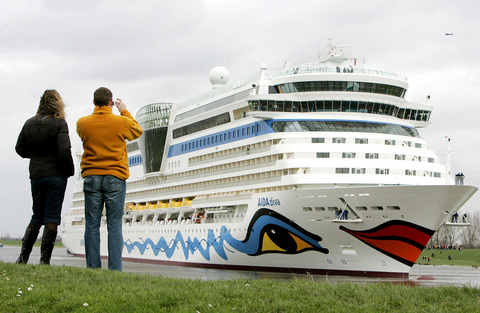
In 2001, the 21 members of the Cruise Lines International Association agreed not to release wastewater within 6.5km of shore. Still, violations happen.
In January, Celebrity Cruises paid US$100,000 to Washington state after its ship the Mercury violated an agreement and dumped more than 1.9 liters of untreated wastewater in the Strait of Juan de Fuca in 2005, a few kilomters from commercial shellfish beds. In 2002, the Crystal Harmony released 136,000 liters of wastewater into the Monterey Bay National Marine Sanctuary in California. Crystal Cruises disclosed it four months afterward.
"As a lifelong resident of the Monterey Bay area, I was angered by the actions of Crystal Cruises line when they dumped in our bay," said Representative Sam Farr, the area's congressman.
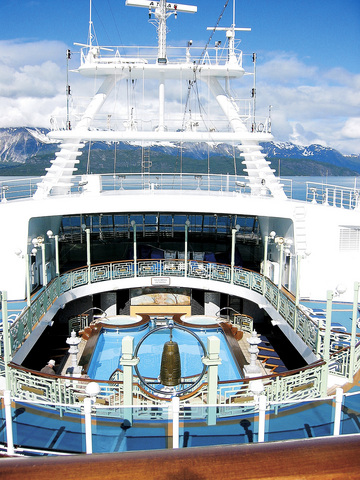
PHOTO: NY TIMES NEWS SERVICE
A Crystal Cruises spokeswoman, Mimi Weisband, said, "It was a terrible mistake, and contrary to our own policy to never discharge in any marine sanctuary." She noted that the discharge of the treated wastewater was legal, taking place 22.5km offshore, while maritime law allows the discharge of untreated wastewater 19km offshore.
The Crystal Cruises incident prompted Simitian, the state senator, to write what are now laws banning the release of sewage, oily bilge, or sewage sludge into California waters and prohibiting cruise ships from incinerating garbage within 5km of the state's shore. It also spurred Farr, a Democrat, to help write the Clean Cruise Ship Act, which would make it illegal for cruise ships to discharge any wastewater, treated or otherwise, within 22km of US shores, and would apply strict rules for discharging treated wastewater up to 370km off shore.
The bill was first introduced in 2004, and has been stymied for years. Farr plans to reintroduce it this spring.
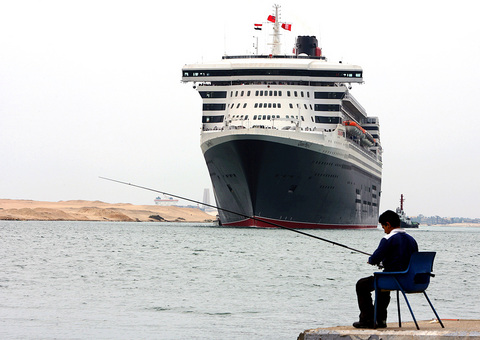
The Alaskan ocean ranger program, created by a ballot referendum passed in August, applies to ships with more than 250 passengers. This year, some 30 ships carrying an estimated 950,000 passengers will sail in Alaskan waters. The initiative requires that the rangers be marine engineers licensed by the Coast Guard who are also trained in wastewater treatment systems and environmental and public health rules.
The program will cost each passenger US$4, funds that will also pay for satellite transponders to track the ships' movements in and out of state waters. The US$4 tax is expected to draw in about US$3.6 million annually, and the ranger program is projected to cost roughly US$5 million a year.
A bill introduced in February would have ocean rangers inspect vessels only at port and not ride with them, for a program that would cost less than US$1 million annually. A vote is expected next month.

PHOTO: AP
In the face of all the outcry, the cruise industry has tried to show a commitment toward the environment. For instance, Celebrity Cruises voluntarily paid US$30,000 more than it had to for the Mercury incident. It also plans to spend more than US$50 million on improved wastewater purification systems for its nine ships.
"It happened because of human error, and we have very publicly taken responsibility for that situation," a Celebrity Cruises spokesman, Michael Sheehan, said of the Mercury incident. He also noted that Royal Caribbean Cruises, which operates Celebrity Cruises, has donated roughly US$10 million in the last 10 years to the Nature Conservancy, World Wildlife Fund, and other organizations through its Ocean Fund.
The International Council of Cruise Lines' executive vice president, Michael Crye, estimates that, so far, roughly 40 percent of its members' 130 ships, which make up two-thirds of the world fleet, have installed advanced wastewater systems, with 10 or 15 more added every year. Each system costs US$2 million to US$10 million a ship and takes six to 12 months to install. Crye said the advent of these new systems made the Clean Cruise Ship Act unnecessary.
Cruise lines are also experimenting with technology to reduce the amount of noxious chemicals that smokestacks release. Ships could also plug into shore power stations to reduce air emissions while in port, which is already happening in Alaska, Washington, and California, Crye added. He said it cost up to US$2 million to modify a ship this way, besides the costs to the port to build and maintain such installations.
Celebrity Cruises has four ships with gas-turbine engines, which release 80 percent to 95 percent less sulfur, fine particles, and nitrogen oxides, said Rich Pruitt, Royal Caribbean's director of environmental programs.
Other efforts include the Cruise Lines International Association's work with Conservation International scientists to develop a global map of coral reefs, shellfish beds, and other sensitive areas. The lines would then avoid discharging untreated wastewater within 6.5km of these places.
But some say more can be done. Teri Shore, the Bluewater Network's clean vessels campaign director, noted that while the advanced wastewater treatment systems are meeting legal criteria for removing germs from ship effluent, they do not treat contaminants like metals or nutrients.
To see how well new wastewater treatment systems actually work, the Environmental Protection Agency sampled wastewater from four large cruise ships in 2004 in Alaska. The data showed that they indeed seemed to remove germs, but "there are some questions we have on the nutrients and the metals," the agency's assistant administrator for water, Benjamin Grumbles, said.
The EPA is now testing the impact of wastewater nutrients and metals on marine life, and said it hoped to propose a ruling by the end of this year on whether it needs to set additional standards for waste discharges in Alaska.

Last week Joseph Nye, the well-known China scholar, wrote on the Australian Strategic Policy Institute’s website about how war over Taiwan might be averted. He noted that years ago he was on a team that met with then-president Chen Shui-bian (陳水扁), “whose previous ‘unofficial’ visit to the US had caused a crisis in which China fired missiles into the sea and the US deployed carriers off the coast of Taiwan.” Yes, that’s right, mighty Chen caused that crisis all by himself. Neither the US nor the People’s Republic of China (PRC) exercised any agency. Nye then nostalgically invoked the comical specter
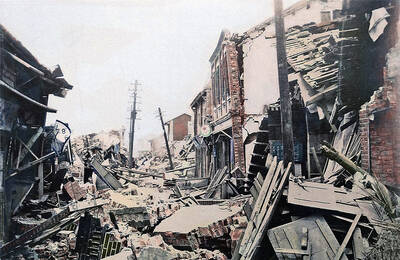
April 15 to April 21 Yang Kui (楊逵) was horrified as he drove past trucks, oxcarts and trolleys loaded with coffins on his way to Tuntzechiao (屯子腳), which he heard had been completely destroyed. The friend he came to check on was safe, but most residents were suffering in the town hit the hardest by the 7.1-magnitude Hsinchu-Taichung Earthquake on April 21, 1935. It remains the deadliest in Taiwan’s recorded history, claiming around 3,300 lives and injuring nearly 12,000. The disaster completely flattened roughly 18,000 houses and damaged countless more. The social activist and

Over the course of former President Ma Ying-jeou’s (馬英九) 11-day trip to China that included a meeting with Chinese Communist Party (CCP) leader Xi Jinping (習近平) a surprising number of people commented that the former president was now “irrelevant.” Upon reflection, it became apparent that these comments were coming from pro-Taiwan, pan-green supporters and they were expressing what they hoped was the case, rather than the reality. Ma’s ideology is so pro-China (read: deep blue) and controversial that many in his own Chinese Nationalist Party (KMT) hope he retires quickly, or at least refrains from speaking on some subjects. Regardless

Approaching her mid-30s, Xiong Yidan reckons that most of her friends are on to their second or even third babies. But Xiong has more than a dozen. There is Lucky, the street dog from Bangkok who jumped into a taxi with her and never left. There is Sophie and Ben, sibling geese, who honk from morning to night. Boop and Pan, both goats, are romantically involved. Dumpling the hedgehog enjoys a belly rub from time to time. The list goes on. Xiong nurtures her brood from her 8,000 square meter farm in Chiang Dao, a mountainous district in northern Thailand’s


 RSS
RSS