


Marnie Stern was onstage alone with her guitar in one among more than a thousand showcase concerts at the annual South by Southwest Music festival.
She wasn't exactly a typical singer-songwriter. Her guitar was electric; her backup band was an iPod clipped to a belt loop, and it blasted crashing, galloping drums and her own recorded guitars as she layered on frenetically repeating runs and slashing chords. "Connected, connections, connected, connections," she sang.
South by Southwest Music is four hyperactive days of making connections for musicians, recording companies and every other business touching on music, from concert bookers to copyright lawyers, publishers to Web geeks. Started in 1987 as a regional showcase, SXSW Music, as it is called, has grown into the US's largest music-business convention, with more than 10,000 registered attendees this year and many more hangers-on. For those four days, it seems, everyone is here because everyone else is here.
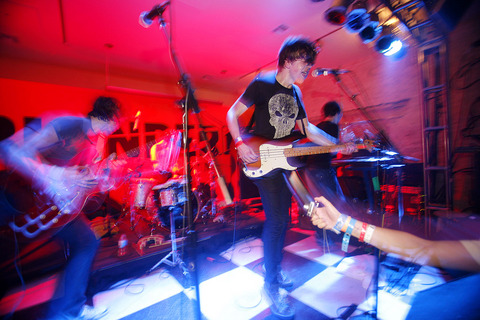
PHOTO: NY TIMES NEWS SERVICE
The Internet can now make every musician's demo recordings available at a click, but it doesn't proffer them with a smile and a handshake. As convention-goers filled the two club corridors of downtown Austin, East Sixth Street and Red River Street, their nametags invited new contacts.
From before noon to near dawn, musicians performed short sets at clubs, parties, amphitheaters, street corners, tents, backyards and probably hotel rooms, hoping to impress the right person and get their next deal. South by Southwest has become an increasingly international festival, with more than 20 percent of the performers from abroad.
One was Lonely China Day, a band from Beijing that brought a profoundly meditative tone to songs with lyrics from ancient Chinese poetry, inexorable guitar buildups that could appeal to fans of Sigur Ros, and twitches of electronic rhythm from a laptop.
There were government-supported delegations from Australia, Britain, Canada, Finland and Japan, among others. Many bands played multiple shows, sometimes two or three in an afternoon, like the Fratellis, a hearty Scottish trio who, when I saw them, strummed acoustic guitars and sang deft, catchy, 1960s-flavored songs about romantic ups and downs.
There were also hundreds of bands that had scraped together gas money, packed up vans and driven hundreds of miles to play for 40 minutes to clubs half full of people already considering the next set. And there was music for virtually every taste: doomy heavy metal (Zoroaster, Boris), supple Brazilian pop (Tita Lima), brutally innovative electronica (Amon Tobin) or charmingly nerdy indie-rock (Menomena).
While many of the bands were new — or relatively new, with a handful of albums on small labels — much of the music deliberately looked back. The Black Angels, from Austin, revived not only a Velvet Underground song title (The Black Angel's Death Song) but also the measured pace, ritualistic intensity and seething guitar of the Velvet Underground's drones, coupled with ominous incantations with echoes of Jim Morrison. The Besnard Lakes, from Montreal, drew on a more benevolent 1960s sound: the expansive, almost orchestral buildups of Brian Wilson and the Beatles' Hey Jude, so that songs with titles like Devastation and Disaster swelled into reassuring anthems.
Tokyo Police Club, a Canadian band whose oldest member is 21, reached back to the terse, kinetic structures of post-punk bands from the late 1970s like Wire and the Cure, while the Wombats, from Liverpool, merged punk-speed, guitar-charged pop, usually about love gone awry, with the oohs and ahs of Beach Boys harmony.
But there were also new twists on past styles. Maps & Atlases, from Chicago, packed the intricacies of progressive rock into much shorter attention spans. Black Moth Super Rainbow, from Pittsburgh, played pulsating, mesmerizing songs on vintage keyboards, with vocals filtered electronically through a vocoder, while animated videos unfurled in neo-psychedelic splendor overhead. Luminous Orange, from Yokohama, Japan, swerved between sunny pop melodies and unlikely but invigorating shifts of key and tempo. Illinois, a band from Pennsylvania, flaunted a banjo in rowdy songs that mingled Merseybeat rock, skiffle and punky absurdism.
This year SXSW had a stronger hip-hop presence, recognizing both the new prominence of Texas hip-hop — there was a packed 1am set by Devin the Dude, from Houston, a few days before the release of his new album — and hip-hop's long success as a street-level, do-it-yourself phenomenon. Public Enemy, which revolutionized hip-hop in the 1980s and 1990s, played one of the festival's free amphitheater shows, leading an audience of thousands in chants against US President George Bush.
In a music business that can no longer center itself on sales of hit CDs, even for the lucky few that have them, SXSW has thrived as musicians piece together careers in other ways: from touring, from selling their own music online, from licensing their songs to movies or advertisers. If the festival has an overall message, it's that musicians need to build their own support systems and hustle for themselves. For most musicians, performing rather than recording will be the bulk of a career, and with six sets a night in more than 60 clubs — along with countless affiliated and unaffiliated daytime and late-night shows — SXSW prizes live performances above all.
And is also a festival that celebrates perseverance as much as trendiness. At the Convention Center longtime musicians — Pete Townshend of the Who, Emmylou Harris, the Memphis soul mainstay Booker T. Jones, the Brazilian songwriter and minister of culture Gilberto Gil — spoke about careers, memories, ideas and inspiration. (Then Townshend went out and jammed as a surprise guest in the clubs.)
There were reunions of the Stooges, the Buzzcocks, the Saints and Booker T. and the M.G.'s. Mary Weiss, the lead singer of the Shangri-La's, was promoting a new album, and Stax Records celebrated its 50th anniversary with appearances by Isaac Hayes and William Bell. There was also a set by Jandek, the pseudonymous Texas who has released 49 albums on his own label since 1978 and didn't perform in public until 2004 — perhaps the most independent musician in a festival devoted to self-sufficiency.
Stern had another song that summed up South by Southwest's lessons: "Keep on!" she sang as her guitar lines ricocheted everywhere. "Keep at it!"

Last week Joseph Nye, the well-known China scholar, wrote on the Australian Strategic Policy Institute’s website about how war over Taiwan might be averted. He noted that years ago he was on a team that met with then-president Chen Shui-bian (陳水扁), “whose previous ‘unofficial’ visit to the US had caused a crisis in which China fired missiles into the sea and the US deployed carriers off the coast of Taiwan.” Yes, that’s right, mighty Chen caused that crisis all by himself. Neither the US nor the People’s Republic of China (PRC) exercised any agency. Nye then nostalgically invoked the comical specter

April 15 to April 21 Yang Kui (楊逵) was horrified as he drove past trucks, oxcarts and trolleys loaded with coffins on his way to Tuntzechiao (屯子腳), which he heard had been completely destroyed. The friend he came to check on was safe, but most residents were suffering in the town hit the hardest by the 7.1-magnitude Hsinchu-Taichung Earthquake on April 21, 1935. It remains the deadliest in Taiwan’s recorded history, claiming around 3,300 lives and injuring nearly 12,000. The disaster completely flattened roughly 18,000 houses and damaged countless more. The social activist and

Over the course of former President Ma Ying-jeou’s (馬英九) 11-day trip to China that included a meeting with Chinese Communist Party (CCP) leader Xi Jinping (習近平) a surprising number of people commented that the former president was now “irrelevant.” Upon reflection, it became apparent that these comments were coming from pro-Taiwan, pan-green supporters and they were expressing what they hoped was the case, rather than the reality. Ma’s ideology is so pro-China (read: deep blue) and controversial that many in his own Chinese Nationalist Party (KMT) hope he retires quickly, or at least refrains from speaking on some subjects. Regardless

Approaching her mid-30s, Xiong Yidan reckons that most of her friends are on to their second or even third babies. But Xiong has more than a dozen. There is Lucky, the street dog from Bangkok who jumped into a taxi with her and never left. There is Sophie and Ben, sibling geese, who honk from morning to night. Boop and Pan, both goats, are romantically involved. Dumpling the hedgehog enjoys a belly rub from time to time. The list goes on. Xiong nurtures her brood from her 8,000 square meter farm in Chiang Dao, a mountainous district in northern Thailand’s


 RSS
RSS