


While the world grieved for the Columbia crew lost Feb. 1, 2003, three lonely men in space had a somewhat more complicated reaction. They were the members of Expedition Six, two Americans and a Russian installed at the International Space Station. They had been there since the previous November, and they were getting ready to come home. But the Challenger disaster suspended space travel, so no new crew would arrive to relieve them in the foreseeable future. Suddenly they were stuck in a sci-fi limbo.
This crisis became the basis for an Esquire article in which Chris Jones recreated the experience of the three men: Donald Pettit, Captain Kenneth Bowersox and Nikolai Budarin. Jones focused tightly on this story, giving it both intimacy and suspense. Now, one National Magazine Award later (Jones won for feature writing in 2005), his longer, less assured version of Expedition Six's perilous journey has been turned into a book.
Like air in a vacuum, the story told in Too Far From Home expands to fill the boundaries it has been given. But it has lost its tight focus and some of its verve. Jones' efforts to provide context for Expedition Six yield more generic, less compelling historical detail about both the American and Russian space programs, as well as occasionally inflated prose about the lyrical loneliness of an astronaut's mission.

"Like every astronaut and every cosmonaut, from the first to the last, they were seen as something alien and wonderful, these ordinary assemblies of skin and tissue that had been turned into artifacts by virtue of the places they had been," he writes about the Expedition Six members, post-expedition. And: "Between expectation and reality, between flying and falling — between earth and space, between home and away — there will forever remain some kind of gap." Whatever this is, it isn't the right stuff.
With his book based largely on the astronauts' recollections ("NASA declined to help me out — for reasons I've never been able to fathom," Jones writes) and on data that is also well documented on the Web site Space.com, he must bring something unusual to what would otherwise be a relatively routine and mundane mix, despite the drama of Expedition Six's temporary dilemma.
So he concentrates on the you-are-there physical peculiarities of life in space. Oh, wow: Imagine what happens when someone puts Alka-Seltzer in a bubble-sphere of water under zero-gravity conditions. This account is actually at its best with space-trippy images of that kind.
Then there are the diapers. With no inkling about how notorious these would become, Jones makes diapers part of his detailed examination of how astronauts perform bodily functions in space. No spitting allowed: they have to swallow their toothpaste. Moisture from their sweat will eventually wind up in their tea.
Russian cosmonauts are too tough to wear diapers. Americans do, but the Expedition Six crew declined to use them once it had been determined that they would go home on an outmoded Russian capsule, the Soyuz TMA-1. That trip, which became a nail-biter, was supposed to be relatively brief.
"The American space program has traditionally paid little attention to the psychological health of its astronauts in space," Jones notes. But "there is strong evidence that spending a long time in space can make people crackers." Diapers and all, Too Far From Home is certainly prescient this way.
Still, in spite of potentially nerve-wracking claustrophobia and other strains, the Expedition Six team members stayed level-headed and sane.
"Bowersox was the firstborn brother," Jones writes. "He was reason and responsibility. Pettit was the wide-eyed kid who loved eating his drinks with chopsticks." (Pettit loved experimenting with fluids. His other efforts included that Alka-Seltzer trick.) "Budarin was the weird uncle from Russia." Although he spends much more time describing each of them, the author doesn't much deviate from those simple thumbnail descriptions.
Still, Jones finds ways to overstate each case. "Like Picasso going through his Blue period, Pettit had once been obsessed with clocks," he says of Pettit's ingenious tinkering. Much is also made of Budarin's revelation that a breakfast packet of dried strawberries, if soaked in water all day, would make a nice dinnertime dessert. "Another lesson learned, another trick revealed," Jones writes of this.
But he makes it clear that the astronaut world has needed to lose its daredevil edge, and that a new breed of calm, stoical, strawberry-soaking astronauts will help give a business-as-usual facade to great space leaps of the future.
At Edwards Air Force Base in California, where Tom Wolfe's test pilots created their legends in The Right Stuff and where Bowersox later trained as a test pilot, "the romance has been waived for reason," the book says. "And at the end of the day, today's students are far more likely to retire to the in-school lounge with their textbooks and a cup of coffee than to some dusty desert bar with black-and-white photographs of dead pilots on the wall."
For all the professionalism and sang-froid described in Too Far From Home, though, there remains a real, underlying sense of what makes astronauts so far removed from the ordinary. Even when performing routine repairs, an astronaut may gaze at his or her foot and see behind it a similar-sized object that turns out to be Australia.
Emotions in space are no less strange; they bring higher highs and lower lows. And the title Too Far From Home hints at the secret ambivalence that goes with this territory. At first glance, to the sentimental reader, the title may signify the loneliness of space travel. But when the men of Expedition Six returned to Earth, they missed their privilege and isolation. They were homesick here, too.
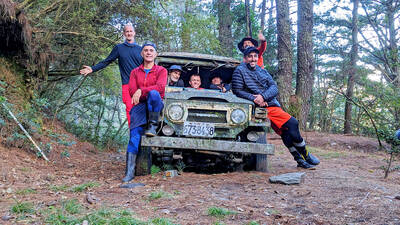
The year was 1991. A Toyota Land Cruiser set out on a 67km journey up the Junda Forest Road (郡大林道) toward an old loggers’ camp, at which point the hikers inside would get out and begin their ascent of Jade Mountain (玉山). Little did they know, they would be the last group of hikers to ever enjoy this shortcut into the mountains. An approaching typhoon soon wiped out the road behind them, trapping the vehicle on the mountain and forever changing the approach to Jade Mountain. THE CONTEMPORARY ROUTE Nowadays, the approach to Jade Mountain from the north side takes an

Last week Joseph Nye, the well-known China scholar, wrote on the Australian Strategic Policy Institute’s website about how war over Taiwan might be averted. He noted that years ago he was on a team that met with then-president Chen Shui-bian (陳水扁), “whose previous ‘unofficial’ visit to the US had caused a crisis in which China fired missiles into the sea and the US deployed carriers off the coast of Taiwan.” Yes, that’s right, mighty Chen caused that crisis all by himself. Neither the US nor the People’s Republic of China (PRC) exercised any agency. Nye then nostalgically invoked the comical specter

Relations between Taiwan and the Czech Republic have flourished in recent years. However, not everyone is pleased about the growing friendship between the two countries. Last month, an incident involving a Chinese diplomat tailing the car of vice president-elect Hsiao Bi-khim (蕭美琴) in Prague, drew public attention to the People’s Republic of China’s (PRC) operations to undermine Taiwan overseas. The trip was not Hsiao’s first visit to the Central European country. It was meant to be low-key, a chance to meet with local academics and politicians, until her police escort noticed a car was tailing her through the Czech capital. The
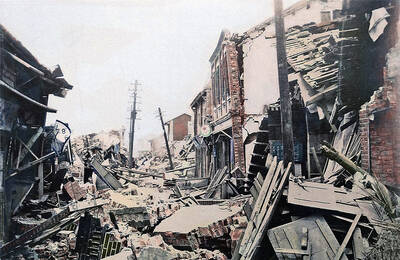
April 15 to April 21 Yang Kui (楊逵) was horrified as he drove past trucks, oxcarts and trolleys loaded with coffins on his way to Tuntzechiao (屯子腳), which he heard had been completely destroyed. The friend he came to check on was safe, but most residents were suffering in the town hit the hardest by the 7.1-magnitude Hsinchu-Taichung Earthquake on April 21, 1935. It remains the deadliest in Taiwan’s recorded history, claiming around 3,300 lives and injuring nearly 12,000. The disaster completely flattened roughly 18,000 houses and damaged countless more. The social activist and


 RSS
RSS