


Life and death. You cannot have one without the other. Both are on the program of Cloud Gate Dance Theater's (雲門舞集) spring program, which begins next Friday at the National Theater.
The beginnings of spring, the sudden bursting of cherry blossoms, are vivid reminders of life. Cloud Gate's performances will make you think about the joy of life, but also how ephemeral life is and about death.
Artistic director and founder Lin Hwai-min (林懷民) has put together a show that is very unlike any of the company's previous offerings. Its the first time Cloud Gate will be performing without one of Lin's creations, the first time that Cloud Gate 2 dancers will be performing at the National Theater, the first time that a non-Taiwanese has choreographed a work especially for Cloud Gate.
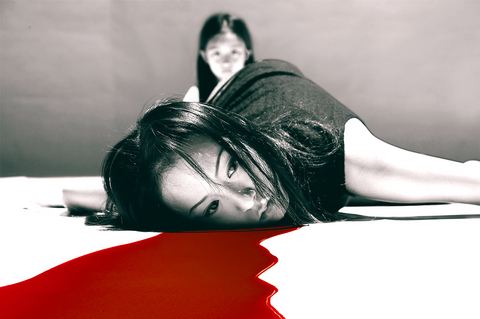
PHOTO COURTESY OF CLOUD GATE
For the first half of the program, the women of Cloud Gate Dance Theater will be performing in the world premiere of British choreographer Akram Khan's Lost Shadows. The second half will be Wu Kuo-chu's (伍國柱) 70-minute masterpiece, Oculus, performed by Cloud Gate 2.
Khan and Wu are young choreographers whose careers Lin has followed almost from the beginning. He said he wanted a different perspective this year: "Akram and Wu, they are really dealing with everyday life, speaking from a young person's point of view."
He had first asked Khan to do something for the company back in 2002, while Wu had choreographed On the Heights for the company in 2004, as well as several pieces for Cloud Gate 2.
Khan said Lin had told him "just do whatever you want."
He said he sketched out four or five plans: "Something based on a museum, on Lin Hwai-min's paintings … [I was] testing out ideas in workshops in other countries. The concept of death — how different people are with death."
He was looking for a story that would be both personal and universal. He said he had been influenced by the movie The Da Vinci Code — the power of the female, which is why he is only using women in the piece. British government advertisements against drunk driving were another source of inspiration.
"The story is based on one person who does not want to accept death but she is seeing her own body — she's in between heaven and earth — she's trying to figure out how she came to be in this crash, this accident," Khan said. "While she tries to replay what happened just before her death, she sees a friend who died. A car hit her — she didn't want to die, it was chosen for her — but she reminisces about her friend who committed suicide by running in front of train in childhood."
"She was running toward death, not knowing she was going to have an accident but her friend was running away from life," he said.
Khan said he frequently thinks about death — there's a lot of it in the world right now with the war in Iraq, bombings, other conflicts — but he's not morbid about it.
"For me it's a life, a form of therapy to create a piece of work — a way of dealing with what's happening in the rest of the world," he said. "In order to understand death you have to understand life. In order to understand life you have to understand death."
Death's shadow also hangs over the second work on the program, Oculus, but it the shadow of a life ended far too soon. Wu died in Taipei in January 2006 at age 36 after a 16-month battle with leukemia. He had taken the European dance world by storm in just a few short years. He as diagnosed with the disease just a few months after taking the job as artistic director of the Staatstheater Kassel Dance Company in Germany.
Lin wanted to stage Oculus as both a memorial to Wu and to help his youngest dancers, who were hit not only with the death of Wu, whom many saw as a big brother, but by the death of their company's founder and artistic director, Lo Man-fei (羅曼菲) a few months later. But even more, he wanted to ensure that more people have the chance to see Wu's work.
"It's [Oculus] a landmark work. I wanted to challenge those that come after him and challenge the dancers," he said. "When he passed away I invited three dancers from Kassel — classmates and friends from Essen — to come last summer for three weeks of intensive rehearsal."
"Wu was born in southern Taiwan, a lower middle-class family — you don't expect anyone from that village to become a great artist … he had such energy … he was so young," Lin said.
He also came to dance in a very roundabout way. Wu was a theater major at university and didn't start his dancing career until he entered the Folkway Hochshule in Essen, Germany, at 24. He began choreographing at 27.
"He was a fatso. He started dance classes at university to lose weight," Lin said. "He got the theater department kids to take ballet — this fat guy really struggled at the bar — even in his last days he loved ballet … he would come out of the hospital to give Cloud Gate 2 ballet class. He would plead with the doctors, we would send a car for him."
"He was wonderfully sensitive to music — very rare among young choreographers," Lin said.
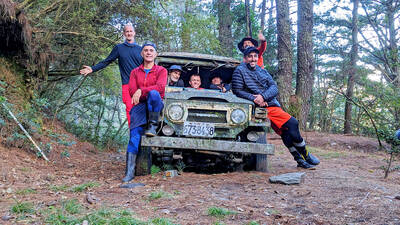
The year was 1991. A Toyota Land Cruiser set out on a 67km journey up the Junda Forest Road (郡大林道) toward an old loggers’ camp, at which point the hikers inside would get out and begin their ascent of Jade Mountain (玉山). Little did they know, they would be the last group of hikers to ever enjoy this shortcut into the mountains. An approaching typhoon soon wiped out the road behind them, trapping the vehicle on the mountain and forever changing the approach to Jade Mountain. THE CONTEMPORARY ROUTE Nowadays, the approach to Jade Mountain from the north side takes an

Last week Joseph Nye, the well-known China scholar, wrote on the Australian Strategic Policy Institute’s website about how war over Taiwan might be averted. He noted that years ago he was on a team that met with then-president Chen Shui-bian (陳水扁), “whose previous ‘unofficial’ visit to the US had caused a crisis in which China fired missiles into the sea and the US deployed carriers off the coast of Taiwan.” Yes, that’s right, mighty Chen caused that crisis all by himself. Neither the US nor the People’s Republic of China (PRC) exercised any agency. Nye then nostalgically invoked the comical specter

Relations between Taiwan and the Czech Republic have flourished in recent years. However, not everyone is pleased about the growing friendship between the two countries. Last month, an incident involving a Chinese diplomat tailing the car of vice president-elect Hsiao Bi-khim (蕭美琴) in Prague, drew public attention to the People’s Republic of China’s (PRC) operations to undermine Taiwan overseas. The trip was not Hsiao’s first visit to the Central European country. It was meant to be low-key, a chance to meet with local academics and politicians, until her police escort noticed a car was tailing her through the Czech capital. The
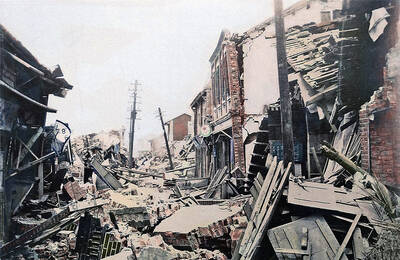
April 15 to April 21 Yang Kui (楊逵) was horrified as he drove past trucks, oxcarts and trolleys loaded with coffins on his way to Tuntzechiao (屯子腳), which he heard had been completely destroyed. The friend he came to check on was safe, but most residents were suffering in the town hit the hardest by the 7.1-magnitude Hsinchu-Taichung Earthquake on April 21, 1935. It remains the deadliest in Taiwan’s recorded history, claiming around 3,300 lives and injuring nearly 12,000. The disaster completely flattened roughly 18,000 houses and damaged countless more. The social activist and


 RSS
RSS