


It is easy to pinpoint the exact moment when I realized West Africa was ready to shed its backpacker haven image and embrace a new kind of traveler. I was sitting on a beach at the mouth of the Saloum River, a smoky grilled oyster in one hand, glistening in its charred shell, a glass of muscadet in the other.
I was in the Sine Saloum Delta, a glorious melding of river, earth and sea just north of Senegal's border with the Gambia, where a handful of hotels have sprung up in the last five years, drawing a new set of travelers.
West Africa has for decades been the province of backpackers — the place to go for life-altering journeys filled with US$2-a-night hotels, interminable, jouncing journeys in the back of bush taxis on rutted back roads and gorp for lunch and mystery meat stew for dinner. I made many such journeys myself as a high school student living in Ghana in the early 1990s. But the big-money tourists went east or south for the big game safaris and the luxury resorts on the Indian Ocean and the Cape.
PHOTOS: NY TIMES NEWS SERVICE
But in West Africa today, in places like Ghana, Benin, Mali and especially Senegal, travelers are searching for the other Africa — more Wole Soyinka and Leopold Senghor than Isak Dinesen and Ernest Hemingway — are finding new and surprisingly sumptuous options.
The Sine Saloum Delta region of Senegal is perhaps the best embodiment of the trend, mostly around the town of Palmarin, a collection of villages on a narrow strip of land between the Atlantic Ocean and Saloum River. On a recent trip to the delta, my partner, Candace Feit, and I spent a few days comparing two very different but quite luxurious lodges that have sprouted between the river and the sea and plying the mangrove-lined tributaries in massive wooden boats, spotting birds and eating oysters plucked straight from the brackish water.
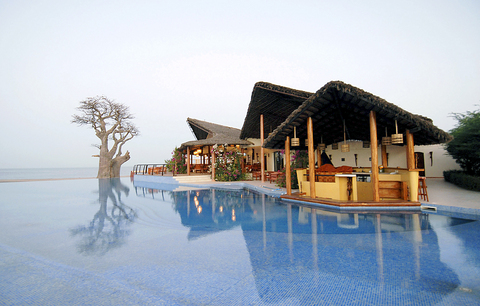
Our first stop, the Royal Lodge, was a spare-no-expense collection of sprawling suites in thatch-roof bungalows beside a broad beach. The cavernous suites were divided into three spaces of equal gigantitude: a sitting room, bedroom and a showstopper bathroom, complete with a whirlpool tub that looked big enough for a family of four.
With its infinity pool, swim-up bar and oceanfront location, the Royal Lodge is a state-of-the-art beach resort, but few people come here for the beaches, which are nice enough, but nothing compared with the breathtaking scenery. The delta is a place of ethereal beauty: the still, snaking branches of mangrove-lined tributaries, thick with herons, ibises and pelicans; the eerie stands of baobab trees, those mighty symbols of Africa with their gnarled, finger-like branches; the spongy expanses of marshy earth crisscrossed by the pitchfork feet of a million birds.
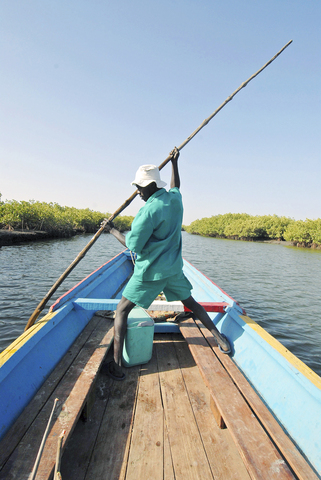
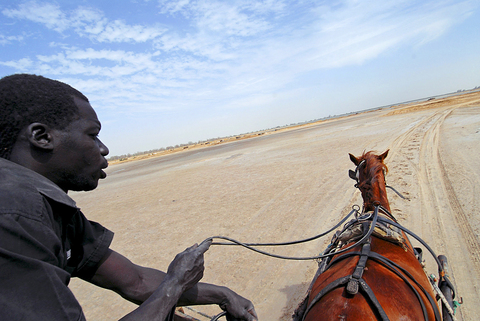
With that in mind, we hired a horse-drawn cart and a guide named Simon Mbissane Ndiaye through the hotel to take us on a ride through the countryside to a pirogue, a type of wide, colorful fishing boat used all over Senegal, for a cruise. Our cart quickly veered off the main road and into the Palmarin nature preserve, a vast and rich tapestry of plants and animals.
We weaved our way through an otherworldly landscape of salt pits, huge craters dug by local villagers — mostly women — who harvest the crystalline hunks that cling to the earth as water evaporates. Each pool has a different hue. Some are the color of melted butter, others deep ocher, still others in shades of pistachio and peach, a bizarre and mesmerizing palette created by soil, minerals and microscopic plants.
Just past a majestic grove of baobabs our pirogue waited in the shallows to take us to the Isle de Sangomar, a spit of sand that sits between the river and the sea. It used to be part of the mainland, but a big storm in 1987 lacerated the coast and washed away the sandbar connecting the town of Djifer with what had been Pointe de Sangomar, Ndiaye told us.
The remains of the sandbar form a gorgeous beach of smooth, white sand on the river side of the island, lapped by gentle waves perfect for lazy lolling. Rougher surf pounds the other side of the island, and at its heart stands a sacred baobab, used by sorcerers and storytellers of the Serer people, who dominate this region, as a source of inspiration.
On the way back from the island, we raced against the setting sun and retreating tide to return to our horse cart. The water was shallow, and the boat could barely clear the bottom in some spots. In the limpid water, we could see silvery schools of fish darting away from the birds drawn out by the cool air of dusk. Ibises and sunbirds swooped through the air, and white cranes divebombed the glassy surface of the water, seeking fish below. Though we had not intended to take a sunset cruise, visiting the mangroves at dusk was one of the highlights of the trip.

After a couple of nights in the over-the-top luxury of the Royal Lodge we were ready for a change of pace and checked into the Lodge des Collines de Niassam, an eco-lodge nestled on a particularly idyllic tributary of the Saloum.
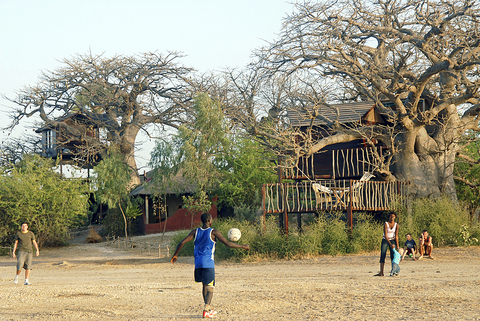
Built by a French couple about five years ago, the lodge was designed to have minimal impact on the fragile ecosystems around it but also to maximize luxury and style. The rooms are either tree houses built into the baobab trees, low huts on stilts built over the river or adobe-like bungalows carved into the low hillocks on which the lodge is built.
The decor owes a serious debt to Bali, from which much of the furniture and a lot of the fabrics were imported, but the main star is the stunning scenery. Each room is designed to take full advantage of the sweeping views, and none disappoint. Having stayed in the waterfront rooms several times on previous visits, we opted for a tree house.
We set out for our second boat trip, this time with Lamine Doudou Diom, who works at the lodge and learned about the local fauna and flora from his father, who is a healer. As he pushed our pirogue off a sandbar, he explained that the mangroves are the domain of the women who catch small fish and collect clams and oysters in the placid waters. “The sea is for men, but the mangrove is for women,” he said.
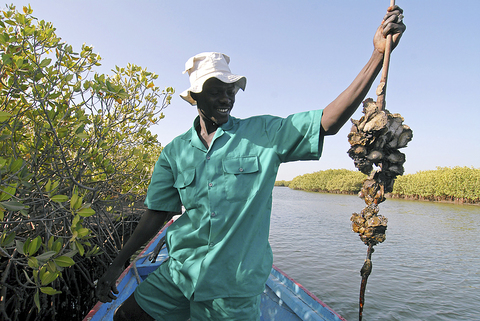
The tide was very low, and the knobby roots of the mangroves hung exposed, their branches encrusted with oysters and tiny mussels. Diom grabbed one branch and yanked it off, hauling the algae-coated treasure aboard. The boat's captain added to the stash, and we were off to a secluded beach, where Diom built a fire then grilled the oysters on the open flame. Some came out of the shell brown and chewy, infused with woody flavor, while others glistened with just a hint of smoke, each as fresh and delicious as the next. The pile of oyster shells grew, the bottle of muscadet emptied, and we soon boarded the boat to head back.
At the lodge, lounging is the order of the day, and the indoor and outdoor spaces are designed for it. Shaded cabanas line the small swimming pool, and strategically placed deck chairs and hammocks invite peaceful contemplation.
But we chose to take a long walk instead, heading west toward the setting sun. As the sun dipped and the day's heat receded, birds came alive, flitting from the ancient baobabs to the glassy surface of the water. I kicked off my flip-flops and let my toes sink into the primordial ooze. Tendrils of black mud snaked between my toes, sending forth this the essence of this beguiling place, redolent of salt, earth and sky.
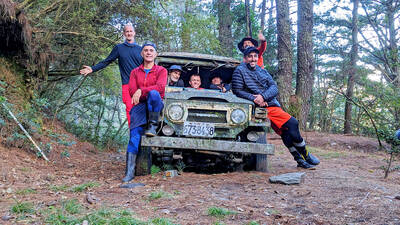
The year was 1991. A Toyota Land Cruiser set out on a 67km journey up the Junda Forest Road (郡大林道) toward an old loggers’ camp, at which point the hikers inside would get out and begin their ascent of Jade Mountain (玉山). Little did they know, they would be the last group of hikers to ever enjoy this shortcut into the mountains. An approaching typhoon soon wiped out the road behind them, trapping the vehicle on the mountain and forever changing the approach to Jade Mountain. THE CONTEMPORARY ROUTE Nowadays, the approach to Jade Mountain from the north side takes an

Relations between Taiwan and the Czech Republic have flourished in recent years. However, not everyone is pleased about the growing friendship between the two countries. Last month, an incident involving a Chinese diplomat tailing the car of vice president-elect Hsiao Bi-khim (蕭美琴) in Prague, drew public attention to the People’s Republic of China’s (PRC) operations to undermine Taiwan overseas. The trip was not Hsiao’s first visit to the Central European country. It was meant to be low-key, a chance to meet with local academics and politicians, until her police escort noticed a car was tailing her through the Czech capital. The

Last week Joseph Nye, the well-known China scholar, wrote on the Australian Strategic Policy Institute’s website about how war over Taiwan might be averted. He noted that years ago he was on a team that met with then-president Chen Shui-bian (陳水扁), “whose previous ‘unofficial’ visit to the US had caused a crisis in which China fired missiles into the sea and the US deployed carriers off the coast of Taiwan.” Yes, that’s right, mighty Chen caused that crisis all by himself. Neither the US nor the People’s Republic of China (PRC) exercised any agency. Nye then nostalgically invoked the comical specter
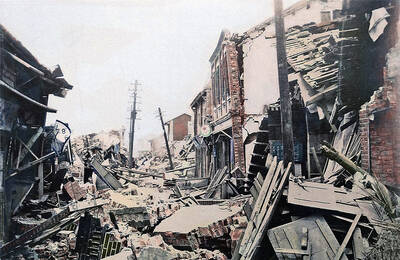
April 15 to April 21 Yang Kui (楊逵) was horrified as he drove past trucks, oxcarts and trolleys loaded with coffins on his way to Tuntzechiao (屯子腳), which he heard had been completely destroyed. The friend he came to check on was safe, but most residents were suffering in the town hit the hardest by the 7.1-magnitude Hsinchu-Taichung Earthquake on April 21, 1935. It remains the deadliest in Taiwan’s recorded history, claiming around 3,300 lives and injuring nearly 12,000. The disaster completely flattened roughly 18,000 houses and damaged countless more. The social activist and


 RSS
RSS