


The novel came into being with nothing but novelty to recommend it. Classical precedents were lacking: it disparaged epic swagger, and democratized the haughty seriousness of tragedy. It even flirted with the demolition of literature, since novels could be written by characters who — like Defoe's Crusoe keeping his diary or Richardson's Pamela scribbling her correspondence — were not writers at all. From the first, novelists had to double as theorists, defining and justifying their heterodox form. Cervantes in Don Quixote examines the glories and fallacies of chivalric romance, and Fielding in Tom Jones interrupts the story with essays that explain the mock heroic procedures of his storytelling.
Milan Kundera has inherited that wittily self-conscious duality. His novel Immortality, for instance, is about the immortality of the novel, which throughout the 20th century kept alive the idea of individuality, defying ideologies that insisted on "service of the collective life" and a docile "uniformity of being." Isabel Archer in The Portrait of a Lady bravely sets out to discover her destiny; Mrs. Dalloway whimsically insists on buying the flowers herself. Such initiatives sum up what Kundera sees as the gospel of the form: novels preserve and validate the unpredictability of human behavior. They show that truth is relative, and therefore remind us why fiction is necessary.
The English novel begins, thanks to Defoe and Richardson, with semi-literate individuals telling their stories, which the novelists merely edit. Character breaks free from narrative and, as Kundera says in this zigzagging history of the form, "appropriates total freedom of speech."

The tyrannical author is "dethroned," in a revolution that is at once political and aesthetic. We are introduced to "a carnival of separate truths," a playground of "lovely lunacies." Mrs. Shandy, mentally unsynchronized with her husband, interrupts their love-making to ask if he has wound up the clock. Dickens's Uncle Dick babbles about King Charles' severed head, while Mrs. Gamp erects her infinitely extensible umbrella. In a happy accident organized by Rushdie at the beginning of The Satanic Verses, a jumbo jet explodes above London, extruding two characters who float unharmed to earth, delighting in the cosmic chaos that the bomb has revealed to them.
The curtain of Kundera's title is the veil of prejudice or pre-interpretation that occludes our view of reality. It is thick and stiff, "woven of legends"; Cervantes tore through it when he released Don Quixote from romance into a world of nakedly comical prose, and this "destructive act" is the creative boon of "every novel worthy of the name." Only by ripping the curtain can novelists ask the existential questions about truth, identity and love that define the form. Those questions can never be answered: humor or irony require us to be content with ambiguity, to accept the apparent absence of meaning. The laughter Kundera extols in his novel The Book of Laughter and Forgetting welcomes imperfection and incompleteness. In a nudist colony, Kundera's heroine Edwige surveys the bodies and says that, despite their paunches and puckering, all are beautiful. Nature, like the novel, is instinctively irregular, smilingly impartial.
George Eliot regretted the "spots of commonness" that defaced her characters, but to Kundera, such ordinary defects establish our human commonality and enroll us in a community of feeling: Sancho Panza, though heartbroken, is of good cheer while keeping a vigil at the deathbed of Don Quixote.
Novels insist on "the beauty of modest sentiments," and the novel is therefore the chosen art form of what Kundera, remembering his early life in Czechoslovakia, calls "small nations." Ignoring the canonized literary traditions of England and America, he makes an unexpected connection between Central Europe and Latin America, "two neglected, disdained, abandoned lands," where reality warps into magic in the novels of Kafka and Broch or Garcia Marquez and Fuentes.
Novels are skeptical about the grandiose controllers of human history. The battle of Waterloo is mere marginal noise in Thackeray's Vanity Fair; the fear of a French invasion mobilizes the troops in Pride and Prejudice and incites an erotic tizz in the Bennet household, but Napoleon is never mentioned. "The novelist," Kundera says, "is never a valet to historians," and this skepticism about the heroic agenda set by generals and politicians secretly helped the cause of subversion in Kundera's oppressed corner of Europe. Hence the Czech fondness for the deserter in Hasek's The Good Soldier Schweik, who ingeniously flouted the dictates of the Habsburg Empire. Kundera praises novels for mocking epic, and for deriding poetry. They are "anti-lyrical" because they refuse to believe in the rhapsodic hysteria that "feeds festivals and massacres alike and turns individuals into ecstatic mobs."
Kundera also credits the novel with releasing us from the heady delusion of tragedy, with its emphasis on definitive, self-deifying actions (which usually involve a showy suicide). He describes tragic protagonists as fanatics who "totally identify with the convictions for which they are prepared to die, and do die." This stray remark suggested to me that Shakespeare's tragedies are actually novels. Hamlet has opinions not convictions, and even in his last moments is not prepared to die. Cleopatra knows that death is the only way of avoiding public disgrace, but slyly seeks for "easy ways to die," and ensures that the one she chooses will cause no pain and leave her body unscathed.
The characters of tragedy kill themselves in acts of boastful bravado, like Hedda Gabler aiming her father's dueling pistol at her own head. But Tolstoy, when describing how Anna Karenina kills herself by jumping under a train, emphasizes "the prose of a suicide" and its sober, untheatrical practicality. Anna approaches her death as a technical problem to be solved, with the minimum of fuss. She has to collaborate with the train as it lurches past, inserting herself between the carriages at just the right moment; her first attempt fails because she takes fractionally too long to remove a bag from her arm.
As a victim of East European bureaucracy, Kundera has good reason to despise the clerical strictures of "literary bureaucrats," by whom he means academic critics. His theorizing here is playful, delightfully provisional: lightness may be unbearable as a condition of being, but levity is the leaven of his writing. At times he gives up explaining and instead simply exclaims, voicing an aesthetic wonder and gratitude censured by those who profess literature in universities. Mentioning Smetana's string quartets, he inserts an appreciative parenthesis: "splendid!" Even more eloquently, in a climactic passage about the audacity of the modern novel, he allows words to fail him: "And Ulysses!" he says, leaving the exclamation mark to convey his reverence for it. He reduces me to the same blissful burbling. Ah, Kundera!

In late October of 1873 the government of Japan decided against sending a military expedition to Korea to force that nation to open trade relations. Across the government supporters of the expedition resigned immediately. The spectacle of revolt by disaffected samurai began to loom over Japanese politics. In January of 1874 disaffected samurai attacked a senior minister in Tokyo. A month later, a group of pro-Korea expedition and anti-foreign elements from Saga prefecture in Kyushu revolted, driven in part by high food prices stemming from poor harvests. Their leader, according to Edward Drea’s classic Japan’s Imperial Army, was a samurai

Located down a sideroad in old Wanhua District (萬華區), Waley Art (水谷藝術) has an established reputation for curating some of the more provocative indie art exhibitions in Taipei. And this month is no exception. Beyond the innocuous facade of a shophouse, the full three stories of the gallery space (including the basement) have been taken over by photographs, installation videos and abstract images courtesy of two creatives who hail from the opposite ends of the earth, Taiwan’s Hsu Yi-ting (許懿婷) and Germany’s Benjamin Janzen. “In 2019, I had an art residency in Europe,” Hsu says. “I met Benjamin in the lobby
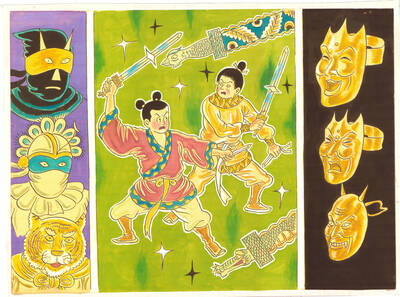
April 22 to April 28 The true identity of the mastermind behind the Demon Gang (魔鬼黨) was undoubtedly on the minds of countless schoolchildren in late 1958. In the days leading up to the big reveal, more than 10,000 guesses were sent to Ta Hwa Publishing Co (大華文化社) for a chance to win prizes. The smash success of the comic series Great Battle Against the Demon Gang (大戰魔鬼黨) came as a surprise to author Yeh Hung-chia (葉宏甲), who had long given up on his dream after being jailed for 10 months in 1947 over political cartoons. Protagonist

A fossil jawbone found by a British girl and her father on a beach in Somerset, England belongs to a gigantic marine reptile dating to 202 million years ago that appears to have been among the largest animals ever on Earth. Researchers said on Wednesday the bone, called a surangular, was from a type of ocean-going reptile called an ichthyosaur. Based on its dimensions compared to the same bone in closely related ichthyosaurs, the researchers estimated that the Triassic Period creature, which they named Ichthyotitan severnensis, was between 22-26 meters long. That would make it perhaps the largest-known marine reptile and would


 RSS
RSS