


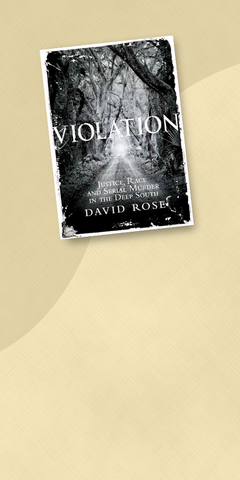
Fifteen pages before the end of Violation, David Rose tells us that he has been asked "innumerable times" whether he believes the death row protagonist of his book is innocent. "It is," he writes, "the wrong question to ask." We should consider instead whether Carlton Gary received a fair trial, he suggests; we should wonder if there is enough evidence not to prove his innocence but to introduce a reasonable measure of doubt as to his guilt. Rose's answers to these questions are unequivocal — the story is about a miscarriage of justice — and yet, as he must know, by this point his reader has grappled with "the wrong question" for some time.
In 1977 and 1978, in an elite white enclave of Columbus, Georgia, seven elderly women were brutally raped and murdered by a criminal who became known as the "stocking strangler." Carlton Gary, a young black man who had been imprisoned for armed robbery and investigated for more serious crimes, was believed to have been associated with all seven murders. In 1986 he was convicted of three.
The story affords Rose an ideal prism through which to view race relations in that part of the South. Columbus is the home of Coca-Cola (and its affluence), the home of blues singer Ma Rainey (and affluence's opposite), the birthplace of Carson McCullers, who wrote about that gap. In alternating the details of the search for the stocking strangler with racist crimes since the Civil War, Rose makes a persuasive case that it would be difficult for an African-American to get a fair trial in that town with that collective memory. The man appointed to bring the strangler to justice is the son of the leader of a famous lynch mob; many of the victims, and the lawyers, were members of a racist country club; Rose buys a reactionary history of the Civil War and finds inside it a business card for a white supremacist organization. Rose writes eloquently of "buried values" and "arbitrary power." While Gary's guilt was certainly not established beyond a reasonable doubt, and though Rose reveals the astounding impropriety with which evidence and funds were withheld from the defense, Carlton Gary looks — even quite late in the book — like the right man caught by the wrong means. The jury heard, for instance, how in Syracuse, New York in 1970 Gary had been involved in the rape and murder by strangling of an elderly woman; Gary had claimed to have been acting merely as a lookout while his buddy went in and robbed the place, and that he had no idea such a crime would be committed. His friend was tried for the murder, and acquitted. In January 1977 another older woman named Jean Frost survived a similar attack in Syracuse. A valuable watch was among items stolen from her apartment. She could not identify the perpetrator, she said, because she passed out from the strangling, but two days later Gary was arrested in Syracuse for an unrelated theft. When he turned out his pockets, Jean Frost's watch was there.
On this occasion, too, Gary claimed he had been the lookout for a more violent friend. Questioned by the police in 1984 about the stocking stranglings, Gary reportedly offered a similar defense: he had been there, but he had not committed the crimes. That violent friend was a third person, Malvin Alamichael Crittenden, whom he referred to as "Michael." Michael was also the name Gary himself often went by. Either — though Rose does not suggest this — he was presenting a Jekyll and Hyde explanation for his own actions, or he had exceptionally poor taste in friends. The fact that the crimes, committed in different parts of the country where Gary happened to be, were so similar lends little credence to the idea of three different perpetrators — all, coincidentally, friends of Gary.
Rose, however, expertly unpicks the prosecution's line on all of this. He has hard evidence to refute it — the criminal histories of Gary's supposed co-conspirators, new forensic tests to show his semen doesn't match that found at the crime scenes, a cast of the killer's distinctive and different teeth from a bite mark on the last victim's breast, footprints several sizes smaller than Gary's feet — and he offers less tangible evidence to show how Gary might have been framed: tapes Gary claims were made of his police statement were said never to have existed yet were referred to in the margins of police files; matching fingerprints the police claimed to have found at the crime scenes were never, as was procedure, photographed in situ.
If anyone knows what he is doing in a case such as this one, it is Rose, who has made a distinguished career as a reporter of miscarriages of justice. He first went to Columbus, Georgia to write a piece for the Observer, and spent eight years working on this book, sometimes — as he points out — jeopardizing his independence as a journalist in an attempt to have a significant effect on Gary's case. He was appointed a paralegal investigator by Gary's appeal lawyers, and visited Gary on death row a number of times. These scenes — of Rose and Gary locked, according to prison regulations, in a narrow room from 9am to 3pm — are among the most evocative of the book's many jaw-dropping interviews, and one is stunning. In the absence of official permission to collect Gary's semen for a new forensic test, Rose takes it upon himself to ask for some in person, returning to his hotel with a strong-smelling package of clingfilm, which he duly allows to dry on his desk before FedExing it to a lab.
The result of all this is a dazzlingly reported, supremely elegant book of scholarly confidence. Yet at times when the discomfort level rises (Gary sends jokes and drawings to Rose's children), you can't help wondering: of all the people awaiting execution who might benefit from Rose's expertise, why does Gary deserve this special treatment?
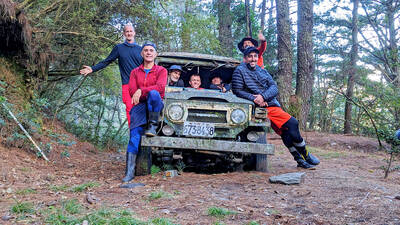
The year was 1991. A Toyota Land Cruiser set out on a 67km journey up the Junda Forest Road (郡大林道) toward an old loggers’ camp, at which point the hikers inside would get out and begin their ascent of Jade Mountain (玉山). Little did they know, they would be the last group of hikers to ever enjoy this shortcut into the mountains. An approaching typhoon soon wiped out the road behind them, trapping the vehicle on the mountain and forever changing the approach to Jade Mountain. THE CONTEMPORARY ROUTE Nowadays, the approach to Jade Mountain from the north side takes an

Relations between Taiwan and the Czech Republic have flourished in recent years. However, not everyone is pleased about the growing friendship between the two countries. Last month, an incident involving a Chinese diplomat tailing the car of vice president-elect Hsiao Bi-khim (蕭美琴) in Prague, drew public attention to the People’s Republic of China’s (PRC) operations to undermine Taiwan overseas. The trip was not Hsiao’s first visit to the Central European country. It was meant to be low-key, a chance to meet with local academics and politicians, until her police escort noticed a car was tailing her through the Czech capital. The

Last week Joseph Nye, the well-known China scholar, wrote on the Australian Strategic Policy Institute’s website about how war over Taiwan might be averted. He noted that years ago he was on a team that met with then-president Chen Shui-bian (陳水扁), “whose previous ‘unofficial’ visit to the US had caused a crisis in which China fired missiles into the sea and the US deployed carriers off the coast of Taiwan.” Yes, that’s right, mighty Chen caused that crisis all by himself. Neither the US nor the People’s Republic of China (PRC) exercised any agency. Nye then nostalgically invoked the comical specter
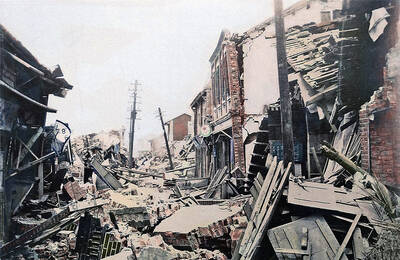
April 15 to April 21 Yang Kui (楊逵) was horrified as he drove past trucks, oxcarts and trolleys loaded with coffins on his way to Tuntzechiao (屯子腳), which he heard had been completely destroyed. The friend he came to check on was safe, but most residents were suffering in the town hit the hardest by the 7.1-magnitude Hsinchu-Taichung Earthquake on April 21, 1935. It remains the deadliest in Taiwan’s recorded history, claiming around 3,300 lives and injuring nearly 12,000. The disaster completely flattened roughly 18,000 houses and damaged countless more. The social activist and


 RSS
RSS