


Sometimes you need to step back to move forward and Italian art, if we are to believe curator Alessandro Riva, has recently done this. The result is a brand new school of art called "Italian Factory" and its impact can be judged at an exhibition currently being held at the Taipei Fine Arts Museum (TFAM).
Riva is one of a contemporary breed of curators, arguably as important as the artists he represents. The critic and journalist said he coined the term Italian Factory in 2003 to describe a less intellectual and more classical approach to the production of art in his home country.
He said the name works like a trademark, or a company logo because it supports the creation of events — such as The New Italian Art Scene show at TFAM — and advertising campaigns around the world. There have already been Italian Factory exhibitions in Italy, Madrid, Tokyo, Shanghai and elsewhere.
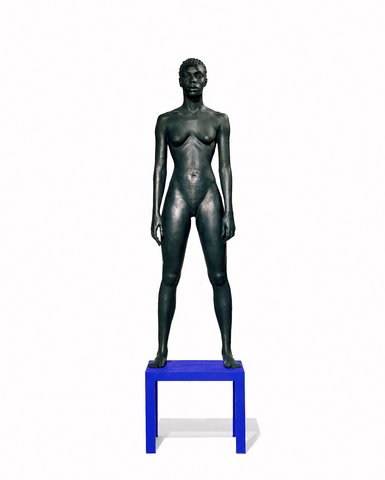
"Italian Factory is not so much a group as a feeling. Actually the movement existed before the name and as a critic I have followed the development of these artists up to this point," Riva said last weekend at the exhibition opening, which comprises 47 works from 10 painters and sculptors.
"They are the generation after the baby boomers and are concerned with the renewal of traditional languages. They are very interested in the technical aspects of production. They are a new pop generation but are not like [US artist Jeff] Koons, as they have a different way of seeing."
According to Riva, his stable of artists have "taken from the media, comics and other sources but have returned to the material." They are also recognizably Italian in terms of the content of their works and their return to Renaissance, 17th- and 20th-century forms of painting and sculpting.

PHOTOS COURTESY OF TFAM
As an example, he pointed to Livio Scarpella and his polychrome terracotta figurines such as the Baby series: Baby Killer holds a handgun, surrounded by knives, mobile phones and a pair of handcuffs; Baby Gay's testicles rest on a pink cushion and he is caught guiltily applying makeup; Baby China is Asian-looking and appears to be unhappy with his toys, models of Mao Zedong (毛澤東) and Mary, mother of Jesus Christ.
"They seem to be traditional terracotta models," Riva said. "They look as if they were made by an artisan but the content is borrowed from pop culture and therefore the works are a new twist on an old idea. This is typical of Italian Factory."
Moving on to Giulio Durini, Riva said the artist's works, mainly oil on canvas, hark back to Renaissance portraiture in terms of coloration and concentration on the nude figure. However, all Durini's paintings feature males who are overtly homosexual and modern in their attitudes. They pose like fashion models.
Giovanni, for example, sits spread-eagled on a chair, languidly staring at the viewer. His genitalia are the focus of the picture and due to foreshortening are nearly as big as his face. This makes the painting particularly modern in its nod to pornography and homoeroticism, according to Riva.
Aron Demetz's life-sized figures made of lime wood are given an aluminum skin, so they appear to be part man, part machine (as in the movie I, Robot). Some have red paint smeared over them, representing blood or a return to the earth, according to the artist.
"They look almost perfect don't they? But the red color suggests they are still human and the idea of my statue Purification is that he has feet of clay," Demetz said.
While a lot of Italian art in the past seems inextricably linked with Catholicism, the themes of Italian Factory owe more to globalization, the environment, contemporary culture and experimentation. For instance, Alessandro Busci's Central Rosso is a blaze of enamel on iron and incorporates rust to emphasize the industrial nature of his landscape painting.
The sublime natural landscapes of Enrico Lombardi are almost primitive in their simplicity, but have a 21st-century feel because of their palette, composition and aesthetic. The same conceit is seen in the works of Mauro Reggio and Marco Petrus, who appear to borrow from the futurist school but have brought it up to date.
For the director of TFAM Huang Tsai-lang (黃才郎), Italian Factory "creates a bridge between the modern and contemporary to present new creative ideas and authentic artistic styles." He said he hoped local artists would be inspired by the transformations of reality into art that the new Italian school had achieved.
There is little doubt that Italian Factory represents fine artists following in a great Italian tradition. Thankfully, there was just one Madonna on show, in Scarpella's ironic Baby China. Any more and you would have to wonder if Italian art had indeed moved on.
There were just two unanswered questions at the end. Firstly, where were the women artists?
Secondly, does creating a brand make the art new or different? The answer here is that it does if the art works for the audience. Time will tell if Italian Factory truly represents a significant addition to the unrivaled canon of Italian art.
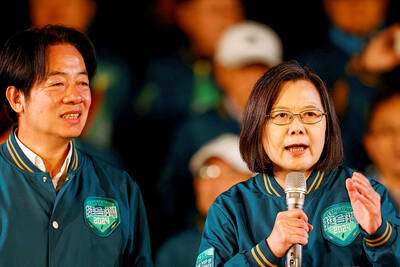
Last week Joseph Nye, the well-known China scholar, wrote on the Australian Strategic Policy Institute’s website about how war over Taiwan might be averted. He noted that years ago he was on a team that met with then-president Chen Shui-bian (陳水扁), “whose previous ‘unofficial’ visit to the US had caused a crisis in which China fired missiles into the sea and the US deployed carriers off the coast of Taiwan.” Yes, that’s right, mighty Chen caused that crisis all by himself. Neither the US nor the People’s Republic of China (PRC) exercised any agency. Nye then nostalgically invoked the comical specter
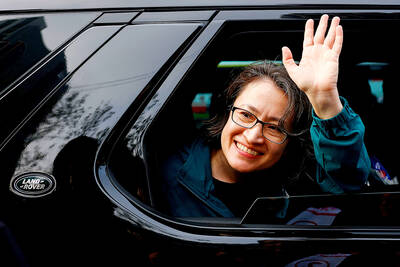
Relations between Taiwan and the Czech Republic have flourished in recent years. However, not everyone is pleased about the growing friendship between the two countries. Last month, an incident involving a Chinese diplomat tailing the car of vice president-elect Hsiao Bi-khim (蕭美琴) in Prague, drew public attention to the People’s Republic of China’s (PRC) operations to undermine Taiwan overseas. The trip was not Hsiao’s first visit to the Central European country. It was meant to be low-key, a chance to meet with local academics and politicians, until her police escort noticed a car was tailing her through the Czech capital. The
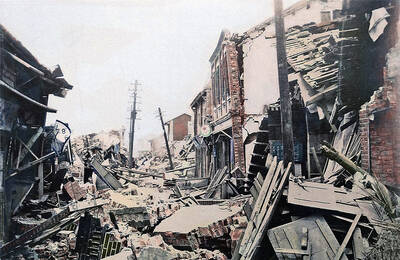
April 15 to April 21 Yang Kui (楊逵) was horrified as he drove past trucks, oxcarts and trolleys loaded with coffins on his way to Tuntzechiao (屯子腳), which he heard had been completely destroyed. The friend he came to check on was safe, but most residents were suffering in the town hit the hardest by the 7.1-magnitude Hsinchu-Taichung Earthquake on April 21, 1935. It remains the deadliest in Taiwan’s recorded history, claiming around 3,300 lives and injuring nearly 12,000. The disaster completely flattened roughly 18,000 houses and damaged countless more. The social activist and

Over the course of former President Ma Ying-jeou’s (馬英九) 11-day trip to China that included a meeting with Chinese Communist Party (CCP) leader Xi Jinping (習近平) a surprising number of people commented that the former president was now “irrelevant.” Upon reflection, it became apparent that these comments were coming from pro-Taiwan, pan-green supporters and they were expressing what they hoped was the case, rather than the reality. Ma’s ideology is so pro-China (read: deep blue) and controversial that many in his own Chinese Nationalist Party (KMT) hope he retires quickly, or at least refrains from speaking on some subjects. Regardless


 RSS
RSS