


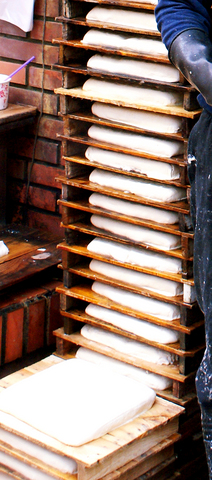
Wang Fen-chi (王鈖基) gently stacks pallets of soft tofu (嫩豆腐) into a square metal frame that is bolted into the ground out front of his small factory in Shiding (石碇), a small village located about a 40-minute drive from Taipei. The tofu is so fresh that steam wafts off from the side of the wooden skids as water trickles down onto the cement floor. Beside the metal rack used for stacking and pressing soft tofu is a large circular stone that Wang's great-great grandfather once used to grind yellow soybeans, a testament to his family's long tradition of making tofu by hand.
"I represent the fifth generation of this business," says Wang with a certain amount of pride. "When my father got too old to do it, I naturally took over just like he did when his father was too old."
Out front of Wang's small shop is a makeshift sales counter fashioned with three large sheets of plywood that rest on four large red buckets. Two young women run back and forth cutting the recently made tofu into squares and placing them into plastic bags that they sell to the line-up of customers.
PHOTOS: NOAH BUCHAN, TAIPEI TIMES
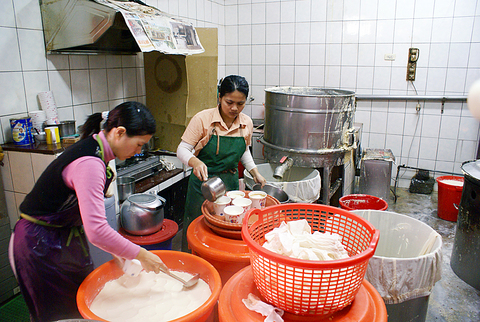
Through a small doorway located just behind the makeshift sales counter is a large room that serves as Wang's factory. Inside, Wang's younger brother and two other employees dressed in large smocks and black rubber boots grind yellow soybeans and then boil, strain and press the mash into tofu.
As a group of cyclists from Taipei lingers on the steps across the street from Wang's shop wolfing down their recently purchased breakfast of soymilk or tofu pudding (豆花), Wang explains how to make tofu by hand.
"The process of steeping soybeans determines the quality of the soybean milk and tofu," Wang says referring to how he maintains quality control. "The steeping time varies depending on the [outside] temperature."
During the hot summer months when the average temperature is 30?C, he says, the soybeans need to be steeped in water for four to five hours after which they become bloated enough to use. Cooler temperatures require a longer soaking period.
After soaking the soybeans, they are placed into a machine that grinds them into a bucket. Once full, Wang drags the bucket over the wet cement floor and scoops the mixture into a large heated pot. The concoction is boiled and stirred for 20 minutes, making it creamy in texture and color.
Using two dippers, employee Li Shih-feng (黎氏鳳) scoops the milk into a filtering machine that separates the milk into a large metal drum and the bean sludge into a large plastic bucket, the contents of which are boiled again to further extract any remaining milk.
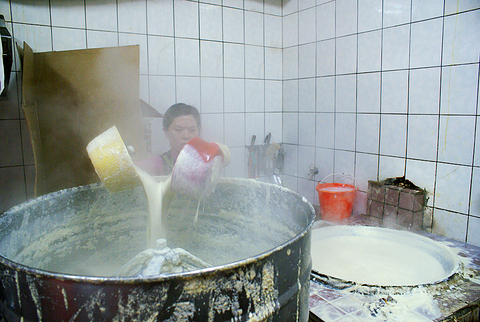
"We know the soybean quality is low if the soybean milk sticks to the filtering cloth," Wang says.
After Li filters the milk, Wang's younger brother Wang Chun-jung (王俊榮) takes over and adds a congealing agent to the steaming milk. The younger Wang continues to stir the mixture until it becomes a jelly-like substance, which usually takes 10 minutes. He then scoops it into cloth-lined, wooden moulds.
On the bottom of these molds is a solid piece of wood with vertical and horizontal grooves that form 5cm by 5cm squares. The tofu is pressed into the grooves, allowing for easy drainage of excess water.
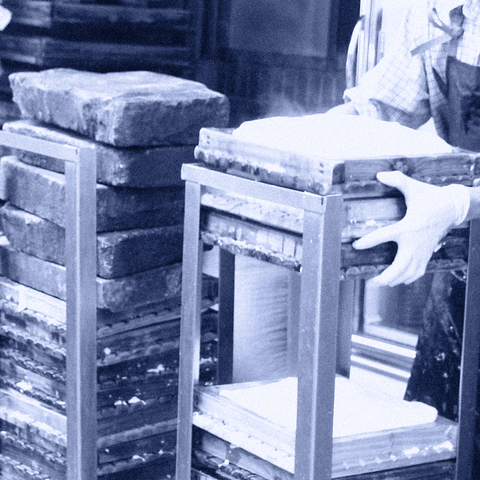
When the moulds are full, the younger Wang wraps cloth around the top and takes them outside where they are stacked. He then places four heavy square stones on top of the stake, which sets the tofu and further strains off any excess water. After 20 minutes of pressing, the tofu is unwrapped and removed from the moulds and is again stacked on wooden pallets.
During this process, trucks continually arrive and depart, their cabs filled with tofu that is transported to local restaurants and markets. At 10am, Wang finishes making tofu for the day and begins delivering it to nearby Shenkeng (深坑).
Taiwan's capital of tofu culture
If one wants to understand Taiwan's tofu culture, a trip to Shenkeng is an absolute must. On any given weekend, hundreds of Taiwanese make the trip to one small street in the town to sample its famous delicacy, stinky tofu (臭豆腐, choudofu).
Visitors wander up and down the narrow street lined with restaurants to buy and eat the pungent delicacy, while vendors make, cook and sell the smelly treat.
The flavor of this fermented tofu is in marked contrast to the subtle, soft variety made by Wang. For those who have never tried choudofu, don't let the strong smell put you off. While the smell may resemble Taipei's sewers on a hot summer day, the flavor is light; connoisseurs — of which most Taiwanese claim to be — liken the flavor to mild blue cheese.
Back at Wang's small shop, he is philosophical about his profession. "Making tofu a tough job with little profit margins," he says, adding that he is too busy to manage the business properly.
With low profits and long working hours, one wonders why Wang continues to do make tofu.
"Because of its popularity. The public knows about this place and like to come here to eat tofu. It's a family tradition," he said.

In late October of 1873 the government of Japan decided against sending a military expedition to Korea to force that nation to open trade relations. Across the government supporters of the expedition resigned immediately. The spectacle of revolt by disaffected samurai began to loom over Japanese politics. In January of 1874 disaffected samurai attacked a senior minister in Tokyo. A month later, a group of pro-Korea expedition and anti-foreign elements from Saga prefecture in Kyushu revolted, driven in part by high food prices stemming from poor harvests. Their leader, according to Edward Drea’s classic Japan’s Imperial Army, was a samurai

Approaching her mid-30s, Xiong Yidan reckons that most of her friends are on to their second or even third babies. But Xiong has more than a dozen. There is Lucky, the street dog from Bangkok who jumped into a taxi with her and never left. There is Sophie and Ben, sibling geese, who honk from morning to night. Boop and Pan, both goats, are romantically involved. Dumpling the hedgehog enjoys a belly rub from time to time. The list goes on. Xiong nurtures her brood from her 8,000 square meter farm in Chiang Dao, a mountainous district in northern Thailand’s

Located down a sideroad in old Wanhua District (萬華區), Waley Art (水谷藝術) has an established reputation for curating some of the more provocative indie art exhibitions in Taipei. And this month is no exception. Beyond the innocuous facade of a shophouse, the full three stories of the gallery space (including the basement) have been taken over by photographs, installation videos and abstract images courtesy of two creatives who hail from the opposite ends of the earth, Taiwan’s Hsu Yi-ting (許懿婷) and Germany’s Benjamin Janzen. “In 2019, I had an art residency in Europe,” Hsu says. “I met Benjamin in the lobby
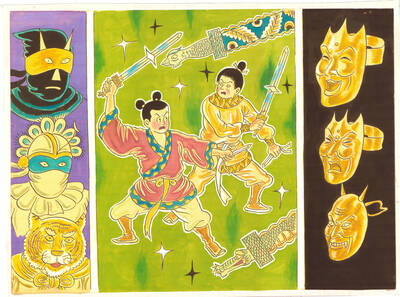
April 22 to April 28 The true identity of the mastermind behind the Demon Gang (魔鬼黨) was undoubtedly on the minds of countless schoolchildren in late 1958. In the days leading up to the big reveal, more than 10,000 guesses were sent to Ta Hwa Publishing Co (大華文化社) for a chance to win prizes. The smash success of the comic series Great Battle Against the Demon Gang (大戰魔鬼黨) came as a surprise to author Yeh Hung-chia (葉宏甲), who had long given up on his dream after being jailed for 10 months in 1947 over political cartoons. Protagonist


 RSS
RSS