


In Leopold von Sacher-Masoch's novel about humiliation and marble-white flesh, Venus in Furs, a seductress named Wanda taunts the man who would be her slave, "And so now fur arouses your bizarre fantasies?" Impatient for the inevitable answer (yes, and how), Wanda begins "coquettishly draping herself in her splendid fur, so that the dark, shiny sables flashed delightfully around her breasts, her arms." From such turgid lust and swollen prose a perversion is born, as well as a slow-burn Velvet Underground song.
The new film Fur: An Imaginary Portrait of Diane Arbus is a fantasy of a different order. Its marble-white Venus is Nicole Kidman, who here wears a conceit rather than a sable. The film's core idea is that Arbus, who trained her photographic gaze on nudists, twins, grimacing children and the retarded, liberated her muse by coaxing out her inner freak. The film conjures a conduit to her liberation in the furry form of Lionel, a neighbor played by Robert Downey Jr. The actor's involvement is something you need to take on faith, since he spends most of the film covered in fur, a costume that suggests the bewitched prince in Cocteau's Beauty and the Beast and makes Downey look like an immaculately groomed Shih Tzu.
Fur is a folly, though not a dishonorable one. It was directed by Steven Shainberg, whose last feature, Secretary, was a tender love story about a shy masochist and the boss who spanks his way into her heart. The film was funny and modest, and it treated the putative perversions of its characters with the kind of good, gracious humor that insists on respect for everyone involved. Fur is a more ambitious work, in part because of Kidman, whose talent cannot obscure that she has been grievously miscast and left to indulge her mannered coyness.
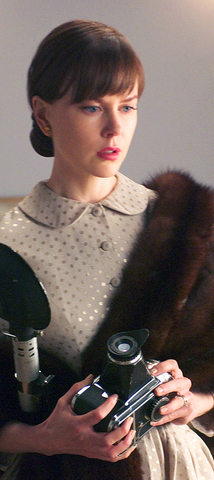
PHOTO COURTESY OF GROUP POWER
The fetish of casting high-wattage movie stars, no matter how badly they fit the role, is one of the maladies of contemporary independent and quasi-independent filmmaking.
In 1971, at age 48, Arbus swallowed a large number of barbiturates and then, perhaps to make sure that she had finished the job, slit her wrists. Born Diane Nemerov into a wealthy New York family (her brother was the poet Howard Nemerov), she met Allan Arbus, played by Ty Burrell, when she was 14 and married him as soon as she was legal. He introduced her to photography and she served as his assistant. Together they worked for fashion magazines and on advertising campaigns, including those for her family's department store, Russeks, which was known for its furs. According to Arbus' biographer, Patricia Bosworth, Diane's father understood how to drape women in ermine. "Fur," he said, "creates a protective image."
One woman's protective image is another woman's sexual fetish is another woman's fictional gamble. In Fur, Shainberg's screenwriter, Erin Cressida Wilson, who also wrote Secretary, twists the classic Freudian concept of sexual fetishism, having apparently decided that the best way to explain Arbus's singular perspective on the world is to transform her into a fetishist. Thus, in this formulation, Lionel, her fuzzy neighbor, becomes a kind of walking, talking fetish, a means — to freedom, creativity, imagination and what Bosworth calls the dark world — that will usher her into a new realm. This sounds more promising than what materializes on screen largely because Shainberg and Wilson have turned Arbus' life into a neurotic fairy tale.
Maybe they just got hung up on the repeated mentions of the word fur in the opening chapter of Bosworth's biography. Whatever the case, they, like their subject, wander into dangerous territory, though without the same inspired results. In 1957, Arbus stopped working with her husband and began wandering New York after dark taking photographs. It's instructive that the film doesn't mention that she also studied with the photographer Lisette Model, whose interest in everyday people, with their odd shapes and suffering faces, was an obvious influence. The idea that art can also arise from example and instruction just wouldn't jibe with the film's vision of an otherworldly kingdom in which hard work, ego and depression of the sort that probably claimed Arbus' life have no place.
And, so, in Fur, the Park Avenue princess leaves the bright world and climbs up, up, up to Lionel's enchanted garret filled with objets d'exotica and mounds of fur as neatly coiled as sleeping cats. Through her furry friend, she meets an armless woman, a dominatrix and many dwarves. She lets down her hair, goes sleeveless and abandons her husband and children to squalor. Kidman bears no physical resemblance to Arbus, who was small and dark and seemed very much tethered to the earth, perhaps because that is where she found the grist for her genius.

In late October of 1873 the government of Japan decided against sending a military expedition to Korea to force that nation to open trade relations. Across the government supporters of the expedition resigned immediately. The spectacle of revolt by disaffected samurai began to loom over Japanese politics. In January of 1874 disaffected samurai attacked a senior minister in Tokyo. A month later, a group of pro-Korea expedition and anti-foreign elements from Saga prefecture in Kyushu revolted, driven in part by high food prices stemming from poor harvests. Their leader, according to Edward Drea’s classic Japan’s Imperial Army, was a samurai

Located down a sideroad in old Wanhua District (萬華區), Waley Art (水谷藝術) has an established reputation for curating some of the more provocative indie art exhibitions in Taipei. And this month is no exception. Beyond the innocuous facade of a shophouse, the full three stories of the gallery space (including the basement) have been taken over by photographs, installation videos and abstract images courtesy of two creatives who hail from the opposite ends of the earth, Taiwan’s Hsu Yi-ting (許懿婷) and Germany’s Benjamin Janzen. “In 2019, I had an art residency in Europe,” Hsu says. “I met Benjamin in the lobby
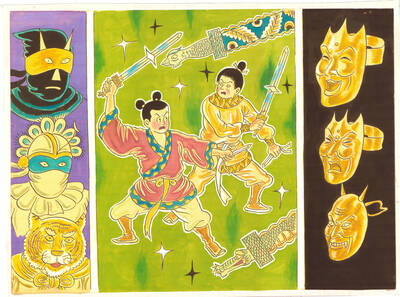
April 22 to April 28 The true identity of the mastermind behind the Demon Gang (魔鬼黨) was undoubtedly on the minds of countless schoolchildren in late 1958. In the days leading up to the big reveal, more than 10,000 guesses were sent to Ta Hwa Publishing Co (大華文化社) for a chance to win prizes. The smash success of the comic series Great Battle Against the Demon Gang (大戰魔鬼黨) came as a surprise to author Yeh Hung-chia (葉宏甲), who had long given up on his dream after being jailed for 10 months in 1947 over political cartoons. Protagonist

A fossil jawbone found by a British girl and her father on a beach in Somerset, England belongs to a gigantic marine reptile dating to 202 million years ago that appears to have been among the largest animals ever on Earth. Researchers said on Wednesday the bone, called a surangular, was from a type of ocean-going reptile called an ichthyosaur. Based on its dimensions compared to the same bone in closely related ichthyosaurs, the researchers estimated that the Triassic Period creature, which they named Ichthyotitan severnensis, was between 22-26 meters long. That would make it perhaps the largest-known marine reptile and would


 RSS
RSS