


A fairy tale in realist drag, The Pursuit of Happyness is the kind of entertainment that goes down smoothly until it gets stuck in your craw. Inspired by a true story, as they like to say in Hollywood, the film traces the fleeting ups and frightening downs of Chris Gardner, whose efforts to keep his family from sinking into poverty evolve into a life-and-death struggle of social Darwinian proportions. It's the early 1980s, and while former US president Ronald Reagan is delivering the bad economic news on television, Chris is about to prove you don't need an army to fight the war on poverty, just big smiles and smarts, and really sturdy shoes. (It also helps that the star playing him is as innately sympathetic as Will Smith.)
Given how often Chris breaks into a run on the streets of San Francisco, it's a good thing his shoes are well built; his lungs, too. Written by Steven Conrad and directed by Gabriele Muccino, The Pursuit of Happyness recounts how Chris, plagued by some bad luck, a few stupid moves and a shrew for a wife, Linda (Thandie Newton), loses his apartment and, with his five-year-old, Christopher (Jaden Christopher Syre Smith, Smith's own beautiful son), joins the ranks of the homeless, if not the hopeless. Evicted from the mainstream and bounced from shelter to shelter, Chris holds firm to his dignity, resolve, faith, love and independence. His optimism sweeps through the film like a searchlight, scattering clouds and dark thoughts to the wind.
It's the same old bootstraps story, an American dream artfully told, skillfully sold. To that calculated end, the filmmaking is seamless, unadorned, transparent, the better to serve Smith's warm expressiveness. That warmth feels truthful, as does the walk-up apartment Chris' family lives in at the start of the film, which looks like the real paycheck-to-paycheck deal. As does the day care center, which is so crummy it can't even get happiness right (hence the title).
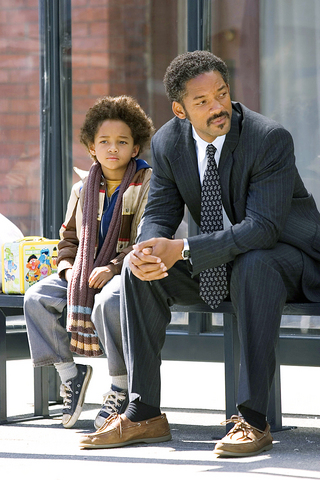
PHOTO: AP
This is no small thing, considering the film industry's usual skewed sense of economic class, a perspective encapsulated by the insider who described the middle-class family in Little Miss Sunshine to me as working class, perhaps because the mother drives a gently distressed Miata rather than next year's Mercedes.
Money matters in The Pursuit of Happyness, as it does in life. But it matters more openly in this film than it does in most Hollywood stories that set their sights on the poor, largely because Chris' pursuit of happiness eventually becomes interchangeable with his pursuit of money. He doesn't want just a better, more secure life for himself and his child; either by scripted design or by the example of the real Chris Gardner, he seems to yearn for a life of luxury. His desires aren't just upwardly mobile; they're materialistically unbound. Instead of a nice starter home, he (and the filmmakers) ogles mansions.
That may sound like a punch line, at least to some ears, but it's the holy grail in The Pursuit of Happyness. A self-starter, Chris has sunk all of the family's money into costly medical scanners that he tries to sell to doctors and hospitals. But the machines are overpriced, and the sure thing he banked on has landed them in debt. Forced to work two shifts at a dead-end job, Linda angrily smolders and then rages at Chris, which seems reasonable since he has gambled all of their savings on an exceptionally foolish enterprise. (And, unlike her, he hasn't signed up for overtime.) But this is a film about father love, not mother love, and Linda soon leaves the picture in a cloud of cigarette smoke and a storm of tears.
Chris and the filmmakers seem happy to see her go, but life only gets tougher once she and her paychecks disappear. Much of the film involves Chris' subsequent efforts to keep himself and his child housed and fed while he is enrolled in an unpaid internship program at a powerful stock brokerage firm. Bright and ferociously determined, Chris easily slides into this fantastical world of shouting men, ringing phones and benevolent bosses. He goes along to get along, and when one of his bosses asks for money to pay for a cab, he quickly opens his wallet. Chris himself stiffs another working man for some money because that wallet is so light. But this is a film about him, not the other guy.
How you respond to this man's moving story may depend on whether you find Smith and his son's performances so overwhelmingly winning that you buy the idea that poverty is a function of bad luck and bad choices, and success the result of heroic toil and dreams. Both performances are certainly likable in the extreme, though Smith shined brighter and was given much more to do when he played the title character in Michael Mann's underrated Ali.
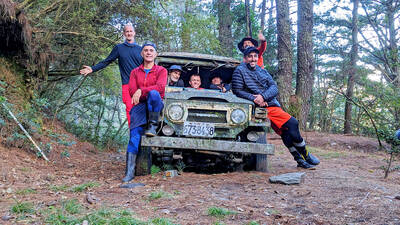
The year was 1991. A Toyota Land Cruiser set out on a 67km journey up the Junda Forest Road (郡大林道) toward an old loggers’ camp, at which point the hikers inside would get out and begin their ascent of Jade Mountain (玉山). Little did they know, they would be the last group of hikers to ever enjoy this shortcut into the mountains. An approaching typhoon soon wiped out the road behind them, trapping the vehicle on the mountain and forever changing the approach to Jade Mountain. THE CONTEMPORARY ROUTE Nowadays, the approach to Jade Mountain from the north side takes an

Last week Joseph Nye, the well-known China scholar, wrote on the Australian Strategic Policy Institute’s website about how war over Taiwan might be averted. He noted that years ago he was on a team that met with then-president Chen Shui-bian (陳水扁), “whose previous ‘unofficial’ visit to the US had caused a crisis in which China fired missiles into the sea and the US deployed carriers off the coast of Taiwan.” Yes, that’s right, mighty Chen caused that crisis all by himself. Neither the US nor the People’s Republic of China (PRC) exercised any agency. Nye then nostalgically invoked the comical specter

Relations between Taiwan and the Czech Republic have flourished in recent years. However, not everyone is pleased about the growing friendship between the two countries. Last month, an incident involving a Chinese diplomat tailing the car of vice president-elect Hsiao Bi-khim (蕭美琴) in Prague, drew public attention to the People’s Republic of China’s (PRC) operations to undermine Taiwan overseas. The trip was not Hsiao’s first visit to the Central European country. It was meant to be low-key, a chance to meet with local academics and politicians, until her police escort noticed a car was tailing her through the Czech capital. The
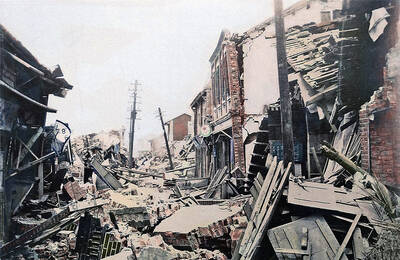
April 15 to April 21 Yang Kui (楊逵) was horrified as he drove past trucks, oxcarts and trolleys loaded with coffins on his way to Tuntzechiao (屯子腳), which he heard had been completely destroyed. The friend he came to check on was safe, but most residents were suffering in the town hit the hardest by the 7.1-magnitude Hsinchu-Taichung Earthquake on April 21, 1935. It remains the deadliest in Taiwan’s recorded history, claiming around 3,300 lives and injuring nearly 12,000. The disaster completely flattened roughly 18,000 houses and damaged countless more. The social activist and


 RSS
RSS