


The movie business recognizes no such thing as an unfilmable book. In some cases, just the title is bought and a story invented, as with Sex and the Single Girl, or, in the case of Ernest Hemingway's The Killers, added on. When serious artists are confronted by seemingly intractable material, they make a movie about the making of such a movie: this was Harold Pinter's solution to putting John Fowles's The French Lieutenant's Woman on the screen and more or less what Michael Winterbottom did when filming Sterne's Tristram Shandy as A Cock and Bull Story.
Special problems arise with books featuring what Wayne C. Booth in his critical classic The Rhetoric of Fiction calls "unreliable narrators," first-person novels where the world is rendered as other than it is or other than the author might objectively portray it. In The Innocents, Jack Clayton's film of Henry James's Turn of the Screw, for instance, we see much of the film from the central character's point of view. In Patrick Marber's adept adaptation of Zoe Heller's novel Notes on a Scandal, there is a voice-over commentary by a classic instance of the unreliable narrator, Barbara Covett, played by Judi Dench.
This is not just an ironic commentary on the action but a reinterpretation of the world around middle-aged schoolteacher Barbara. For what we hear on the soundtrack are daily entries in the diary she obsessively keeps as a shelter from her intense loneliness, a declaration of her self-worth and an assertion of her moral and intellectual superiority.
The film begins and ends with Barbara sitting on a bench on Parliament Hill, one of the highest points of Hampstead Heath, looking south over London, a position of solitude, detachment from the throng and seeming omniscience. She appears to be the film's observer, but she is, in fact, a godlike manipulator, a sad self-deceiver, pitiable, someone capable of monstrous acts, but not exactly a monster.
The chief object of her gaze in the story is Sheba Hart (Cate Blanchett), an upper-middle-class bohemian in her thirties, the second wife of a university lecturer, Richard (Bill Nighy), who has deserted his first wife and family for her. They now have two children, one a surly, teenage girl, the other a boy with Down's syndrome.
Sheba is the inexperienced new art teacher at the dismal north London state school where Barbara heads the history department. Heller reveals on the third page of her novel that Sheba is out on bail for having had sex with a 15-year-old pupil (Andrew Simpson) from a working-class Irish background. In the film, we do not learn of this until about half-an-hour has passed, when Barbara sees her giving the boy a blowjob in the art room. In the book, we are learning how things came about. In the cinema, we're waiting for things to happen, followed by the suspense, which is very well handled, of wondering to what use Barbara will put this secret knowledge of transgressive sex.
Initially, we think Barbara is a witty, sardonic observer of the school, an intelligent person made cynical by a seemingly impossible task of teaching in this place. She's self-consciously clever — witness her question to Sheba about her name — is it biblical (from the Queen of Sheba) or literary (after the heroine of Far From the Madding Crowd)? Her acerbic manner makes her feared and disliked by her colleagues and the filmmakers share her opinion that they're an idle, ignorant, styleless bunch.
Sheba, on the other hand, is a vulnerable, idealistic innocent, thinking she can change things by her sincerity. Gradually, we discover that Barbara is drawn to Sheba by sexual desires she cannot face, for envious social reasons she consciously rejects and as a way of assuaging her loneliness. The novelist and the moviemakers signal this somewhat blatantly through the names Covett and Hart, and, almost as if he were in a Restoration comedy, there's a teacher called Rumer.
The movie centers on acts of transgression, betrayal and bad faith, involving not only Barbara and Sheba, but Sheba's husband, Richard, the headmaster, a teacher smitten by Sheba and the 15-year-old lover. Everyone believes their motives are honest, but all are involved in forms of self-deception. There are brilliantly handled scenes of anger, embarrassment and humiliation, and brutal physical and emotional confrontations of great power.
The teachers are a trifle caricatured, but the four central actors bring depth and subtlety to their roles. In a magnificently un-self-regarding performance, Dench brings to Barbara that chilly aloofness combined with a desperate desire to reach out for comfort and warmth that informed her Queen Victoria in Mrs. Brown and Iris Murdoch in Iris.
Richard Eyre, who directed Iris, has done nothing as good as this since his remarkable movie debut with The Ploughman's Lunch back in 1983. Chris Menges, cinematographer on some of the finest movies of our time, ranging from Kes to The Mission, has done a beautiful job of showing how suburban London looks and feels today. My only real doubts concern Philip Glass's hectic, overemphatic music.

In late October of 1873 the government of Japan decided against sending a military expedition to Korea to force that nation to open trade relations. Across the government supporters of the expedition resigned immediately. The spectacle of revolt by disaffected samurai began to loom over Japanese politics. In January of 1874 disaffected samurai attacked a senior minister in Tokyo. A month later, a group of pro-Korea expedition and anti-foreign elements from Saga prefecture in Kyushu revolted, driven in part by high food prices stemming from poor harvests. Their leader, according to Edward Drea’s classic Japan’s Imperial Army, was a samurai

The following three paragraphs are just some of what the local Chinese-language press is reporting on breathlessly and following every twist and turn with the eagerness of a soap opera fan. For many English-language readers, it probably comes across as incomprehensibly opaque, so bear with me briefly dear reader: To the surprise of many, former pop singer and Democratic Progressive Party (DPP) ex-lawmaker Yu Tien (余天) of the Taiwan Normal Country Promotion Association (TNCPA) at the last minute dropped out of the running for committee chair of the DPP’s New Taipei City chapter, paving the way for DPP legislator Su
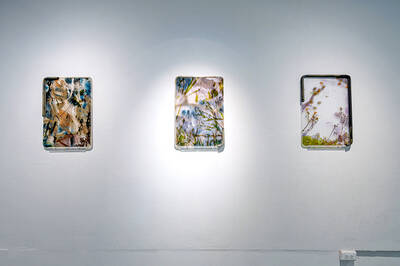
Located down a sideroad in old Wanhua District (萬華區), Waley Art (水谷藝術) has an established reputation for curating some of the more provocative indie art exhibitions in Taipei. And this month is no exception. Beyond the innocuous facade of a shophouse, the full three stories of the gallery space (including the basement) have been taken over by photographs, installation videos and abstract images courtesy of two creatives who hail from the opposite ends of the earth, Taiwan’s Hsu Yi-ting (許懿婷) and Germany’s Benjamin Janzen. “In 2019, I had an art residency in Europe,” Hsu says. “I met Benjamin in the lobby

It’s hard to know where to begin with Mark Tovell’s Taiwan: Roads Above the Clouds. Having published a travelogue myself, as well as having contributed to several guidebooks, at first glance Tovell’s book appears to inhabit a middle ground — the kind of hard-to-sell nowheresville publishers detest. Leaf through the pages and you’ll find them suffuse with the purple prose best associated with travel literature: “When the sun is low on a warm, clear morning, and with the heat already rising, we stand at the riverside bike path leading south from Sanxia’s old cobble streets.” Hardly the stuff of your


 RSS
RSS