


One was a successful corporate lawyer, another a Mercedes-driving businesswoman and a third a navy officer who steered battleships and hunted down cocaine smugglers in South America.
They are among a growing number of women in their 20s and 30s across the United States who have shed high-powered jobs, career ambitions and boyfriends for a nun's veil and a life devoted to the church.
Though the trend is by no means spreading like wildfire, several Roman Catholic communities throughout the country say they have noticed a surprising and welcome phenomenon in the last decade as younger women join their ranks.
“The inquiries in recent years have been coming from younger and younger women, most of them in their early to mid-20s,” Sister Agnes Mary, mother superior at the Sisters of Life community in New York, said.
The Catholic community, which counted seven members when it was founded in 1991, has grown to 52 women who live in six convents scattered throughout the New York area. A seventh convent is planned within the next two years.
“I think young women are searching for something and culture is not giving it to them so they are turning to God,” said Sister Mary Karen, 33, the superior at the Sisters of Life Formation House in the Bronx, where 18 women are being groomed for a life of obedience, poverty and chastity.
All have college degrees, are well traveled and were more cosmopolitan than cloistered growing up.
They have abandoned cell phones, iPods, daily Starbucks runs and, in some cases, fiances for dorm-like rooms, or “cells” as they are known, and a wardrobe of a simple veil and habit.
“I was in the navy for a total of 10 years because I wanted to do something great with my life but I realized I could never be passionate about it,” said Angela Karalekas, 28, who entered the convent in September and will receive her habit and new religious name in June.
“I was raised Catholic but my decision has been hard on my father and three brothers.”
Once the women take their final vows, a process that takes about eight years from the time they enter the convent, they are required to give up all their worldly possessions and rely on donations for their needs.
They rise at 5am — 5:30am or 6am on weekends — and spend the major part of the morning in prayer or contemplative silence.
Those who have taken their final vows work within the community, helping the homeless, pregnant women or anyone in need.
“It was basically apply to medical school or apply to a convent and the convent won out,” said Bridget Heisler, 24. “I knew there was a love in my life and it was the Lord.”
The nuns relax every afternoon by going on bike rides, playing basketball or rollerblade hockey, all dressed in their habits. The sight inspires some passersby to whip out their cell phones to take pictures or shout: “Go Sister.”
According to the Center for Applied Research in the Apostolate (CARA), there are currently 66,608 Catholic nuns in the US compared to nearly 180,000 in 1965. Worldwide, there are an estimated 776,260 nuns, compared with around one million in 1970.
But despite the dwindling overall number, several new orders and communities, especially those founded during the 1978-2005 pontificate of John Paul II, say they have seen a surge of new blood in the last decade, a welcome turnabout for the church.
“These women are looking for something deeper,” said Brother Paul Bednarczyk, executive director of the National Religious Vocation Conference.
“They are looking to develop their Catholic identity and given our secular values in the US where we promote sex, money and power, it is a very counter-cultural thing to profess celibacy, poverty and obedience.”
Bednarczyk and others also credit the late John Paul II's charisma and his effort to reach out to younger Catholics for the mounting popularity of some communities.
“The John Paul II generation is a generation of young people, a generation of authenticity,” said Sister Joseph Andrew Bogdanowicz, vocation director at the Dominican Sisters of Mary, Mother of the Eucharist, located in the midwestern state of Michigan.
“They have seen the emptiness of many worldly values and many want something more,” added Bogdanowicz, 54, who founded her community in 1997 along with three other women.
The convent today counts 71 women whose average age is 24. Next summer 20 more postulants are set to join the order which is rushing to raise funds for a new building to house the inflow.
“God in his goodness is sending us so many young vocations that we can't build fast enough to keep up with the number of young women entering our community,” Bogdanowicz said.
But apart from divine intervention, those interviewed also credit the Internet with breathing new life into the nunnery. Most orders today have Web sites and about 20 nuns run their own blogs.
“The (church) today needs to be on the Internet because that's where young people are going to go,” Bednarczyk said.
Julie Vieira, 35, who began a blog entitled A Nun's Life last July to chronicle her experience as a sister of the Immaculate Heart of Mary, said she gets about 600 hits a day and at least a half dozen emails from people inquiring about religious life.
“One of the reasons I started the blog was to explain what it's like to be a nun and to address the stereotypes out there,” said Vieira, who works at Loyola Press, a Catholic publisher in Chicago.
“I just wanted to tell people: ‘Hey, I'm an ordinary person.’”

Last week Joseph Nye, the well-known China scholar, wrote on the Australian Strategic Policy Institute’s website about how war over Taiwan might be averted. He noted that years ago he was on a team that met with then-president Chen Shui-bian (陳水扁), “whose previous ‘unofficial’ visit to the US had caused a crisis in which China fired missiles into the sea and the US deployed carriers off the coast of Taiwan.” Yes, that’s right, mighty Chen caused that crisis all by himself. Neither the US nor the People’s Republic of China (PRC) exercised any agency. Nye then nostalgically invoked the comical specter

Relations between Taiwan and the Czech Republic have flourished in recent years. However, not everyone is pleased about the growing friendship between the two countries. Last month, an incident involving a Chinese diplomat tailing the car of vice president-elect Hsiao Bi-khim (蕭美琴) in Prague, drew public attention to the People’s Republic of China’s (PRC) operations to undermine Taiwan overseas. The trip was not Hsiao’s first visit to the Central European country. It was meant to be low-key, a chance to meet with local academics and politicians, until her police escort noticed a car was tailing her through the Czech capital. The
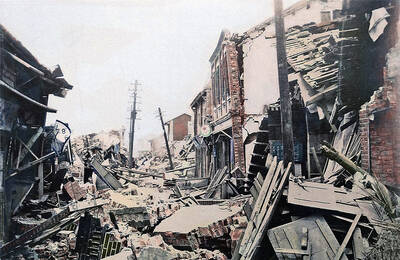
April 15 to April 21 Yang Kui (楊逵) was horrified as he drove past trucks, oxcarts and trolleys loaded with coffins on his way to Tuntzechiao (屯子腳), which he heard had been completely destroyed. The friend he came to check on was safe, but most residents were suffering in the town hit the hardest by the 7.1-magnitude Hsinchu-Taichung Earthquake on April 21, 1935. It remains the deadliest in Taiwan’s recorded history, claiming around 3,300 lives and injuring nearly 12,000. The disaster completely flattened roughly 18,000 houses and damaged countless more. The social activist and

Over the course of former President Ma Ying-jeou’s (馬英九) 11-day trip to China that included a meeting with Chinese Communist Party (CCP) leader Xi Jinping (習近平) a surprising number of people commented that the former president was now “irrelevant.” Upon reflection, it became apparent that these comments were coming from pro-Taiwan, pan-green supporters and they were expressing what they hoped was the case, rather than the reality. Ma’s ideology is so pro-China (read: deep blue) and controversial that many in his own Chinese Nationalist Party (KMT) hope he retires quickly, or at least refrains from speaking on some subjects. Regardless


 RSS
RSS