


Far more unites men and women than divides us, but when it comes to negative stereotypes, women win hands down. Girls are "bossy" and grow into women who "nag," while boys of all ages are "authoritative" and "natural-born leaders." When men go out for a drink together it is considered positive social interaction or "networking," when women get together they "gossip." But the stereotype that many women hate the most is "bitch." Men bitch too, of course, only in their case it is dubbed Machiavellian (with a palpable hint of respect) or they are hailed for their acerbic wit. As the actor Bette Davis once said: "When a man gives his opinion, he's a man; when a woman gives her opinion, she's a bitch."
For centuries, the straight definition of the word bitch was simply a sexually promiscuous woman. Then, as women became more powerful throughout the 20th century, the definition expanded to include being duplicitous. Now men tend to call women bitches when they do not get what they want from them. So, if a woman turns a man down for a date, she is a bitch. If she climbs the career ladder faster than him, she is a bitch. If she becomes his boss and turns down one of his ideas, she is — you guessed it — a bitch.
Current slang associations underline the fact that, for some, the idea of being called a bitch is just as derogatory as ever. Bikers "ride bitch" (pillion), but only when their own bike is unavailable, of course. Among heroin users, the major artery for injection is known as "your bitch," hence the Prodigy's most famous track Smack My Bitch Up. That small, unattractive tuft of hair that some men like to grow beneath their lower lip is also known as a bitch, presumably because of its vague resemblance to female genitalia.

PHOTOS: AP
Given all its negative connotations, it is not surprising that women fear being called a bitch. In fact, though, it is something that we should embrace. Why? The US feminist magazine BITCH explains it like this on its Web site: "When it's being used as an insult, bitch is an epithet hurled at women who speak their minds, who have opinions and do not shy away from expressing them and who do not sit by and smile uncomfortably if they are bothered or offended. If being an outspoken woman means being a bitch, we will take that as a compliment, thanks."
The Web Site Heartless Bitches International agrees, announcing on its homepage that Bitch means Being In Total Control Honey. It is a sign of strength in a woman and of honesty.
After all, look at some of the women who get called bitches. Michiko Kakutani, the famously ferocious book critic on the New York Times, has been accused by the male literary establishment of being "weird," and a "feminist" who deliberately trashes the likes of Norman Mailer simply because he is male. You can almost read the word bitch between the lines, can't you? But Kakutani is a Pulitzer prize-winning journalist who is dedicated to literature. Her reviews are honest appraisals of each book rather than sycophantic hero-worship of incredibly well-known authors, which we tend to get this side of the Atlantic. It is hard to believe Kakutani would suffer the same sort of criticism for giving her opinion if she were a man.
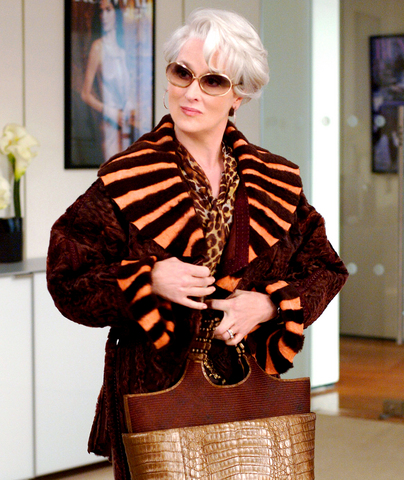
Bitching thrills because it flouts manners and speaks the truth. Feminists such as Germaine Greer and the British journalist Julie Burchill excel at the art because they dare to say what they really think of other people, even when that offends. Then there is Joan Rivers, one of the funniest women alive, who has made her name savaging other famous women, usually over their appearance. What she says she hates is the dishonesty, the pretence, that they have had no cosmetic surgery. And what could be seen as cruelty is mitigated by her own self-deprecation: "I wish I had a twin so that I could know what I looked like without plastic surgery. My best birth control now is to leave the lights on."
Many of us are still so constrained by conventional stereotypes of how women should be — selfless, kind, enabling of others, calm and supportive — the good girl essentially, that the real girl inside gets denied. We take insults on the chin and say nothing. We find it hard to compete or ask for that pay rise because we are not sure we deserve it. We are not supposed to shout or get angry about all the inequities we face as women. We become the bitch, the bad girl, when we want more, when we are not prepared to make do with what we have and when being heard is more important than being liked. That is a liberating feeling. If we fear being labeled as a bitch, we still seek validation from men on their terms rather than ours.
Of course, there is a huge difference between the "strong" bitch I am writing about, the woman who happily flouts conventional female stereotypes, and the "weak" bitch whose persona proceeds from vulnerability and who manipulates others to make herself feel stronger. Teenage girls bitch to bond when they feel vulnerable, and bitching to bully is rife in our schools. This is rarely detected because it can be very subtle, but when women bitch from a position of sheer envy and vulnerability it can have devastating effects — as we saw in British TV's Big Brother house last week. Our culture is full of this kind of weak bitching, and girls have little guidance as to how to move from that ugly, bad-bitch stereotype to being a strong, good bitch who stands up to the world with courage.
Bitching can be clever, with far more wit and irony than sarcasm. It is also more subtle than the blunt instrument of insult. Joan Crawford once boasted that her first husband, Douglas Fairbanks Jr., had introduced her to the great plays, while her second husband, Franchot Tone, had taught her what they meant, along with "words like 'metaphor' and 'transference.'" Jean Harlow's response when she heard this was, "And she taught him words like 'jump' and 'fuck.'"
A good bitch with someone you trust can be cathartic when life as a woman gets you down. It is better for your health than Prozac and cheaper than therapy. Few things are more interesting than other people — talking about them behind their backs is often illuminating as well as entertaining. We bitch to bond for support and when we spar as equals it can be incredibly funny. For instance,
broadcasters Gill Pyrah and Susan Marling have been friends for years. At the height of David Bowie's Ziggy Stardust era, Pyrah was the proud owner of an all-in-one light blue space suit with metallic lining. When Marling saw it she said, “Lovely. And you're oven-ready.”
Think of all the fantastic bitches that have gone before us — from Jane Austen, Margot Asquith and Eleanor Roosevelt to the extraordinary verbal rivalry between Bette Davis and Joan Crawford. Katharine Hepburn, Tallulah Bankhead, Lauren Bacall and Greta Garbo were all strong, inspiring women who fired off as many great lines off-screen as on. “Why am I so good at playing bitches? I think it's because I'm not a bitch,” said Bette Davis, warming up for the perfect punchline. “Maybe that's why Miss Crawford always plays ladies.”
Life would be extremely dull without these women or the characters they created, Davis as veteran movie bitch Margo Channing in All About Eve, or Crawford as Crystal in The Women. In literature, there are Emma, the Bingley Sisters and Becky Sharp, female characters who thrill us because they dare to present women as they really are: clever, calculating and verbally dexterous. A healthy malevolence lurks beneath the good girl facade. Take Mae West, for instance, who wrote most of her own material, as well as being a sex symbol. In her list of 15 “Things I'll Never Do” (which includes cook, bake, sew or take another woman's man), number seven says it all — “Play mother parts, sad parts, dumb parts or a virtuous wife, betrayed or otherwise. I pity weak women, good or bad, but I can't like them. A woman should be strong either in her goodness or badness.”
In an ideal, ungendered world, everybody would be nicer to each other. All women are human, with a wide range of strengths and weaknesses, just like men. We are just as competitive and ambitious, we get just as angry but we are not supposed to show it. Girls still grow up squeezing themselves into stereotypical “good” girl notions of femininity (and their feet into uncomfortably high-heeled shoes) and when we are not aware of how fettered we are by these stereotypes we veer towards being the kind of weak bitches who put other women down simply to make ourselves feel better. But there is a much stronger bitch inside each one of us just bursting to get out. As Madonna once said, “I'm tough, ambitious and I know what I want. If that makes me a bitch, OK.” Real women are loud, brave, outspoken, astute and funny, as well as kind, loving and supportive. So let her out girls, for “life's a bitch and then you die.” You might as well get what you want from it while you can.
Kate Figes is the author of The Big Fat Bitch Book, published by Virago.

In late October of 1873 the government of Japan decided against sending a military expedition to Korea to force that nation to open trade relations. Across the government supporters of the expedition resigned immediately. The spectacle of revolt by disaffected samurai began to loom over Japanese politics. In January of 1874 disaffected samurai attacked a senior minister in Tokyo. A month later, a group of pro-Korea expedition and anti-foreign elements from Saga prefecture in Kyushu revolted, driven in part by high food prices stemming from poor harvests. Their leader, according to Edward Drea’s classic Japan’s Imperial Army, was a samurai

The following three paragraphs are just some of what the local Chinese-language press is reporting on breathlessly and following every twist and turn with the eagerness of a soap opera fan. For many English-language readers, it probably comes across as incomprehensibly opaque, so bear with me briefly dear reader: To the surprise of many, former pop singer and Democratic Progressive Party (DPP) ex-lawmaker Yu Tien (余天) of the Taiwan Normal Country Promotion Association (TNCPA) at the last minute dropped out of the running for committee chair of the DPP’s New Taipei City chapter, paving the way for DPP legislator Su

It’s hard to know where to begin with Mark Tovell’s Taiwan: Roads Above the Clouds. Having published a travelogue myself, as well as having contributed to several guidebooks, at first glance Tovell’s book appears to inhabit a middle ground — the kind of hard-to-sell nowheresville publishers detest. Leaf through the pages and you’ll find them suffuse with the purple prose best associated with travel literature: “When the sun is low on a warm, clear morning, and with the heat already rising, we stand at the riverside bike path leading south from Sanxia’s old cobble streets.” Hardly the stuff of your
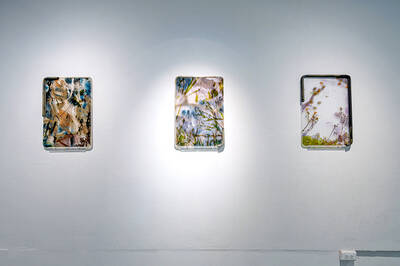
Located down a sideroad in old Wanhua District (萬華區), Waley Art (水谷藝術) has an established reputation for curating some of the more provocative indie art exhibitions in Taipei. And this month is no exception. Beyond the innocuous facade of a shophouse, the full three stories of the gallery space (including the basement) have been taken over by photographs, installation videos and abstract images courtesy of two creatives who hail from the opposite ends of the earth, Taiwan’s Hsu Yi-ting (許懿婷) and Germany’s Benjamin Janzen. “In 2019, I had an art residency in Europe,” Hsu says. “I met Benjamin in the lobby


 RSS
RSS