


Yasmina Reza's latest novel, Adam Haberberg, like her hit play, Art, is a polished, pared-down, professionally turned production that appears to tackle big ideas — Time, Mortality, the Possibility of Human Connection, the Meaninglessness of Life — but does so with the paint-by-numbers breeziness of a television mini-series. While Adam Haberberg starts off promisingly as a sympathetic portrait of a writer filled with regrets about his life and art, it soon devolves into a kind of dumbed-down, user-friendly imitation of Krapp's Last Tape — Beckett Extra Lite, as it were, transported to the Paris suburbs.
Although he's only 47, Adam feels he's reached the end of the line. His doctor has just told him he has a thrombosis in one of his eyes that may endanger his sight, and he may very well be developing glaucoma, too. His wife, Irene, a high-powered telecom engineer, who has supported the family through the lengthening dry spells in Adam's career, has no time or sympathy for him. His last book has been a disaster, and his vocation as a writer appears to be trickling to an end. The future, he concludes, holds "no prospect of joy."
Adam Haberberg is sitting on a bench in the Jardin des Plantes zoo in Paris, thinking these gloomy thoughts, when an old schoolmate named Marie-Therese Lyoc approaches him. He can barely remember her: If he were to have described her back in the day, he would have said she was "insignificant, even though at the time, he thinks, it would not have occurred to anyone to describe her at all."

Marie-Therese is a lively chatterbox of a woman. She prattles away to Adam about her job selling items like "mini fridge magnets, traditional fridge magnets, magnetic words" to zoos, amusement parks, and museums, and she tells him how obsessed she is with kitchen appliances. She's just the sort of person snobbish Adam detests, but his woes have left him feeling oddly passive, and he quietly acquiesces when she invites him to dinner at her apartment in the suburbs. The remainder of the novel consists of the drive to Marie-Therese's home and their dinner there, all embroidered with Adam's running commentary about the visit and his thoughts.
Like many of Reza's works, Adam's story is basically a sort of stream-of-consciousness monologue. Sometimes he says things to Marie-Therese and sometimes he simply thinks things to himself, but it all runs together into a Moebius strip looping back and forth between the present and the past, as he broods over his current difficulties and laments long-ago events. Remembering old class pictures from his school days, he thinks he looks "sadder and uglier" with each passing year. Remembering holiday trips he's taken with his family, he thinks about his failure to connect with his wife and kids. As for his current life, he thinks of himself as "a piece of flotsam", a spiritual and physical wreck whose "solitude clings" to him.
Although we start out having plenty of compassion for poor, worried Adam, it soon becomes clear that he's a completely self-absorbed misanthrope. And as his monologue becomes increasingly filled with judgmental rage against the world, the reader's concern about his physical ailments gives way to feelings of suffocation and annoyance. Many of his riffs concern the difficulty of being an artist (as compared with what, the reader wants to ask, compared with being a soldier? A factory worker? A farmer?) and the stupidity of ordinary people. His attitude toward Marie-Therese runs the gamut of emotions from contempt to, well, to contempt.
"You can understand nothing about my life," he thinks, "because you, Marie-Therese, were damned from the start. You accepted this damnation and you live with it. You've blended into the mass, you've ironed out all the discords between the world and yourself, and made your nest there, you say bottom line, you talk about the image of a washing machine, you say I have positively bloomed, a women who talks about my business with that fervor is forever alien to me." He adds that "there's no parity between you and me," and that "we do not belong to the same caste."
This bitter narcissism is a quality shared by many of Reza's earlier characters as well. In Desolation, the curmudgeon hero rails against his son for committing the sin of happiness. In Hammerklavier, a woman writes off a man because he doesn't care for her necklace. In The Unexpected Man, the hero rants about everything from professional slights to his daughter's taste in men.
For that matter, Reza seems to have the same contempt for her heroes that her heroes have for others, and a similarly nihilistic outlook. Instead of probing the reasons for Adam's failures and disappointments, instead of examining the middle-aged despair that he and Marie-Therese actually share, she simply allows Adam to babble on self-indulgently, piling one complaint upon the next.
In the end, this is why Adam's long rant has little in common with Krapp's or Lear's existential rage at the world and everything in common with the late-night bloviating of an angry blogger, eager to whine and vent — full of sound and fury, and signifying nothing.

Last week Joseph Nye, the well-known China scholar, wrote on the Australian Strategic Policy Institute’s website about how war over Taiwan might be averted. He noted that years ago he was on a team that met with then-president Chen Shui-bian (陳水扁), “whose previous ‘unofficial’ visit to the US had caused a crisis in which China fired missiles into the sea and the US deployed carriers off the coast of Taiwan.” Yes, that’s right, mighty Chen caused that crisis all by himself. Neither the US nor the People’s Republic of China (PRC) exercised any agency. Nye then nostalgically invoked the comical specter

Relations between Taiwan and the Czech Republic have flourished in recent years. However, not everyone is pleased about the growing friendship between the two countries. Last month, an incident involving a Chinese diplomat tailing the car of vice president-elect Hsiao Bi-khim (蕭美琴) in Prague, drew public attention to the People’s Republic of China’s (PRC) operations to undermine Taiwan overseas. The trip was not Hsiao’s first visit to the Central European country. It was meant to be low-key, a chance to meet with local academics and politicians, until her police escort noticed a car was tailing her through the Czech capital. The
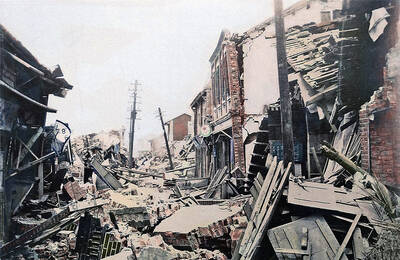
April 15 to April 21 Yang Kui (楊逵) was horrified as he drove past trucks, oxcarts and trolleys loaded with coffins on his way to Tuntzechiao (屯子腳), which he heard had been completely destroyed. The friend he came to check on was safe, but most residents were suffering in the town hit the hardest by the 7.1-magnitude Hsinchu-Taichung Earthquake on April 21, 1935. It remains the deadliest in Taiwan’s recorded history, claiming around 3,300 lives and injuring nearly 12,000. The disaster completely flattened roughly 18,000 houses and damaged countless more. The social activist and

Over the course of former President Ma Ying-jeou’s (馬英九) 11-day trip to China that included a meeting with Chinese Communist Party (CCP) leader Xi Jinping (習近平) a surprising number of people commented that the former president was now “irrelevant.” Upon reflection, it became apparent that these comments were coming from pro-Taiwan, pan-green supporters and they were expressing what they hoped was the case, rather than the reality. Ma’s ideology is so pro-China (read: deep blue) and controversial that many in his own Chinese Nationalist Party (KMT) hope he retires quickly, or at least refrains from speaking on some subjects. Regardless


 RSS
RSS