


The unmarked path twists off a dirt road and into the forest, and within a few seconds there is the surreal sight of pale white bodies swathed in colorful sarongs, milling around a wooden house on stilts. Up the stairs, a woman named Noi greets guests, sends them to a ramshackle changing room and then into a windowless cell where three benches are barely visible through the dense steam infused with eucalyptus, citrus, rosemary, lemongrass, basil and mint. She offers weak tea to sweat-drenched survivors, who are encouraged to take a fresh sarong and lie down on one of six beds for a slow but powerful massage in the open air.
This isn't a latter-day commune or the headquarters of a cult in the business of brainwashing backpackers. It's an herbal sauna on the grounds of the Wat Sok Pa Luang, a temple on the outskirts of Vientiane, in Laos. Lying there as the sun sets with only the trees, birds and an occasional mosquito around, you might just think about putting down your own roots.
It's easy to turn into a turbo-tourist in Southeast Asia. Bangkok, Chiang Mai, Phnom Penh, Siem Reap, Luang Prabang, Ho Chi Minh City, Hanoi — a vacation can start to feel like a mail route as you dutifully hit every beach and temple. When it's time to take a break, there's Vientiane.
PHOTOS: NY TIMES NEWS SERVICE
Laos' relaxed capital is rich with pleasures, and its tranquility can be a tonic for those who have been hopscotching nonstop around the region. New hotels are adding to the city's appeal. Fancier bars and restaurants are opening up, too, mainly to serve the capital's several thousand foreign aid and government workers. Yet the fundamental allure of the city is centuries old: its location along a long stretch of the Mekong River, its pungent traditional foods and the low-key Buddhist culture that has sprinkled gracious temples and monuments throughout the city.
Most hotels are along the Mekong or within a stone's throw of the city center, and the rest of the city is eminently walkable. The Japanese government recently donated a road that will lead from the airport, through the city and then all the way to the Friendship Bridge that crosses the Mekong to Thailand.
"It's really good for tourism because the road is better and the transport is better," said Det Temmerath, who was helping out in his mother-in-law's shop while waiting to start a government job. He said he was especially grateful for the generosity of the Japanese, who have also given three-quarters of a billion yen (about US$6.2 million) in cultural grants since 1975 and are duly thanked on signs outside several local sights.
"It's a gift, not a loan," Det said. "When we get some loan from the Asian Development Bank, the country is still in debt." That's a thought to keep in mind as you pass the bank's spotless local office, surrounded by manicured lawns, on Lan Xang Avenue.
The new hot spots are often run by expatriate Europeans or Australians. Most retain some local flavor, though, whether it's the wicker-backed armchairs lining the bar at Jazzy Brick or the dark wood furniture that fills the suites at the Green Park Boutique Hotel.
Some colonial gems have also reached an international standard, like Kua Lao, a restaurant in an old mansion named by many residents as one of the capital's best places to eat local cuisine. Laotian food is a delicious, spicy crossroads of Thai, Vietnamese and southern Chinese cuisine with the addition of its own special flavors, from local chili paste to — for the more courageous — ant larvae.
In addition, a few citizens of the old colonial power, France, have returned bringing more up-to-date influences, as at Le Central, a modern bistro near the center of town. South Asian merchants, too, have begun to populate the markets selling gemstones and jewelry.
Despite these burgeoning charms and cosmopolitan touches, however, it may take some time for tourists to regard Vientiane as more than an enjoyable afterthought.
After savoring a meal at Kua Lao with his grown children, Bob Bell, from Virginia, said the trip to Vientiane had been a last-minute decision. He and his family had been visiting Kuchinarai, in northern Thailand, where Bell was stationed as a naval officer in 1964. Then his son, Rob, asked when they would ever be 30 miles from the Laotian border again. "We were going to Vietnam and these guys, who are passport-stamp-hogs, wanted to get another country," the elder Bell joked.
And just as Laos is often overshadowed by Vietnam, Thailand and Cambodia, Vientiane is usually left in the shade by scenic Luang Prabang. But there are marvels throughout the city.
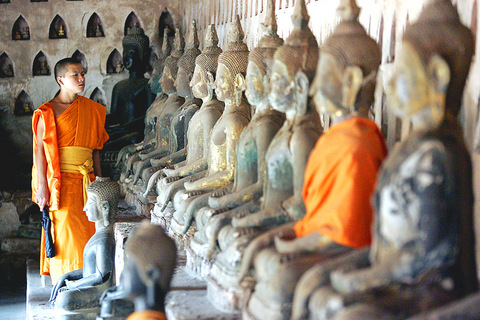
Wat Si Saket, Vientiane's oldest large temple surviving in its original, early 19th-century form, has a peaceful courtyard overlooked by tall palm trees and filled with memorial pillars, stone stupas (traditional Buddhist monuments) and butterflies. The surrounding cloister, with its terra-cotta-tiled roof, contains countless niches displaying thousands of tiny Buddhas, plus bigger ones painted gold.
Along the edge of the cloister are potted plants bursting with flowers. Everywhere is the sound of bats roosting in the eaves of the sanctuary, whose interior walls are painted with fading but minutely detailed murals that tell pictorial tales of battle and devotion. If you're lucky, you might catch what passes for spectacle here: French tourists chasing after an orange-swathed, umbrella-carrying monk like so many paparazzi.
The markets are worth a special visit. For lunch, the Talat Sao market offers fried fish, minced meats mixed with herbs and served with sticky rice, barbecued sausages and spicy noodle soup. There's fresh sugar cane juice or, if you prefer, a bottle of strong spirits with a cobra, scorpion or both soaking inside. The market's clean, orderly interior offers embroidered silk in every form, from tablecloths to ties, plus shining silver jewelry and dozens of counterfeit coins claiming to be silver piastres from the era of French control.
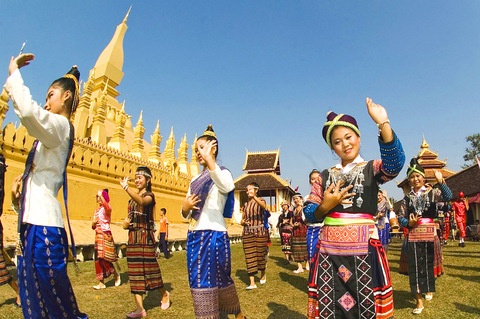
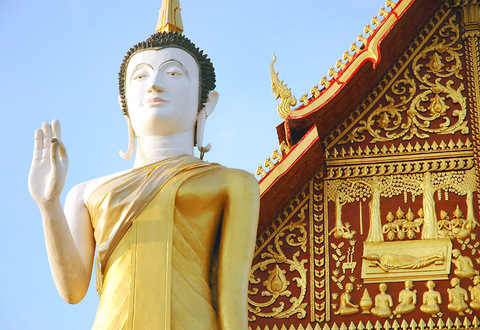
Finally, of course, there is the Pha That Luang, the shining golden temple that is Laos' national symbol. It doesn't matter how many photographs you've seen of the Pha That Luang before you come. The first glimpse, even from a kilometer away, will take your breath away. You could be forgiven for thinking that the stupa, not the sun, is lighting up the sky.
As at other big temples in the capital, you're bound to find one more symbol of development and globalization: cheerful young monks hoping to practice their English. Still, the growth of Vientiane is all a matter of perspective. When asked if there had been big changes in the city, Phone (pronounced pohn), a 22-year-old monk tending the Wat That Luang Neua temple next to the Pha That Luang, said yes, indeed there had. The city had expanded quite a bit since taking over as capital from Luang Prabang, he said. Of course, that happened over 400 years ago.

Last week Joseph Nye, the well-known China scholar, wrote on the Australian Strategic Policy Institute’s website about how war over Taiwan might be averted. He noted that years ago he was on a team that met with then-president Chen Shui-bian (陳水扁), “whose previous ‘unofficial’ visit to the US had caused a crisis in which China fired missiles into the sea and the US deployed carriers off the coast of Taiwan.” Yes, that’s right, mighty Chen caused that crisis all by himself. Neither the US nor the People’s Republic of China (PRC) exercised any agency. Nye then nostalgically invoked the comical specter
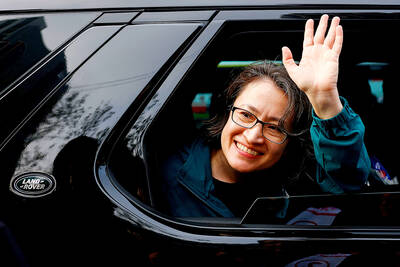
Relations between Taiwan and the Czech Republic have flourished in recent years. However, not everyone is pleased about the growing friendship between the two countries. Last month, an incident involving a Chinese diplomat tailing the car of vice president-elect Hsiao Bi-khim (蕭美琴) in Prague, drew public attention to the People’s Republic of China’s (PRC) operations to undermine Taiwan overseas. The trip was not Hsiao’s first visit to the Central European country. It was meant to be low-key, a chance to meet with local academics and politicians, until her police escort noticed a car was tailing her through the Czech capital. The
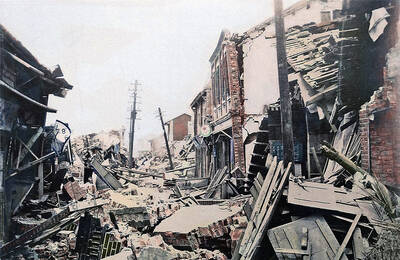
April 15 to April 21 Yang Kui (楊逵) was horrified as he drove past trucks, oxcarts and trolleys loaded with coffins on his way to Tuntzechiao (屯子腳), which he heard had been completely destroyed. The friend he came to check on was safe, but most residents were suffering in the town hit the hardest by the 7.1-magnitude Hsinchu-Taichung Earthquake on April 21, 1935. It remains the deadliest in Taiwan’s recorded history, claiming around 3,300 lives and injuring nearly 12,000. The disaster completely flattened roughly 18,000 houses and damaged countless more. The social activist and

Over the course of former President Ma Ying-jeou’s (馬英九) 11-day trip to China that included a meeting with Chinese Communist Party (CCP) leader Xi Jinping (習近平) a surprising number of people commented that the former president was now “irrelevant.” Upon reflection, it became apparent that these comments were coming from pro-Taiwan, pan-green supporters and they were expressing what they hoped was the case, rather than the reality. Ma’s ideology is so pro-China (read: deep blue) and controversial that many in his own Chinese Nationalist Party (KMT) hope he retires quickly, or at least refrains from speaking on some subjects. Regardless


 RSS
RSS