


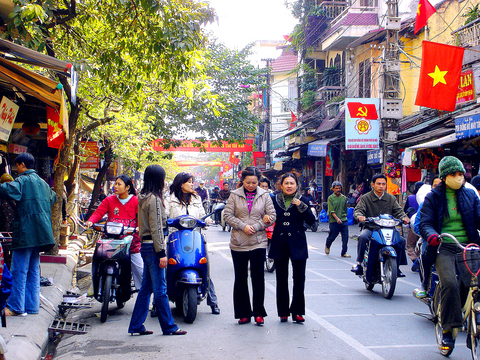
I stand on the curb and wait for the traffic to pass, and wait some more, until it feels like I could spend the rest of my life lingering on the edge of this small street in Vietnam's capital.
There are no lights, no crosswalks, no stop signs. Just an interminable growl of passing motorbikes, nearly all beeping their high-pitched horns. I'm with a scrum of tourists in something of a pedestrian's purgatory, stranded in front of a parade that won't end.
It takes a few days to learn the proper road-crossing etiquette: barrel ahead (even if death seems probable), don't stop, and never retreat. The bikers, who have de facto right of way, expect human roadblocks, but they expect them to move forward. Stopping or changing direction tends to throw off their high-speed, instantaneous adjustments.

PHOTOS: NY TIMES NEWS SERVICE
How to avoid becoming road kill was one of many lessons learned on a spontaneous trip to Vietnam. My girlfriend and I had come on a whim from Hong Kong when we realized it was only a two-hour flight to Hanoi. We had only vague ideas of what to expect, beyond cinematic visions of communist peasants in conical straw hats spouting quotations from Ho Chi Minh.
On the road from the airport, we find a flat, Midwestern landscape marked more by factories and skinny, regal-looking homes than by rice paddies. Old signs bearing government propaganda fade next to flashy billboards advertising mobile phones. Merchants pack narrow sidewalks, hawking everything from socks and roses to shoelaces and warm baguettes.
We spend the day taking in a millennium of history in the Old Quarter, a densely packed district of "tunnel" houses (built tall and slender to avoid real estate taxes), murky lakes lined with willow trees, and everything from low-rent hotels to street-side noodle bars to stores selling lacquerware — all catering to the thousands of foreign tourists who now visit Hanoi every year.
We devour a US$3 spread of noodles, vegetables, fried rice, and fruit juice. We pass rickshaw peddlers, sidestep motorbikers selling rides, and ignore touts pushing "massages" and forged copies of Lonely Planet guides. We watch a water-puppet show, a bizarre poolside opera with fireworks and ear-splitting arias.
After an exhausting day struggling to pronounce xin chao (hello) and cam on (thank you), we return to our three-star hotel — relatively expensive at US$40 a night — and collapse. As soon as we shut the door, we realize our mistake of having chosen a room just a few floors above the street. The din of the pollution-choked city fills our sleepless dreams with bright green waters, the placid sea we saw in all the windows of Hanoi's many travel agencies.
So, in the morning, we slurp a breakfast of steaming noodle soup, lug our backpacks into the street, and find a van headed to Halong Bay, the tourist industry's most aggressively advertised slice of paradise.
It's a three-hour ride over flat farmland and potholed roads. We make a mandatory stop at a shop hawking crafts said to be made by victims of Agent Orange, a defoliant US forces used in the war. We arrive at a port where swarms of tourists are loaded and unloaded from an armada of sampans.
Our boat is a large, wood-paneled vessel with a dragon's head carved into the bow. It's a floating restaurant, with sleeping cabins and a crew dressed in white. We board and sit for the first of a succession of three-course meals, variations of shrimp, tofu, rice, french fries, and watermelon, all washed down with Tiger beer.
The engines rumble and the boat cuts through a film of haze. As we pass other tourists, I wonder whether we've made a mistake, confining ourselves on a boat for the next three days. We putter along for an hour, and as the other boats disappear and the smog evaporates, my doubts do, too.
Gliding over the glassy water, an otherworldly horizon suddenly reveals itself: a forest of giant limestone outcroppings, or karsts, and ancient rocks of all possible shapes, which erupt through the sea like moss-covered sculptures.
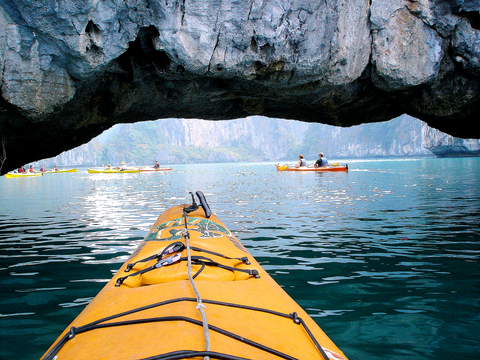
Between meals and visits to caves, we swim in the smooth, cold water, glide over it in a kayak, and spend hours staring as the sun sets and the emerald expanse turns from lime to jade. It's hard to imagine that the US Navy once mined these same waters, which are part of the Gulf of Tonkin.
We chat up our crew, who pass much of the first night transfixed watching a state TV documentary outlining the US government's "human rights abuses." Ngoc, our 28-year-old guide, criticizes his government's controls on speech, and says he admires the US. He tells us why he doesn't regret the North's victory over the South and its US allies: Most Vietnamese supporting "Uncle Ho," including his father, fought the French and Americans for the same reasons they spent centuries fighting China. They wanted independence and unification, not communism.
But his understanding of history seems gilded by the victors. He professes little knowledge of the purges after Saigon fell in 1975 and insists some one million US soldiers died in the conflict, far more than the 58,000 tallied by the US government.
The next night, we dock on the rocky shores of Cat Ba Island, which is surrounded by floating fishing villages and a rising tourist industry. After a big feast, we join scores of locals in a variety show, in which we compete in pear-eating contests, and watch a succession of crooners belt out American and Vietnamese ballads.
With only a day left in the country, we return to Hanoi in the afternoon and try to cram in as much as possible. For US$2, we take a 20-minute taxi ride to the well-manicured grounds around Ho Chi Minh's mausoleum and the One Pillar Pagoda, a replica of a man-made, millennium-old lotus. There's also a parade area for the troops. We peek through gates at the old presidential palace, which is yellow, the color of power in Vietnam, and walk to Ho Tay (West Lake) to watch people play badminton on courts illuminated only by distant street lights.
We walk for hours along the city's cracked sidewalks, browsing the crowded night markets and avoiding rats on the rain-soaked streets. We explore fluorescent-lighted slums, where families cram into small apartments, many with TVs, coal-fired stoves, and elaborate shrines to ancestors.
The next morning, we hire a driver to take us to see more caves and limestone peaks, where we find conical hats selling for US$1 and a teenager with a "US Army" patch on his acid-wash jean jacket who guides us through reedy wetlands on a bamboo raft.
Our final stop comes at the end of a muddy, unpaved road crowded with packs of livestock and children in uniforms. Three hours south of Hanoi, we reach Cuc Phuong National Park, a rain forest, where we spend a few hours ogling langurs, gibbons, and other monkeys at the Endangered Primate Rescue Center.
When we return to Hanoi, it's pouring. But we don't want to stop; there's so much more to see.
We pass the old opera house and other restored colonial buildings, tramp along the wide, embassy-lined avenues in the French Quarter, and haggle for silk and lacquerware. We slog through ankle-deep puddles until we are drenched and cold.
We try to hold on to everything we pass — the old women balancing baskets of bananas from their shoulders, the mad motorbikers splashing past, the red, yellow-star flags flapping in the wind.

Last week Joseph Nye, the well-known China scholar, wrote on the Australian Strategic Policy Institute’s website about how war over Taiwan might be averted. He noted that years ago he was on a team that met with then-president Chen Shui-bian (陳水扁), “whose previous ‘unofficial’ visit to the US had caused a crisis in which China fired missiles into the sea and the US deployed carriers off the coast of Taiwan.” Yes, that’s right, mighty Chen caused that crisis all by himself. Neither the US nor the People’s Republic of China (PRC) exercised any agency. Nye then nostalgically invoked the comical specter
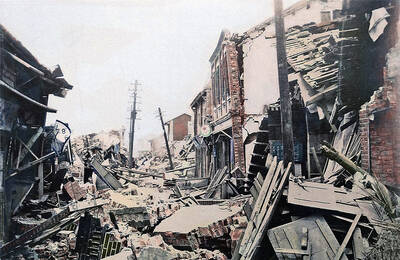
April 15 to April 21 Yang Kui (楊逵) was horrified as he drove past trucks, oxcarts and trolleys loaded with coffins on his way to Tuntzechiao (屯子腳), which he heard had been completely destroyed. The friend he came to check on was safe, but most residents were suffering in the town hit the hardest by the 7.1-magnitude Hsinchu-Taichung Earthquake on April 21, 1935. It remains the deadliest in Taiwan’s recorded history, claiming around 3,300 lives and injuring nearly 12,000. The disaster completely flattened roughly 18,000 houses and damaged countless more. The social activist and

Over the course of former President Ma Ying-jeou’s (馬英九) 11-day trip to China that included a meeting with Chinese Communist Party (CCP) leader Xi Jinping (習近平) a surprising number of people commented that the former president was now “irrelevant.” Upon reflection, it became apparent that these comments were coming from pro-Taiwan, pan-green supporters and they were expressing what they hoped was the case, rather than the reality. Ma’s ideology is so pro-China (read: deep blue) and controversial that many in his own Chinese Nationalist Party (KMT) hope he retires quickly, or at least refrains from speaking on some subjects. Regardless

Approaching her mid-30s, Xiong Yidan reckons that most of her friends are on to their second or even third babies. But Xiong has more than a dozen. There is Lucky, the street dog from Bangkok who jumped into a taxi with her and never left. There is Sophie and Ben, sibling geese, who honk from morning to night. Boop and Pan, both goats, are romantically involved. Dumpling the hedgehog enjoys a belly rub from time to time. The list goes on. Xiong nurtures her brood from her 8,000 square meter farm in Chiang Dao, a mountainous district in northern Thailand’s


 RSS
RSS