


Isaac Greenbaum, a continuing education student at New York University, remembers the day last semester when his media studies class was settling into a discussion of its next group project. Shortly after class began, a brawny, bare-chested figure bounded in wielding a crossbow.
“This guy is shooting arrows, and if he hits you — of course, you can't die — you get teleported to a different land. And he hit me! I got sent to, like, the Himalayas!”
Sabotage can happen when your class is held in cyberspace, where a marauding avatar may just barge in and audit. Avatars are the virtual personas that users design and embellish (with anything from wings to, well, crossbows) to navigate the digital three-dimensional world called Second Life. Much of Second Life, now occupied by some 2 million users, mimics real life (R.L., in the vernacular): sun, sky, trees, waterways and anything users think to build. Were avatars the size of their human creators, the Second Life “grid” — a mainland and surrounding islands that users can buy with real money — would be the equivalent of more than 259km2. (Enter at www.secondlife.com.)
Scores of colleges and universities have set up campuses on islands, where classes meet and students interact in real time. They can hold chat discussions and create multimedia presentations from virtual building blocks called prims. The laws of physics don't necessarily apply.
At Middletown Island (named for Ball State's middle-American campus town, Muncie, Indiana), students hold after-class chats about their assignments while their avatars practice dance moves at the island tiki bar. They log in from their R.L. dorm rooms to decorate their avatars' virtual dorm rooms.
Instructors say the Second Life class experience is particularly enhanced for distance learners. In Second Life, classmates and instructor don't just communicate in chat rooms; they can actually see one another — or, at least, digital alter egos — on screen.
Bill Moseley, whose distance-learning course for Pepperdine University meets roughly every two weeks in Second Life, found an unexpected benefit: Within the program's lifelike graphic environment, his students had “a community online and the feeling of being together.” Nearly any time he logs on, he finds one or two tinkering with their project or exploring another area of the grid. For fun one day after class, everyone took a student's new virtual dune buggy for a spin around Malibu Island (Pepperdine is in California, after all).
Rebecca Nesson, a PhD candidate in computer science, brought her class at Harvard Extension School to Second Life last semester. “Normally, no matter how good a distance-learning class is, an inherent distance does still exist between you and your students,” she says. “Second Life has really bridged that gap. There is just more unofficial time that we spend together outside of the typical class session.”
Linden Lab, the company that created and runs Second Life, has sold more than 100 islands for educational purposes, at about US$1,000 each plus US$150 monthly maintenance. Owners of islands have more sophisticated controls over the virtual experience, including the ability to make their land public or private (invisible to others).
Since NYU's media studies class was one of the school's first forays into Second Life, the class, which is offered within the Paul McGhee Division for adult education, took up residence on an island called simply Campus: Second Life. Linden donates a free acre for the duration of a class so a college can experiment before investing in an island.
Second Life's education community is growing: Subscribers to its education listserve number more than 1,000; at least three islands run by library groups are open to the public; and universities are collaborating by lending space on their own islands or sharing ideas. Graduate students doing research or teaching in Second Life have formed a mobile colony that holds discussions with experts in subjects like online ethics or aesthetics. Seton Hall, in South Orange, New Jersey, presented its Second Life teaching methods at a recent conference held on New Media Consortium's island, and the MacArthur Foundation held a panel discussion called The Future of Digital Education on Harvard's island.
“A year ago, in ancient history, we heard educators saying, ‘Wow, I logged into Second Life, and it is pretty neat,'” says John Lester, manager of education and community development at Linden. “A year later, we're seeing them produce case studies in Second Life, pointing out what worked, what didn't and giving a direction to future educators.”
For example, Second Life isn't conducive to traditional lecturing, since streaming real-time audio is difficult. So class on the grid is less professor-centered, because of the free-for-all nature of real-time chat.
“I prefer classes to be discussions, and that's a necessity in Second Life,” says Nesson. “Things pop up in a less linear fashion than they do in a regular classroom.” Still, even when 10 students chime in, the threads of a discussion are easy to follow, she says. “But I've found that it is important to ask questions that are not entirely open-ended,” she adds, “because that's when chaos ensues.”
NEW YORK UNIVERSITY
Last semester, Mechthild Schmidt decided to explore firsthand one of the new media — along with YouTube and blogs — in the curriculum for her adult education class, Visionary Concepts and Development in Motion Arts. On NYU's plot of land in Second Life, a student and Schmidt took a ride on a magic carpet left behind by a previous user. Schmidt's students built the polygon rendition of the Washington Square arch in the background. The name of each avatar hovers overhead.
HARVARD LAW SCHOOL
Last semester, Harvard Law offered CyberOne: Law in the Court of Public Opinion, which explored public expression and new media. Only law students could enroll in the portion taught by professor Charles Nesson in a bricks-and-mortar classroom. But continuing-education students at Harvard Extension School could participate via Second Life. Some 40 avatars attended weekly “in world” classes and watched Nesson's lectures on a large screen in the outdoor lecture pit adjacent to Austin Hall. Sessions were held outdoors because, “for people who are new to Second Life, navigating the indoors can be difficult,” says Rebecca Nesson, the extension-school instructor who taught the course with, yes, her father. Harvard's island is open to the public, and nonstudents eavesdropped: The law-school lectures were downloaded at least 300 times a week, and many avatars at large sat in on her class (although not many law students showed up). Some non-student avatars even logged in to visit Rebecca Nesson during her virtual office hours. This winter, Nesson is moving his intensive trial-procedure class, Evidence, into a newly built virtual courtroom where students can simulate cases. The public will be able to observe from a gallery.
PEPPERDINE UNIVERSITY
In past years, Bill Moseley had to communicate the old-fashioned way with his distance-learning class: text-based chat over the Internet. This year, his 19 graduate students convene on sandy Malibu Island, sometimes in a treehouse, sometimes in a coffee shop. Working in group projects from home bases in Arizona or Ohio, students in his education technology class create multimedia presentations. For an assignment inspired by Daniel Pink's book on steps to excellence, A Whole New Mind, a wraparound wall immerses viewers in images of the students' avatars.
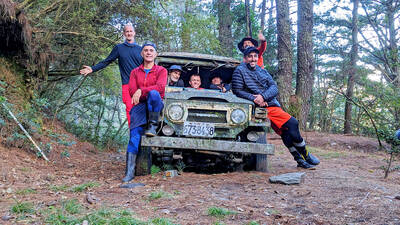
The year was 1991. A Toyota Land Cruiser set out on a 67km journey up the Junda Forest Road (郡大林道) toward an old loggers’ camp, at which point the hikers inside would get out and begin their ascent of Jade Mountain (玉山). Little did they know, they would be the last group of hikers to ever enjoy this shortcut into the mountains. An approaching typhoon soon wiped out the road behind them, trapping the vehicle on the mountain and forever changing the approach to Jade Mountain. THE CONTEMPORARY ROUTE Nowadays, the approach to Jade Mountain from the north side takes an

Last week Joseph Nye, the well-known China scholar, wrote on the Australian Strategic Policy Institute’s website about how war over Taiwan might be averted. He noted that years ago he was on a team that met with then-president Chen Shui-bian (陳水扁), “whose previous ‘unofficial’ visit to the US had caused a crisis in which China fired missiles into the sea and the US deployed carriers off the coast of Taiwan.” Yes, that’s right, mighty Chen caused that crisis all by himself. Neither the US nor the People’s Republic of China (PRC) exercised any agency. Nye then nostalgically invoked the comical specter

Relations between Taiwan and the Czech Republic have flourished in recent years. However, not everyone is pleased about the growing friendship between the two countries. Last month, an incident involving a Chinese diplomat tailing the car of vice president-elect Hsiao Bi-khim (蕭美琴) in Prague, drew public attention to the People’s Republic of China’s (PRC) operations to undermine Taiwan overseas. The trip was not Hsiao’s first visit to the Central European country. It was meant to be low-key, a chance to meet with local academics and politicians, until her police escort noticed a car was tailing her through the Czech capital. The
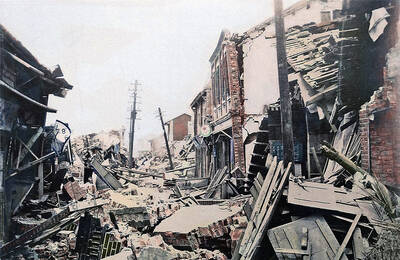
April 15 to April 21 Yang Kui (楊逵) was horrified as he drove past trucks, oxcarts and trolleys loaded with coffins on his way to Tuntzechiao (屯子腳), which he heard had been completely destroyed. The friend he came to check on was safe, but most residents were suffering in the town hit the hardest by the 7.1-magnitude Hsinchu-Taichung Earthquake on April 21, 1935. It remains the deadliest in Taiwan’s recorded history, claiming around 3,300 lives and injuring nearly 12,000. The disaster completely flattened roughly 18,000 houses and damaged countless more. The social activist and


 RSS
RSS