


“According to legend, the place is hell, but once one sees it, it becomes heaven.” Most people will think this view, expressed about Taiwan by a Japanese painter in 1935, is a little extreme at both ends of the spectrum. Even so, it incorporates well enough the wide range of attitudes found in this new compendium of articles on a perennially interesting subject.
Simultaneously eclectic and comprehensive, Taiwan Under Japanese Colonial Rule doesn't aim to present a smooth historical overview. Despite its publisher's implicit claim that it's more wide-ranging and sophisticated than any book ever before published on the topic, it did originate as a collection of papers read out at a conference (in 2001), and so is essentially experts speaking to experts. No one clearly wanted to make a fool of himself by offering generalizations, however impressive, so instead we have 17 dissertations (eight by Taiwanese writers) on often highly specialized subjects. But there is a wealth of interest here nonetheless.
Ever since the publication of Edward Said's Orientalism in 1978, trend-setting academics have united in agreement that the colonizer's view of the colonized cannot possibly be objective. Instead, it is fashioned by the colonizer's own wishes, needs, dreams and fantasies, most notably that he represents the male — strong, dominant, shaping policy — while the colonized stands for the feminine — acquiescent, passive, exotic, and more than a little happy to be possessed by the charismatic intruder.
This book in many places stands for a newer revisionism, not exactly rejecting Said's position but at least qualifying it. Two examples must suffice to illustrate this. Whereas an objective understanding of a subject territory may be indeed impossible, it still has to be understood that the Japanese made the first ever cartographical survey of Taiwan, conducted the first ever census of its population, made the first ever scientific studies of the aboriginal inhabitants, published the first books attempting to account for Han traditional customs, and published for the first time ever a catalogue of all the plants found on the island. The last, certainly, had no direct value to the government's economic ambitions but was conducted purely in the spirit of scientific investigation. In contrast to all this statistical and explorative frenzy, the authorities in Qing Dynasty China had viewed Taiwan as a barbarous place full of pirates (a view that may not, even now, have entirely vanished from the mainland's consciousness).
The second point to emerge is that European colonial ideas of racial difference — superior whites ruling “lesser breeds” beyond the pale of civilized enlightenment — didn't apply with the Japanese. Their approach was that all Asians were brothers, a view that lasted right up until World War II with the plan, partly carried out, for a Greater East Asian Co-Prosperity Sphere. Although in practice Taiwanese going to Japan for study were sometimes advised to pretend they were from Kyushu or Okinawa, the ideal of brotherhood prevailed in official terminology. Nor was it only lip-service — this book contains many examples of Japanese artists traveling to Taiwan in search of a purer, more simple life, in effect looking for values that had been lost in Japan itself through industrialization, urbanization, and the modern in general, seeking, in other words, their own true roots.
All this is seen by several contributors to this book as standing in stark contrast to the later attitudes of the Chinese Nationalist Party (KMT). They may also have, like the Japanese, had economic development at the center of their agenda, but their attitudes to the local culture were very different. What the Japanese studied, the KMT suppressed. Not only that. Their rule, say these writers, was far harsher. Criticisms of dishonest Japanese administrators were very common in Taiwanese newspapers, albeit increasingly published in Japanese as the period progressed, one writer points out. But when the Tainan novelist Yang Kui called in 1949 for freedom of speech and assembly, together with harmony between locals and new arrivals from the mainland, he was given 12 years imprisonment on Green Island for his pains, even though his article, which he never intended to be published, was only 700 Chinese characters long.
There are some fascinating statistics here too. Taiwan's population was three million in 1905, around six million in 1945 (the Japanese held seven censuses during their 50-year rule). When the Japanese arrived the only railway on the island ran from Taipei to Keelung. By 1908 it ran from Keelung to Kaohsiung. By the 1940s some 57 percent of Taiwanese understood the Japanese language (though another contributor states it was only a third), while in the 1930s literacy as a whole in Taiwan has been estimated as second only to Japan's in the entire Asia region.
Japan was Asia's only colonial power. It had three colonies — Korea, Manchuria and Taiwan. But it held Taiwan for longer than the other two, and arguably cherished it with more continuous affection.
If this book's authors can be said to share any single view, it is that the actuality of colonial enterprises is never a cut and dried matter. It's not just a matter of swings and roundabouts. Different individuals had different priorities, matters changed from decade to decade, and many things had effects unforeseeable by their instigators. Movements in the arts affected attitudes of even the most staid administrators, and the southern paradise (as some artists saw Taiwan as being) was never simply a source for raw materials gathered at the expense of the rights of the local inhabitants. Said may have been right in asserting that no objective view of a colonized territory is possible. But what this fine book shows is that some views, nonetheless remain considerably more objective than others.
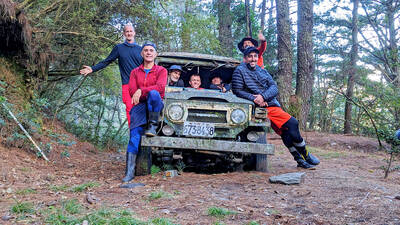
The year was 1991. A Toyota Land Cruiser set out on a 67km journey up the Junda Forest Road (郡大林道) toward an old loggers’ camp, at which point the hikers inside would get out and begin their ascent of Jade Mountain (玉山). Little did they know, they would be the last group of hikers to ever enjoy this shortcut into the mountains. An approaching typhoon soon wiped out the road behind them, trapping the vehicle on the mountain and forever changing the approach to Jade Mountain. THE CONTEMPORARY ROUTE Nowadays, the approach to Jade Mountain from the north side takes an

Last week Joseph Nye, the well-known China scholar, wrote on the Australian Strategic Policy Institute’s website about how war over Taiwan might be averted. He noted that years ago he was on a team that met with then-president Chen Shui-bian (陳水扁), “whose previous ‘unofficial’ visit to the US had caused a crisis in which China fired missiles into the sea and the US deployed carriers off the coast of Taiwan.” Yes, that’s right, mighty Chen caused that crisis all by himself. Neither the US nor the People’s Republic of China (PRC) exercised any agency. Nye then nostalgically invoked the comical specter

Relations between Taiwan and the Czech Republic have flourished in recent years. However, not everyone is pleased about the growing friendship between the two countries. Last month, an incident involving a Chinese diplomat tailing the car of vice president-elect Hsiao Bi-khim (蕭美琴) in Prague, drew public attention to the People’s Republic of China’s (PRC) operations to undermine Taiwan overseas. The trip was not Hsiao’s first visit to the Central European country. It was meant to be low-key, a chance to meet with local academics and politicians, until her police escort noticed a car was tailing her through the Czech capital. The
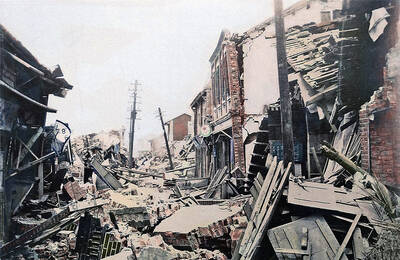
April 15 to April 21 Yang Kui (楊逵) was horrified as he drove past trucks, oxcarts and trolleys loaded with coffins on his way to Tuntzechiao (屯子腳), which he heard had been completely destroyed. The friend he came to check on was safe, but most residents were suffering in the town hit the hardest by the 7.1-magnitude Hsinchu-Taichung Earthquake on April 21, 1935. It remains the deadliest in Taiwan’s recorded history, claiming around 3,300 lives and injuring nearly 12,000. The disaster completely flattened roughly 18,000 houses and damaged countless more. The social activist and


 RSS
RSS