


The Col du Lautaret, a mountain pass that reaches 2,058m, is an hour's drive from Grenoble and sits in the heart of the Southern Alps under the imposing shadow of big peaks and vertical glaciers. It is home to an annual early-winter festival, the Snowkite Masters, which brings together hundreds to participate in this emerging sport, which mixes skiing, snowboarding, kiting and kiteboarding, with a bit of skateboarding, wakeboarding and parasailing thrown in.
Using lightweight foil-type kites that have bellows that inflate with the wind and give impressive lift and power, snowkiters are pulled across, up and over snow-covered hills, mountains, fields and frozen lakes.
Upon my arrival at the mountain pass, known locally as the Col, I walked in knee-deep snow toward a distant, shimmering flotilla of colorful snowkites flying against a deep winter sky. The kites, some as large as a motor home, zipped about the sky in graceful arcs. When hit by sudden gusts, the kites slashed furiously back and forth through the air. Then, without warning, a snowkiter passed silently 9m above me, connected to his kite by 30.5m strings.

PHOTO: NY TIMES NEWS SERVICE
He looked like an oversized marionette, except for the dreadlocks coming from under his helmet and the hand-rolled cigarette dangling from his grinning mouth.
Snowkiting became popular in Europe in the mid-1990s, and the Col quickly gained cult status.
"Here we have consistent wind, varied terrain and easy road access," Xavier Petit, a local snowkiter, said in French. "And the Col is next door to big resorts, where many good skiers and snowboarders live. It's not the easiest place to kite, but it's popular because of media attention and all the crazy riders who live near here."
This year's Snowkite Masters included participants from around the world. The staging area included a teepee and a sports-drink company's promotional tent, with a DJ spinning reggae music for a crowd that was huddling around a snow-pit barbecue and drinking beer.
"We are an anti-contest, with no fees, rules, competitions or prizes," said Guillaume Chastagnol, one of the event's organizers and perhaps the sport's best-known professional. "Yet we still attract the world's top snowkiters who travel here from far away to meet friends, test new equipment and show off new tricks. And, yes, we have very good fiestas."
Pascal Joubert earned his nickname, Big Air, because of his huge jumps, which last as long as five minutes at heights of more than 91m. Jumps are measured in time, not distance. He said he converted to snowkiting 10 years ago when he grew tired of fighting for fresh powder at nearby resorts.
"In snowkiting, we are going back to the roots of the mountain, of the calm, the serenity and virgin snow," Joubert said. "The biggest pleasure for me is to flow over the snow and in the air. In snowkiting, we are no longer a victim of gravity."

Last week Joseph Nye, the well-known China scholar, wrote on the Australian Strategic Policy Institute’s website about how war over Taiwan might be averted. He noted that years ago he was on a team that met with then-president Chen Shui-bian (陳水扁), “whose previous ‘unofficial’ visit to the US had caused a crisis in which China fired missiles into the sea and the US deployed carriers off the coast of Taiwan.” Yes, that’s right, mighty Chen caused that crisis all by himself. Neither the US nor the People’s Republic of China (PRC) exercised any agency. Nye then nostalgically invoked the comical specter
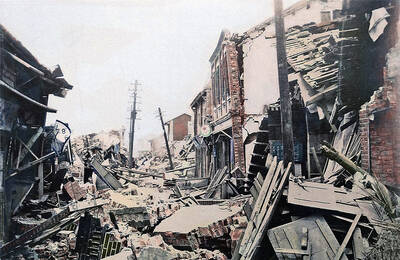
April 15 to April 21 Yang Kui (楊逵) was horrified as he drove past trucks, oxcarts and trolleys loaded with coffins on his way to Tuntzechiao (屯子腳), which he heard had been completely destroyed. The friend he came to check on was safe, but most residents were suffering in the town hit the hardest by the 7.1-magnitude Hsinchu-Taichung Earthquake on April 21, 1935. It remains the deadliest in Taiwan’s recorded history, claiming around 3,300 lives and injuring nearly 12,000. The disaster completely flattened roughly 18,000 houses and damaged countless more. The social activist and

Over the course of former President Ma Ying-jeou’s (馬英九) 11-day trip to China that included a meeting with Chinese Communist Party (CCP) leader Xi Jinping (習近平) a surprising number of people commented that the former president was now “irrelevant.” Upon reflection, it became apparent that these comments were coming from pro-Taiwan, pan-green supporters and they were expressing what they hoped was the case, rather than the reality. Ma’s ideology is so pro-China (read: deep blue) and controversial that many in his own Chinese Nationalist Party (KMT) hope he retires quickly, or at least refrains from speaking on some subjects. Regardless

Approaching her mid-30s, Xiong Yidan reckons that most of her friends are on to their second or even third babies. But Xiong has more than a dozen. There is Lucky, the street dog from Bangkok who jumped into a taxi with her and never left. There is Sophie and Ben, sibling geese, who honk from morning to night. Boop and Pan, both goats, are romantically involved. Dumpling the hedgehog enjoys a belly rub from time to time. The list goes on. Xiong nurtures her brood from her 8,000 square meter farm in Chiang Dao, a mountainous district in northern Thailand’s


 RSS
RSS