


Picture yourself 12m off the ground strapped into a harness with only two blue ropes and a belayer to stop you from plunging to the ground below. Sound scary? Many in Taiwan think so.
"Even now I don't think [indoor climbing] is popular because many parents — and even teachers — think it's dangerous," says Nancy Pan (潘蘭心), a climbing instructor and teacher at the Institute of Developing Effective Adventure (IDEA) in Beitou.
Duck Chung (鍾明均), manager of the adventure company Ecopower and operator of the Y17 climbing wall on Renai Road, agrees: "When children grow up with their parents and their grandparents telling them not to climb, it's difficult to break that kind of thinking."
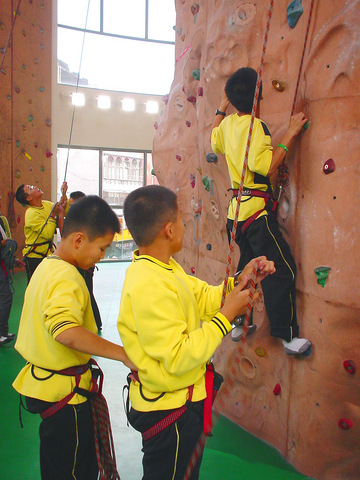
PHOTOS COURTESY OF IDEA
But a trip to an indoor climbing gym is usually enough to allay their fears. "Usually I want parents or teachers to try first. The danger is in their minds and after they try they will let their kids climb," Pan said.
Indoor climbing has come a long way since 1964 when university lecturer Don Robinson stuck slabs of rock onto corridor walls for his physical education students to practice on. The simplicity of this structure — and those that followed — left little room for challenging or interesting climbing routes because of the steepness of the walls and limited handholds.
Today, however, many climbing walls are built with a reinforced fiberglass compound that has the look and feel of rock, complete with indentations and protrusions. Bolted onto the surface are a variety of grips, often of various colors and sizes that denote routes that climbers can take.
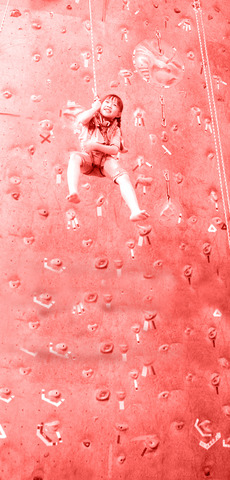
With around a dozen facilities in Taiwan, indoor climbing is becoming popular because it is more controlled than outdoor climbing, making it ideal for beginners. It can also be done all year round.
The color of the handhold tells the climber how challenging a particular route is: green and yellow represent beginner-level routes; blue, red and black are respectively for more advanced climbers. Chung says the different color schemes come from the Yosemite Decimal System (UDS). When following a route, climbers should only use grips of the designated color as handholds, though it is common to allow climbers to use any grip, protrusion or crack as footholds.
"There are no black grips on these walls because the level is too difficult," he says. But even without the expert-level routes, the red and blue are spaced far enough apart to make the journey to the 12m pinnacle enough of a challenge.
The cheapest kind of climbing is called "bordering" because a harness and rope are not required. This style of climbing familiarizes neophyte climbers with the wall and grips by having them move horizontally across the wall's surface. Though learners are less than a meter off the ground, bordering gives them a level of confidence necessary for vertical climbs.
Basic courses at both facilities last six hours and the primary focus is to teach students how to belay. Simply put, belaying is the ability to control the rope so that if a climber slips and falls, they don't plunge very far. Belay is also used to refer to the place where the belayer stands. After completing the course, students take a test to determine whether they can belay and if they pass they receive a certificate.
"If you don't climb well, it's still safe. If you don't belay well, it's dangerous." Pan said, summing up the importance of belaying. "Climbing takes time to train yourself but belay takes attitude because it is about respecting your life and other's life."
Advanced courses teach "leading." Like the name suggests, leading involves being the first person up the wall. As it is more complicated than belaying, courses generally last 10 hours before the test is taken. The advanced course is also directed towards those who want to make the leap to outdoor climbing.
Both facilities offer tailor-made exercise programs including corporate courses that can either take the form of recreational climbing — where the coaches will do the belaying — or learning, where students learn the basic facets of climbing where they themselves can become belayers.
Pan and her climbing colleagues have taken indoor climbing to the next level.
In addition to teaching basic and advanced indoor climbing skills, both individually and in groups, IDEA also offers a variety of programs aimed at corporations.
"We have some programs with educational ideas. For example, we have business training for some companies, like team and leadership building."
In addition to corporate clients, Pan and her colleagues have also been a big hit with schools.
Pan is particularly proud of a course offered to college students known as "experiential activity." Similar to socials in the West, the idea is to bring the students from boys-only and girls-only colleges together for a day of conversation and activities, of which indoor climbing is the highlight.
"The school wants them to have a chance to meet each other and also understand more about communicating with the opposite sexes. So we do co-educational programming."
In order to facilitate dialogue between the students, Pan takes them through a series of scenarios meant to elicit deeper insights into themselves and the opposite sex with teamwork being the ultimate goal. According to Pan, this reduces the fear students often have communicating with the opposite sex and increases the effectiveness of teamwork when they later hit the climbing wall.
"This kind of confidence-building and team-building moves outside the walls of the gym [so that] students use their experiences inside [the gym] to overcome fears they might have in their lives," she said.
It is also a great way to spend an afternoon.
In late October of 1873 the government of Japan decided against sending a military expedition to Korea to force that nation to open trade relations. Across the government supporters of the expedition resigned immediately. The spectacle of revolt by disaffected samurai began to loom over Japanese politics. In January of 1874 disaffected samurai attacked a senior minister in Tokyo. A month later, a group of pro-Korea expedition and anti-foreign elements from Saga prefecture in Kyushu revolted, driven in part by high food prices stemming from poor harvests. Their leader, according to Edward Drea’s classic Japan’s Imperial Army, was a samurai

Located down a sideroad in old Wanhua District (萬華區), Waley Art (水谷藝術) has an established reputation for curating some of the more provocative indie art exhibitions in Taipei. And this month is no exception. Beyond the innocuous facade of a shophouse, the full three stories of the gallery space (including the basement) have been taken over by photographs, installation videos and abstract images courtesy of two creatives who hail from the opposite ends of the earth, Taiwan’s Hsu Yi-ting (許懿婷) and Germany’s Benjamin Janzen. “In 2019, I had an art residency in Europe,” Hsu says. “I met Benjamin in the lobby

April 22 to April 28 The true identity of the mastermind behind the Demon Gang (魔鬼黨) was undoubtedly on the minds of countless schoolchildren in late 1958. In the days leading up to the big reveal, more than 10,000 guesses were sent to Ta Hwa Publishing Co (大華文化社) for a chance to win prizes. The smash success of the comic series Great Battle Against the Demon Gang (大戰魔鬼黨) came as a surprise to author Yeh Hung-chia (葉宏甲), who had long given up on his dream after being jailed for 10 months in 1947 over political cartoons. Protagonist

A fossil jawbone found by a British girl and her father on a beach in Somerset, England belongs to a gigantic marine reptile dating to 202 million years ago that appears to have been among the largest animals ever on Earth. Researchers said on Wednesday the bone, called a surangular, was from a type of ocean-going reptile called an ichthyosaur. Based on its dimensions compared to the same bone in closely related ichthyosaurs, the researchers estimated that the Triassic Period creature, which they named Ichthyotitan severnensis, was between 22-26 meters long. That would make it perhaps the largest-known marine reptile and would


 RSS
RSS