


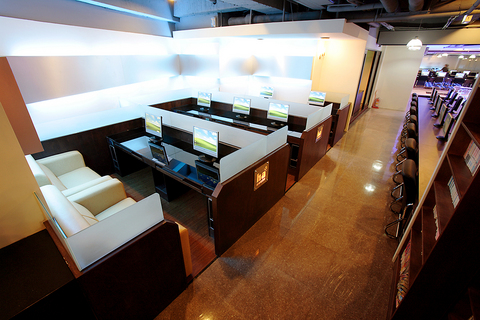
If you had asked someone six years ago what Taiwan's Internet cafe of today would look like, that person might have described something like Ha2 (哈哈活力站) in Shilin (士林), near Taipei's Jiantan MRT station (劍潭站). Located beneath a winding staircase on a street that's often crowded with high school students, H2 is as sleek as a nightclub and as comfortable as the lobby of a five-star hotel. Effortlessly filling its 920m2 spread are 180 high-powered computers, soft white sofas and a conference room straight out of a James Bond movie.
Where competitors smell like airport smoking lounges and serve ramen noodles and instant coffee, H2 has a state-of-the-art ventilation system, a walk-in cooler, and a menu that lists pizza and fried chicken. Customers here for relaxation can read comic books at four-person pods with flat-panel monitors that swivel on mechanical arms, or pair off in cubicles with adjustable, wood-finish desks. Those on business get projector screens and a conference table with a partition that raises via remote control to reveal personal workstations. Set well apart from these areas are rows and rows of brand-new dual-processor PCs, where scores of young men battle day and night with keyboard and mouse on the latest online games.
Among the hundreds of Internet cafes that existed in Taipei six years ago, Ha2 stands out — not so much for staying on the cutting edge of technology and comfort as for the fact that it's still around. Initial overinvestment in the industry, followed by government policies designed to address social problems linked to Internet cafes, have taken their toll. In 2002 there were 32 Internet cafes in Shilin alone, now there are nine, Ha2 manager Rich Kao (高盛興) said.
It's harder now than it was to find an Internet cafe in Taipei, but there are still more than 200 licensed ones in the city to choose from. Others have gone underground, unable to comply with city regulations mandating that they not operate within 200m of a school and limiting the hours when minors can visit. Many Internet cafes, unable to attract new investors, look like time capsules from the turn of the century, albeit with newer games and smoke-yellowed walls.
"Half of the social problems in Taiwan, the government — and the media — have blamed on Internet cafes," said Jacky Wu (吳振彰), founder of industry giant Aztec Technology (戰略高手), which once had nearly 90 franchises across Taiwan but now operates around three-dozen.
The trouble started with concerns that teenagers were spending too much time in Internet cafes, where they were exposed to excessive violence in computer games and could easily obtain access to pornographic Web sites or meet ill-intentioned strangers in online chat rooms. A survey supervised by a former justice minister found that around 400,000 young students were visiting Internet cafes at least once a week, spending an average of eight-and-a half-hours there. It was speculated that more than a quarter of young patrons were addicted to online games.
The Taipei City government responded in 2001 by passing a statute regulating "information-recreation service providers" (資訊休閒業), or Internet cafes. According to published accounts, 90 percent of the city's estimated 800 Internet cafes did not comply with some aspect of the statute, which in addition to restricting access by the young also mandated that such businesses only operate in commercial areas on streets 8m wide or larger, where rent was more expensive than the residential areas where most had set up shop. The national government responded with its own, less stringent regulations.
But the bad publicity continued. A few months after the regulations were approved, a young man was found paralyzed in an Internet cafe in Taipei County. He had been there for three days and had not left his seat except for occasional bathroom breaks. Earlier this year, an unemployed man who had become estranged from his wife died after spending three months in a Danshui (淡水) Internet cafe. According to published accounts, the cafe's owner said that over his lengthy stay, the man played video games, chewed betel nut, ate instant noodles and smoked.
Jacky Wu, a thin man with a gray crew cut who had the air of someone who'd seen too many reporters, estimates there are now between 200 and 300 Internet cafes in Taipei, with another 300 to 400 in Taipei County. Though he now owns only one, Skywalker Multimedia Entertainment Center (天行者), just off Songjiang Road (松江路), his is one of the most well-appointed.
At 1,300m², Skywalker is larger than Ha² but has fewer computers. There is a large area in the back with wood paneling and Chinese scrolls, where customers can rest on comfortable sofas while surfing the Web or flipping through magazines — 50 new titles each month — and comic books — Skywalker has 40,000. There are also workstations equipped with Microsoft Office software, printers, a photocopier and a fax machine. The hourly fee is NT$60, double the average price, but drinks are free. Like Ha2, Skywalker has a large conference room for business meetings, and a dedicated area for computer gamers.
Wu, who also founded the Solar System (太陽系) MTV chain and the King of Comics (漫畫王) franchise, believes that advances in home computing have not rendered Internet cafes obsolete. “You can sing karaoke at home, but people still go to KTVs. You can watch movies at home, but people still go to movie theaters,” he said. “There is room in Taiwan for the kind of cyber cafes they have in Tokyo, the ones with showers and beds and all kinds of media devices. But right now the local economic environment is so bad that no one wants to invest in something new. And if you do, the government will regulate you to death.”
Taipei's largest Internet cafe has found a way to turn the extra government attention to its advantage. Located across the street from a gas station south of Nanjing East Road (LHH Cyber Cafe (麗華行) has four floors jammed with 200 computers, which it replaces every two years. The new models are Dell workstations with Intel Core 2 Duo processors, NT$10,000 NVIDIA graphics cards and Web cams for use with Skype or instant messaging programs.
LHH has received the city education bureau's Outstanding Youth Recreational Venue (青少年健康休閒場所評鑑) award for each of the last four years, one of only seven Internet cafes and 40 youth hangouts, including playgrounds and museums, to have earned that distinction. It has received similar citations from the national government. “If a customer stays here too long, we'll tell him to go home, shower and take a rest,” said LHH manager Wu Shu-fang (吳淑芳), whose pink uniform shirt and curly hair made her look like a playground supervisor.
Both Wu Shu-fang and Ha²'s Kao believe their industry has consolidated its losses and could see a renewed phase of expansion once investors regain confidence in the local economy. “The Internet cafes that had problems have already closed,” said Kao, a former convenience store and restaurant manager who has stayed in the business because he loves computer games. “The ones that are still here will keep getting better.”
Jacky Wu said he will continue to upgrade Skywalker's technology, but sometimes it's hard to see a brighter future. “When the government looks at this business, they just see computer games. They don't see the real potential here,” he said.

The year was 1991. A Toyota Land Cruiser set out on a 67km journey up the Junda Forest Road (郡大林道) toward an old loggers’ camp, at which point the hikers inside would get out and begin their ascent of Jade Mountain (玉山). Little did they know, they would be the last group of hikers to ever enjoy this shortcut into the mountains. An approaching typhoon soon wiped out the road behind them, trapping the vehicle on the mountain and forever changing the approach to Jade Mountain. THE CONTEMPORARY ROUTE Nowadays, the approach to Jade Mountain from the north side takes an

Relations between Taiwan and the Czech Republic have flourished in recent years. However, not everyone is pleased about the growing friendship between the two countries. Last month, an incident involving a Chinese diplomat tailing the car of vice president-elect Hsiao Bi-khim (蕭美琴) in Prague, drew public attention to the People’s Republic of China’s (PRC) operations to undermine Taiwan overseas. The trip was not Hsiao’s first visit to the Central European country. It was meant to be low-key, a chance to meet with local academics and politicians, until her police escort noticed a car was tailing her through the Czech capital. The

Last week Joseph Nye, the well-known China scholar, wrote on the Australian Strategic Policy Institute’s website about how war over Taiwan might be averted. He noted that years ago he was on a team that met with then-president Chen Shui-bian (陳水扁), “whose previous ‘unofficial’ visit to the US had caused a crisis in which China fired missiles into the sea and the US deployed carriers off the coast of Taiwan.” Yes, that’s right, mighty Chen caused that crisis all by himself. Neither the US nor the People’s Republic of China (PRC) exercised any agency. Nye then nostalgically invoked the comical specter
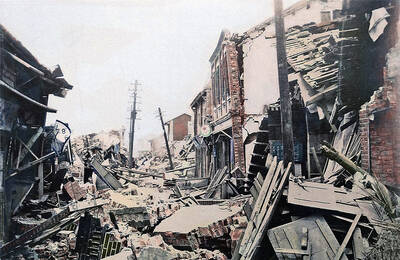
April 15 to April 21 Yang Kui (楊逵) was horrified as he drove past trucks, oxcarts and trolleys loaded with coffins on his way to Tuntzechiao (屯子腳), which he heard had been completely destroyed. The friend he came to check on was safe, but most residents were suffering in the town hit the hardest by the 7.1-magnitude Hsinchu-Taichung Earthquake on April 21, 1935. It remains the deadliest in Taiwan’s recorded history, claiming around 3,300 lives and injuring nearly 12,000. The disaster completely flattened roughly 18,000 houses and damaged countless more. The social activist and


 RSS
RSS