


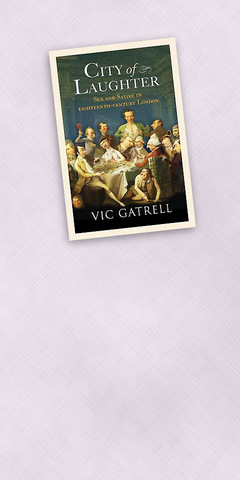
Laughter may be universal, but what provokes it is not. Even within a culture, humor can change drastically over a relatively short period. This truth is abundantly documented in City of Laughter, Vic Gatrell's study of comic prints produced in London during the late 18th and early 19th centuries, a period he deems the golden age of satire.
The humor on display in the prints of James Gillray, Thomas Rowlandson, and George Cruik-shank — the big three in Gatrell's pantheon — was often coarse, bawdy, scatological and obscene. Private parts were on graphic display. Chamber pots and their contents stood front and center. Prostitutes cavorted with princes. Everything that the readers of Jane Austen regarded as private or shameful was shown in living color, on large, beautifully printed sheets hung in the windows of dealers for all London to see, and to laugh at.
Gatrell, a professor of British history at the University of Essex and the author of The Hanging Tree, regards the approximately 20,000 satiric prints published between 1770 and 1830 as social documents. In many cases they are also very funny jokes, but more usefully for Gatrell they provide visual clues to understanding the way that Londoners saw themselves and the world around them.
"No other city was so dynamic, free and uncensored, and nowhere else were the comedies of snobbery and emulation played out and ridiculed so determinedly," he writes. The excesses of the rich, the corruption of the political elite and the absurdities of fashion provided rich material for comic artists, who, thanks to virtually nonexistent libel laws, could fire away at will. Nothing was sacred, and no one was safe, least of all the royal family.
About half the satiric prints produced in this period dealt with political matters. Gatrell is more interested in the other half, the prints that dealt with gossip, fashion, manners and sexual relations, although the two halves often overlap, especially in the many prints devoted to the sexual escapades of the prince regent, the future George IV. Taken as a whole these social prints depict a society in which the well-born mingled easily with the lower orders, whose speech and behavior they freely adopted, a society that tended to laugh at rather than condemn drunkenness, lechery and the idle pursuit of what the early-19th-century novelist Pierce Egan called "fun, frolic, fashion and flash."
Gatrell pays close attention to the subgenre known as debauchery prints, which usually depicted young clubmen and prominent political figures at table or tearing up the town. Copious vomiting, urination, erotic play and bad behavior of every sort figured prominently in these prints, but such scenes were offered as comic spectacles rather than moral lessons. Prostitution tended to be depicted in a manner that was "comically upbeat rather than judgmental." Women were assumed to be just as hungry for sex as their male pursuers.
One of the more fascinating social changes that Gatrell traces is the gradual refusal to laugh at jokes that convulsed the typical English citizen of the 18th century. Tobias Smollett's Adventures of Peregrine Pickle, first published in 1751, contained a wealth of surefire scatological material and jokes about drilling holes in chamber pots. Most of them had to be deleted in the second edition, published a mere six years later, probably, Gatrell theorizes, to accommodate a growing female readership.
By the time Jane Austen put pen to paper, manners had been domesticated and humor tamed, as an increasingly influential middle class defined itself in opposition to both the laboring classes and the aristocracy. Just try to imagine Mister Darcy doing cow imitations, dandling a whore on his knee or breaking wind loudly at the dinner table.
Visual culture did not bend so easily. What disappeared from the novel remained in prints for decades. Gatrell, in elevating the later 18th century above the age of Pope, argues that visual satire, in a culture starved for pictorial images, packed more punch and wielded greater influence.
"Not only did it circulate more widely; it was also longer and more easily remembered," he writes. Gatrell makes a spirited argument, but it seems unlikely that Gillray and Rowlandson will displace Swift, Pope and Dryden.
City of Laughter ought to be much more fun to read than it is. The prints themselves, hundreds of them, are wonderful, and Gillray, in full flight, can be hilarious, with a surreal touch that makes him seem much more modern than his peers.
Gatrell provides expert, detailed commentary on each and every one. There is no task as thankless as explaining a joke of course, but Gatrell makes matters worse by overarguing and repeating himself. There is a fine line between making a point and belaboring it. Gatrell crosses it constantly.
He appends half a dozen supporting quotations to every assertion when one or two would do quite nicely. Having unearthed a mountain of material in researching his subject, he cannot let any of it go. Specialists will no doubt be grateful, but the general reader cannot help but feel put upon.
The prints provide welcome relief. Check out Gillray's Fashionable Contrasts, or the Duchess' Little Shoe Yielding to the Magnitude of the Duke's Foot, a topical print, alluding to the marriage of the duke and duchess of York, it shows nothing more than two pairs of ankles and two pairs of feet recumbent upon a bed. In between the tiny, outturned female feet, shod in dainty shoes, lie two gargantuan ankles and two feet in buckled shoes so large they hang over the end of the bed. The viewer, imagining the rest, completes the joke. It is still funny.

In late October of 1873 the government of Japan decided against sending a military expedition to Korea to force that nation to open trade relations. Across the government supporters of the expedition resigned immediately. The spectacle of revolt by disaffected samurai began to loom over Japanese politics. In January of 1874 disaffected samurai attacked a senior minister in Tokyo. A month later, a group of pro-Korea expedition and anti-foreign elements from Saga prefecture in Kyushu revolted, driven in part by high food prices stemming from poor harvests. Their leader, according to Edward Drea’s classic Japan’s Imperial Army, was a samurai

Located down a sideroad in old Wanhua District (萬華區), Waley Art (水谷藝術) has an established reputation for curating some of the more provocative indie art exhibitions in Taipei. And this month is no exception. Beyond the innocuous facade of a shophouse, the full three stories of the gallery space (including the basement) have been taken over by photographs, installation videos and abstract images courtesy of two creatives who hail from the opposite ends of the earth, Taiwan’s Hsu Yi-ting (許懿婷) and Germany’s Benjamin Janzen. “In 2019, I had an art residency in Europe,” Hsu says. “I met Benjamin in the lobby
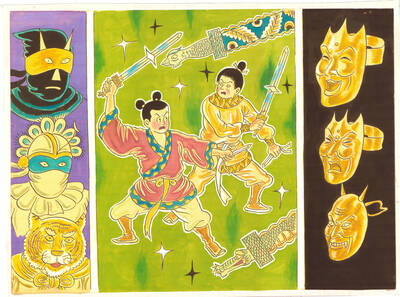
April 22 to April 28 The true identity of the mastermind behind the Demon Gang (魔鬼黨) was undoubtedly on the minds of countless schoolchildren in late 1958. In the days leading up to the big reveal, more than 10,000 guesses were sent to Ta Hwa Publishing Co (大華文化社) for a chance to win prizes. The smash success of the comic series Great Battle Against the Demon Gang (大戰魔鬼黨) came as a surprise to author Yeh Hung-chia (葉宏甲), who had long given up on his dream after being jailed for 10 months in 1947 over political cartoons. Protagonist

A fossil jawbone found by a British girl and her father on a beach in Somerset, England belongs to a gigantic marine reptile dating to 202 million years ago that appears to have been among the largest animals ever on Earth. Researchers said on Wednesday the bone, called a surangular, was from a type of ocean-going reptile called an ichthyosaur. Based on its dimensions compared to the same bone in closely related ichthyosaurs, the researchers estimated that the Triassic Period creature, which they named Ichthyotitan severnensis, was between 22-26 meters long. That would make it perhaps the largest-known marine reptile and would


 RSS
RSS