


Imagine going on an expedition deep into the jungle to find one of the last hidden tribes left on the planet and make "first contact" with them. A holiday to quicken the pulse — and not just among extreme sports desperados? What's on offer is a chance to go back a hundred years to the time when the world's powers were racing to fill in the blanks on the maps. For just a month and £3,000 (NT$191,887) you could don the khakis and discover a tribe that has never before set eyes on an outsider. You might even be shot at by bushmen with bows and arrows.
This is the experience offered by Kelly Woolford, a 43-year-old former tennis coach from Wisconsin who runs an adventure travel outfit based in Bali. He specializes in trekking trips to West Papua, the most eastern province of Indonesia, a rugged land of swamp, jungle and mountain. Access to the interior must be made either by boat, up one of the many rivers snaking north and south from the mountainous spine of the island, or via chartered light aircraft and a short landing strip hacked from the jungle.
There has been tourism in West Papua for many years but few have ventured beyond a few well-trodden destinations. Much of the province has only been surveyed from the air and with good reason — away from the navigable rivers, travel can be slow and arduous, the way forward barred by torrents and treacherously steep, overgrown terrain.
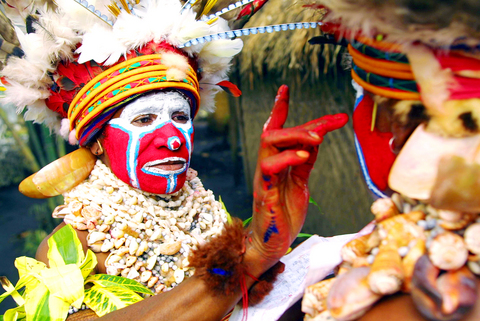
PHOTOS: AGENCIES
Woolford runs all the usual tours but his "first contact" expeditions are the real draw. He promises encounters with "truly 'stone-age' tribes ... people who have never experienced anything from our modern world". It seems incredible. On a planet populated by six billion, where traditional tribes are being pushed to the brink of extinction, can there really still be undiscovered peoples? Yet it's not such a fantastic claim. Survival International, a UK-based charity working to protect the rights of indigenous peoples, reckons New Guinea "has the largest number of un-contacted peoples' outside Brazil." Most anthropologists are skeptical, citing the improbability of an entire tribe somehow escaping the scrutiny of the thousands of explorers, soldiers, missionaries and prospectors who have crisscrossed the island for the past 150 years. Queasy at Woolford's human safaris, they point to the arrogance inherent in the very concept of "first contact". And what constitutes a genuine "first contact" anyway? Does it have to be their first view of white skin, or would a man from the neighboring Moluccas Islands count? Or a Papuan from another part of the island?
Woolford, however, is adamant there are still "lost" tribes in West Papua and dismisses as professional protectionism claims to the contrary. Anthropologists are simply too afraid, he says, to go into the areas he visits.
It did not take long for his expeditions to attract a clientele — or controversy. When Outside Magazine, a respected US adventure journal, sent one of its reporters on a first contact expedition in 2004, the ensuing article effectively claimed the whole trip had been a hoax and that Woolford had somehow staged a show of tribal aggression deep in the forest. Anthropologists shown photographs of the "ambush" agreed, pointing to the fact that the tribesmen were wearing ceremonial dress: what amounted to their Sunday best. In response, Woolford invited the BBC on the first expedition scheduled of this year.
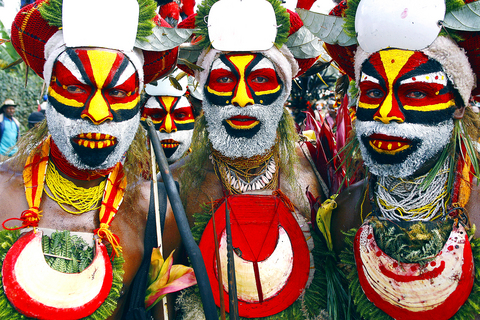
My initial reaction to being asked to accompany this film crew was emphatically negative. Previously unaware of first contact tourism, I was angry at the very idea.
If peoples do exist in West Papua who are unknown beyond, say, their neighbors' tribal territories, I believe it must be because they wish to escape detection — which means they must know far more about the outside world than we give them credit for. Why would they now reveal themselves to a bunch of sweating white men? The more convinced of a hoax I became, the more I began to relax about Woolford's operation, and the prospect of joining one of his trips. The two locals who were to act as our guide had, he told us, been prospecting for gold up in the hills when they had been taken prisoner by a tribe who ate raw meat. Relieved of their clothes and machetes, they had eventually been released, and were now willing to lead us back to the same place. No tribe I had come across ate raw meat: what about worms? With our film crew along, I thought Woolford would pull out all the stops: we would probably be taken prisoner, too, forced to eat raw rat, then miraculously released.
I signed up and three months later was motoring upriver beneath a cloud of giant fruit bats. The film crew and I were in two minds about whether we were being hoaxed. We dissected everything that was going on; Woolford disappearing for a day in the boat; the hopeless disorganization that allowed the boatmen to steal half our food. Often Woolford seemed barely in control of our small army of porters, let alone of some larger scam.
On the other hand, a hoax wouldn't be hard to arrange. All you'd need is to have met the tribesmen before and to have a trusty man slip ahead to make sure the group was met in style. Many Papuan tribes traditionally meet strangers on their territory with angry posturing and arrows brandished or even fired overhead — it's protocol. In this case, they'd just have to slow it down for photos and then make sure they got everyone running for their lives as a finale.
But as the days passed and our caravan snaked towards the dark hills ahead, we still could not work out what was going on. I liked Woolford. I wanted him to be hoaxing us and for the tribe to be making something out of it, but I just couldn't be sure. One day we passed the remains of an enormous logging operation that had been going for 30 years. Surely the tribesmen and loggers must have made contact? But the next day we were into terrain where no bulldozer could ever go.
As we climbed through ever steeper gorges, my fear that Woolford was indeed leading us toward a genuine first contact increased. I did not want that shame and guilt again. Furthermore, several of our porters had colds. In West Papua first contact does not seem to have had the same catastrophic consequences that it had in the Amazon where, typically, around 50 percent of a tribe would die within a year from imported diseases, including the common cold. But who wanted to take that risk? Part of me wanted to turn back but I was also feeling that powerful drive of excitement and curiosity again.
Two days later, one of the path-cutting team came crashing back through the undergrowth and breathlessly told us that one of the prospectors had met some of the tribe. There was no fear on his face, so we marched ahead. The prospector was standing by the river with two men and two boys. All four were naked but for penis gourds, and the men held bows and arrows; it was immediately apparent this was a friendly meeting. Vigorous hand-shaking was still in progress as Woolford and I joined them. We smiled and, squatting in the mud, smoked each other's tobacco and tried to communicate. I felt relief at their obvious ease — and the fact that they wore plastic bead necklaces. Woolford could not hide his disappointment. He perked up, however, when they promised to take us to their village the next day.
In the morning the hunting party was gone. We never did get to the village and I still do not know for sure whether or not there are genuine first contacts to be made in West Papua. Watching one of our porters splashing about in a river one day, however, it struck me that if a naked hunter-gatherer were to emerge from the forest and dress himself in shorts and a T-shirt, he would look exactly like one of our porters; would he still be a traditional hunter-gatherer? And would he be less interesting purely because he was carrying an old steel machete rather than a bow and arrow?
Mark Anstice is the author of First Contact (Eye Books). He has made two documentaries, First Contact, on BBC TV in January, and a six-part series for Discovery, to be shown later next year (2007).

In late October of 1873 the government of Japan decided against sending a military expedition to Korea to force that nation to open trade relations. Across the government supporters of the expedition resigned immediately. The spectacle of revolt by disaffected samurai began to loom over Japanese politics. In January of 1874 disaffected samurai attacked a senior minister in Tokyo. A month later, a group of pro-Korea expedition and anti-foreign elements from Saga prefecture in Kyushu revolted, driven in part by high food prices stemming from poor harvests. Their leader, according to Edward Drea’s classic Japan’s Imperial Army, was a samurai

The following three paragraphs are just some of what the local Chinese-language press is reporting on breathlessly and following every twist and turn with the eagerness of a soap opera fan. For many English-language readers, it probably comes across as incomprehensibly opaque, so bear with me briefly dear reader: To the surprise of many, former pop singer and Democratic Progressive Party (DPP) ex-lawmaker Yu Tien (余天) of the Taiwan Normal Country Promotion Association (TNCPA) at the last minute dropped out of the running for committee chair of the DPP’s New Taipei City chapter, paving the way for DPP legislator Su

Located down a sideroad in old Wanhua District (萬華區), Waley Art (水谷藝術) has an established reputation for curating some of the more provocative indie art exhibitions in Taipei. And this month is no exception. Beyond the innocuous facade of a shophouse, the full three stories of the gallery space (including the basement) have been taken over by photographs, installation videos and abstract images courtesy of two creatives who hail from the opposite ends of the earth, Taiwan’s Hsu Yi-ting (許懿婷) and Germany’s Benjamin Janzen. “In 2019, I had an art residency in Europe,” Hsu says. “I met Benjamin in the lobby
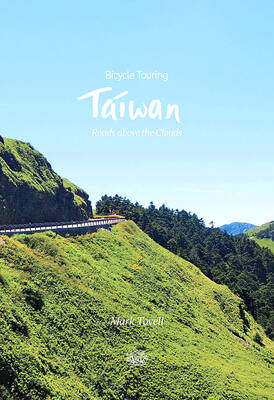
It’s hard to know where to begin with Mark Tovell’s Taiwan: Roads Above the Clouds. Having published a travelogue myself, as well as having contributed to several guidebooks, at first glance Tovell’s book appears to inhabit a middle ground — the kind of hard-to-sell nowheresville publishers detest. Leaf through the pages and you’ll find them suffuse with the purple prose best associated with travel literature: “When the sun is low on a warm, clear morning, and with the heat already rising, we stand at the riverside bike path leading south from Sanxia’s old cobble streets.” Hardly the stuff of your


 RSS
RSS