


The religion with the most adherents on the planet is Christianity, and few people would say they are unfamiliar with the story of its founder and prophet, Jesus. The second largest faith is Islam, and yet there is boundless ignorance among non-Muslims about the story of its founder and prophet, Mohammed, even after 9/11 set off a global panic about whether Islam fuels terrorism.
Since then Mohammed has been defined by his detractors, who have called him a terrorist, a lunatic and most colorfully — by the Reverend Jerry Vines, former president of the Southern Baptist Convention — a "demon-possessed pedophile." Even Pope Benedict XVI, whatever his intention, created an uproar by unearthing a remark from a 14th-century emperor who cited Mohammed's contributions to religion as "only evil and inhuman." Is this the prophet of the world's 1.3 billion Muslims?
It may be time then to put down the biographies of John Adams and Ronald Reagan and devote a little attention to Mohammed. But beware. Several new biographies picture Mohammed through the lens of a suicide bomber, and ultimately these books reveal more about suicide bombers than Mohammed.
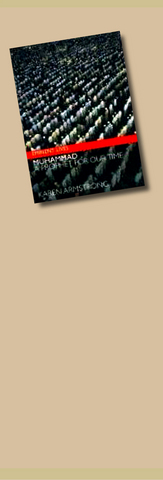
To glimpse how the vast majority of the world's Muslims understand their prophet and their faith, Karen Armstrong's short biography is a good place to start. The volume is part of a series called "Eminent Lives": small profiles of big-name subjects by big-name authors.
Armstrong, best known for A History of God, is a scholar and a former nun with a genius for presenting religions as products of temporal forces — like geography, culture and economics — without minimizing the workings of transcendent spiritual forces.
She profiles Mohammed as both a mystic touched by God on a mountaintop and a canny political and social reformer. He preached loyalty to God rather than tribe; reconciliation rather than retaliation; care for orphans and the poor; and in many ways, empowerment of women, which will be a surprise to some. The Koran gave women property rights and freed orphans from the obligation to marry their guardians: radical changes at a time when women were traded like camels.
Armstrong writes: "His life was a tireless campaign against greed, injustice and arrogance. He realized that Arabia was at a turning point and that the old way of thinking would no longer suffice, so he wore himself out in the creative effort to evolve an entirely new solution." In a nod to her subtitle, A Prophet for Our Time, she argues that as of Sept. 11, 2001, we have entered a new historical era that requires an equally thorough re-evaluation.
This notion that we have entered a new era was one of the reasons that Armstrong decided to revisit a subject she had already covered in 1992 with Mohammed: A Biography of the Prophet.
Mohammed (570-632) was born in a nouveau riche Mecca. Unlike most Arabs, the Meccans were not nomads but traders and financiers who profited from the caravans that stopped in Mecca for water from its underground spring. The site was holy to the Bedouin because it housed the Kabah, a cube-shaped granite building that was tended by Mohammed's tribe, the Quraysh.
Mohammed was orphaned as a child and taken in by relatives, but his fortunes changed at the age of 25 when he married Khadija, an older widow who hired him to manage her caravans. At 40, Mohammed declared he had been seized by a terrifying force and commanded by God to recite scripture.
Khadija was his first convert. At first he shared his revelations with a small group of friends and family members, who became his disciples, "convinced that he was the long-awaited Arab prophet." As Mohammed, who was illiterate, recited new passages, believers wrote them down: a compilation that became the Koran.
The Meccans were offended by Mohammed's preaching that the ideal was submission. ("Islam" means submission.) He taught that the proper way to pray was to bow, forehead to the earth, "a posture that would be repugnant to the haughty Quraysh," Armstrong notes. Mohammed also insisted that the Meccans abandon the worship of their three stone goddesses, because there was only one God, Allah.
Mohammed and his followers were exiled to Medina, 400km north of Mecca. He did not conquer Medina so much as form alliances and win converts. But there were epic battles with the Quraysh and other tribes, and Mohammed was a fighter and tactician.
"Mohammed was not a pacifist," Armstrong writes. "He believed that warfare was sometimes inevitable and even necessary."
This is why some passages in the Koran are rules for warfare. Terrorist groups cite these selectively — or contort or violate them. The Koran says not to take aim at civilians; some terrorist groups declare all Israelis to be combatants because Israelis are required to perform military service.
Armstrong declines to stand in judgment of events that have scandalized other biographers; as when Mohammed falls for the wife of his adopted adult son and takes her as his fifth wife. Armstrong writes: "This story has shocked some of Mohammed's Western critics who are used to more ascetic, Christian heroes, but the Muslim sources seem to find nothing untoward in this demonstration of their prophet's virility. Nor are they disturbed that Mohammed had more than four wives: Why should God not give his prophet a few privileges?"
Mohammed ultimately took back Mecca and reclaimed the Kaabah, still the destination for the Muslim pilgrimage. Armstrong argues that he prevailed by compassion, wisdom and steadfast submission to God. This is the power of his story and the reason that more parents around the world name their children Mohammed than any other name.

Last week Joseph Nye, the well-known China scholar, wrote on the Australian Strategic Policy Institute’s website about how war over Taiwan might be averted. He noted that years ago he was on a team that met with then-president Chen Shui-bian (陳水扁), “whose previous ‘unofficial’ visit to the US had caused a crisis in which China fired missiles into the sea and the US deployed carriers off the coast of Taiwan.” Yes, that’s right, mighty Chen caused that crisis all by himself. Neither the US nor the People’s Republic of China (PRC) exercised any agency. Nye then nostalgically invoked the comical specter
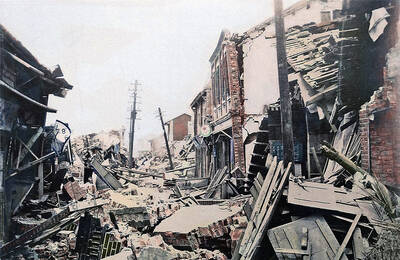
April 15 to April 21 Yang Kui (楊逵) was horrified as he drove past trucks, oxcarts and trolleys loaded with coffins on his way to Tuntzechiao (屯子腳), which he heard had been completely destroyed. The friend he came to check on was safe, but most residents were suffering in the town hit the hardest by the 7.1-magnitude Hsinchu-Taichung Earthquake on April 21, 1935. It remains the deadliest in Taiwan’s recorded history, claiming around 3,300 lives and injuring nearly 12,000. The disaster completely flattened roughly 18,000 houses and damaged countless more. The social activist and

Over the course of former President Ma Ying-jeou’s (馬英九) 11-day trip to China that included a meeting with Chinese Communist Party (CCP) leader Xi Jinping (習近平) a surprising number of people commented that the former president was now “irrelevant.” Upon reflection, it became apparent that these comments were coming from pro-Taiwan, pan-green supporters and they were expressing what they hoped was the case, rather than the reality. Ma’s ideology is so pro-China (read: deep blue) and controversial that many in his own Chinese Nationalist Party (KMT) hope he retires quickly, or at least refrains from speaking on some subjects. Regardless

Approaching her mid-30s, Xiong Yidan reckons that most of her friends are on to their second or even third babies. But Xiong has more than a dozen. There is Lucky, the street dog from Bangkok who jumped into a taxi with her and never left. There is Sophie and Ben, sibling geese, who honk from morning to night. Boop and Pan, both goats, are romantically involved. Dumpling the hedgehog enjoys a belly rub from time to time. The list goes on. Xiong nurtures her brood from her 8,000 square meter farm in Chiang Dao, a mountainous district in northern Thailand’s


 RSS
RSS