


Tom DeLisle, sporting thigh-high waders, squishes through mud and cattails surrounding a pond near Albany, looking for wayward beavers that might have wandered into one of his underwater traps. Alas, his instant-kill traps, baited with Backbreaker castor oil, are empty. But DeLisle plans to keep trapping all winter, knowing that the pelts of beavers and other animals will grow thicker — and may fetch a better price when he sells them — as the months wear on.
"Come trapping season, it's hard to wait," DeLisle said of his pursuit. "It's like a kid on Christmas morning."
At his warehouse in northern Greece, Sotiris Vogiatzis, a fur wholesaler, eagerly waits for pelts from trappers like DeLisle because beaver is a hot fashion item in places like Russia and Turkey. Five years ago, Vogiatzis was buying 5,000 beaver pelts a year; now he buys about 30,000 annually, at prices that have climbed to US$30-US$35 each, from about US$26-US$28. After he gets the pelts — known in the trade as skins — he ships them to plants where they are sheared, tanned, plucked and dyed.

PHOTOS: AGENCIES
Once treated, the beaver skins make their way into the hands of fashion designers around the world, like Zuki Balaila in Montreal. Balaila has been working with beaver since the 1970s (when he was known as "Kooky Zuki," because he dyed beaver in vivid reds and blues for American fashionistas). Today, he serves markets far beyond North America.
"Now we export to China and [South] Korea, which is unheard of," he said, taking special note of surging demand in Russia. "Moscow is like New York City."
As humble beaver skins circle the world at steadily rising prices, so goes the fur market as a whole. Buoyed by the globalization of trade and the broader reach of the fashion industry, sales of fur garments, trim and accessories amounted to about US$13 billion for the fiscal year ended August 2005, the most recent for which data is available — up 9 percent from the previous year and up 40 percent from five years earlier, according to the International Fur Trade Federation. The organization predicts that fiscal 2006 will show a further climb in sales.
PHOTOS: AGENCIES
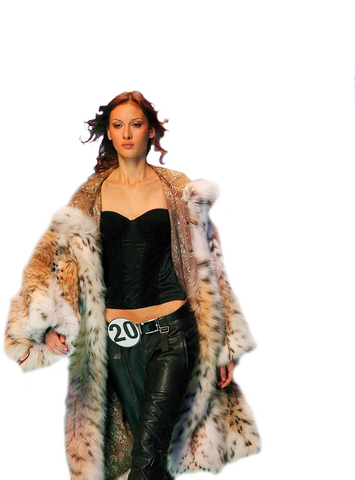
A variety of styles and colors — and for beaver, a new lightness and reversibility owing to improved shearing — has also helped fur fly off the rack worldwide. The price of mink, the gold standard of the fashion industry because of its softness and lightness, is at an all-time high (about US$57 a pelt for Danish mink, for example). Even lesser-known furs have caught fire. The show-stealer has been muskrat, the "poor man's mink," which tripled in price during the last year, to roughly US$8 a pelt. Lynx and western coyote skins are also selling well, while red fox and ubiquitous raccoon pelts have lagged. American consumers spent about US$1.8 billion on fur last year, a 50 percent increase since 1998.
Looming over the entire industry, of course, are animal-rights activists such as People for the Ethical Treatment of Animals, more commonly known as PETA. Activists have earned both enmity and fear in the fashion world for their in-your-face tactics, like the moment in 1996 when an unidentified protester tossed a dead raccoon onto the plate of Anna Wintour, Vogue's fur-wearing editor, as she dined at the Four Seasons.
While some designers, Ralph Lauren most recently, have abandoned fur after pressure from the animal-rights movement, the industry says that many more have taken it up. "The last five to six years, more than 400 international designers have included fur in their collections," said Tina Jagros, executive director of the North American Fur Association, a trade group. She estimates that this is double the number of designers who included it 15 years ago. With sales soaring, the fur trade has become bolder about taking on activists — even securing Osama bin Laden-like status for anti-fur marauders. Last month, the industry claimed a victory when US President George W. Bush signed the Animal Enterprise Terrorism Act, which gives federal authorities enhanced powers to prosecute animal-rights activists for certain offenses. (The act defines "animal enterprise" as any "commercial or academic enterprise that uses or sells animals or animal products for profit, food or fiber production, agriculture, research or testing.")
The main reason for the fur boom, however, may simply be that pricey pelts are now within the reach of a broader and younger population, particularly in developing countries like Russia and China. Innovations like knitted fur, laser-cutting, and precision dying techniques have also made fur more appealing. In another shift from decades past, fur is no longer considered intimidatingly formal.
"People are wearing their mink coats with their jeans," said Melisa Smart of the Alaskan Fur, a clothier based in Overland Park, Kansas. A few years ago, she even made fur jersey-jackets emblazoned with the numbers of the Kansas City Chiefs football players. "You could order a red sheared-beaver jersey with the number 88 on it," she said.
Within the chain that delivers fur from the wild or from farms to wholesalers, designers and retailers stand the trappers, who occupy the most basic and brutal rung in the hierarchy. Fur farms provide about 85 percent of the world's skins, according to the trade federation, with wild fur remaining largely a North American commodity.
Although eight states have severely restricted trapping, some 150,000 trappers ply their trade each winter in the US, and at least 70,000 in Canada. Increasingly, trappers focus on nuisance animals like beavers, muskrats or raccoons that suburbanites want removed. For his part, DeLisle arranges his trapping spots with homeowners and, like most trappers, pursues animals only part time.
DeLisle, a native New Yorker, began trapping when he was 13; his first catch was a muskrat. He recalls bicycling home with animals he had trapped, telling his mother about the catches, then skinning them in the basement, as he does at his own home today. Now his 17-year-old son enjoys trapping, too.
"It's either in your blood or it's not," DeLisle said of his hobby. A self-employed chimney sweep who traps for love of the outdoors, DeLisle caught 30 beavers last year. The US$900 he earned selling those skins accounted for roughly a quarter of his yearly earnings from trapping, most of which he plows directly back into the purchase of expensive traps. DeLisle stores and stretches his pelts to dry them out and then sends them off for sale, generally to an auction.
For trappers, the most important auctions are held in Canada. There are three: the North American Fur Auctions in Toronto, which handles 5.5 million pelts a year; the Fur Harvesters Auction in North Bay, several hundred kilometers north of Toronto, with more than a million pelts annually (DeLisle sends his catches there); and a small one for western pelts in Vancouver.
Luxury skins like mink — which analysts say accounts for more than 70 percent of the fur sold in the US — are mostly farmed. The largest mink producers are Denmark, with more than 12 million pelts annually, followed by China, the Netherlands, Russia and the US. The other heavily farmed animal, fox, is concentrated mostly in Finland.
There are more than 300 mink farms in the US, producing 2.9 million pelts. Utah has the most farms, owing to a large feeding cooperative in the state, but Wisconsin has the most animals, according to Teresa Platt, executive director of Fur Commission USA, an association of mink farms. Fur is so pivotal in Wisconsin that one House member from the state, Representative Tom Petri, was the leading sponsor of the Animal Enterprise Terrorism Act when it was originally introduced.
For decades, farm-raised animals like mink have been getting larger, and the pelts more profitable, because of careful breeding and feeding. Russia used to be a leader in mink farming. But annual mink production has dropped — to about 2.5 million pelts today from 15 million to 16 million before the collapse of the Soviet Union, according to Torben Nielsen, the chief executive of Kopenhagen Fur, the world's largest fur auctioneer.
China's burgeoning mink farms have come under special fire from animal-rights groups, which have sought to outlaw trapping and farming worldwide. PETA has posted a video on a Web site, furisdead.com, that it says was made in China and shows animals being skinned alive. The organization recently opened an office in Hong Kong.
People in the industry acknowledge problems. "Some of the farms we have visited are a very good standard. They use full European standards," said Thomas Wong, chairman of the Hong Kong International Fur Fair, where retailers buy garments for their stores. "But some of the farms they might take time to improve."
When the world's fur buyers gather at auctions, the atmosphere can be tumultuous. Vogiatzis, the Greek wholesaler, deals in most types of skins but buys particularly large quantities of raccoons at auctions. He describes the scene as a "madhouse."
During auction season in Toronto, truckloads of fur flood into the 14,000m2 warehouse of the North American Fur Auctions. As the items are sorted and displayed, the warehouse's concrete floor becomes slick with fur and oil.
Experienced graders in white coats categorize the skins by type and quality. The pelts — still stiff because they are raw and untanned — are then strung together into carefully labeled lots of varying sizes, some lots numbering in the hundreds. As the season progresses, the warehouse becomes a forest of dangling pelts, and the air within develops an intense odor.
In the refrigerated section — which resembles a closet packed with pelts, rather than dresses — raccoon skins are hung inside out (the better to expose blemishes), with their striped tails protruding below. They are hung in the cooler amid other skins, which on a recent visit included silver foxes with white-tipped tails, red foxes, coyotes, river otters and even a few dozen bears.
Several days before the auction, buyers and designers arrive to inspect the pelts before bidding. "When you have to stand up and check the skins for 14, 16 hours a day," Vogiatzis said, "it's not the easiest job in the world."
Vogiatzis, who joined his family's fur business 22 years ago, is one of the largest fur buyers in Greece and says his company has annual revenue of US$8 million to US$10 million. He started as a fur manufacturer in Kastoria, the center of the Greek fur industry, where he and his father employed 300 workers who made coats from minks, foxes and raccoons. But 15 years ago, Vogiatzis decided to shed the manufacturing side of his business and to deal exclusively in skins.
"It's like a small auction house here," he said of his operation. "Going around the world, selling skins — maybe it suits me better than production."
Vogiatzis has witnessed the advent of new fur markets, and the accompanying geographic shifts. When he joined his father's business, he sent furs mostly to Italy. Now most of his furs end up in Russia.
The No.1 factor affecting his business, he said, is the weather. "When the weather is cold, everything is good for us — we can sell," he said. This season, however, he is worried about a warm spell in Russia. "We depend on God sometimes," he said.

Last week Joseph Nye, the well-known China scholar, wrote on the Australian Strategic Policy Institute’s website about how war over Taiwan might be averted. He noted that years ago he was on a team that met with then-president Chen Shui-bian (陳水扁), “whose previous ‘unofficial’ visit to the US had caused a crisis in which China fired missiles into the sea and the US deployed carriers off the coast of Taiwan.” Yes, that’s right, mighty Chen caused that crisis all by himself. Neither the US nor the People’s Republic of China (PRC) exercised any agency. Nye then nostalgically invoked the comical specter

Relations between Taiwan and the Czech Republic have flourished in recent years. However, not everyone is pleased about the growing friendship between the two countries. Last month, an incident involving a Chinese diplomat tailing the car of vice president-elect Hsiao Bi-khim (蕭美琴) in Prague, drew public attention to the People’s Republic of China’s (PRC) operations to undermine Taiwan overseas. The trip was not Hsiao’s first visit to the Central European country. It was meant to be low-key, a chance to meet with local academics and politicians, until her police escort noticed a car was tailing her through the Czech capital. The
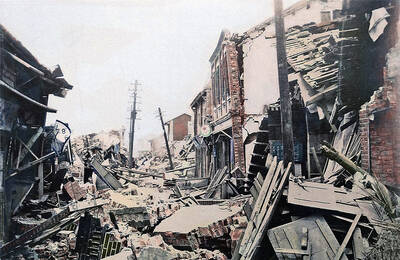
April 15 to April 21 Yang Kui (楊逵) was horrified as he drove past trucks, oxcarts and trolleys loaded with coffins on his way to Tuntzechiao (屯子腳), which he heard had been completely destroyed. The friend he came to check on was safe, but most residents were suffering in the town hit the hardest by the 7.1-magnitude Hsinchu-Taichung Earthquake on April 21, 1935. It remains the deadliest in Taiwan’s recorded history, claiming around 3,300 lives and injuring nearly 12,000. The disaster completely flattened roughly 18,000 houses and damaged countless more. The social activist and

Over the course of former President Ma Ying-jeou’s (馬英九) 11-day trip to China that included a meeting with Chinese Communist Party (CCP) leader Xi Jinping (習近平) a surprising number of people commented that the former president was now “irrelevant.” Upon reflection, it became apparent that these comments were coming from pro-Taiwan, pan-green supporters and they were expressing what they hoped was the case, rather than the reality. Ma’s ideology is so pro-China (read: deep blue) and controversial that many in his own Chinese Nationalist Party (KMT) hope he retires quickly, or at least refrains from speaking on some subjects. Regardless


 RSS
RSS