


Yoga has established itself as the next big thing in Taipei. The mushrooming of many new high profile and up-market yoga establishments in the capital's most fashionable districts seems undeniable proof that yoga, with its mixture of physical exercise and spiritual development, has arrived in Taiwan.
Space Yoga, which opened its doors in March 2005 off trendy Anhe Road, claims to have been the first "boutique" yoga studio to open in Taipei, and to have kick started a wave of yoga studio development. Before the arrival of Space, yoga was largely confined to occasional classes at the various gym chains (the big thing before the arrival of "boutique" yoga), and to various small yoga studios that did not aspire to expensive minimalism, picture windows, and air scented with essential oils.
Now of course, in the wake of the opening of Pure Yoga and True Yoga, as well as the massive expansion of the veteran Chiu Su Jen Yoga Center (邱素真瑜伽天地), Space is but one in a strong field of contenders vying to appeal to the demands of Taiwan's fickle consumers. It is certainly doing something right, for this week it announced its second expansion this year with the addition of three new classrooms and many other facilities to its Anhe Road center. Space has also recently brought over a number of highly regarded yoga masters for workshops that have attracted many local yoga teachers and celebrities.
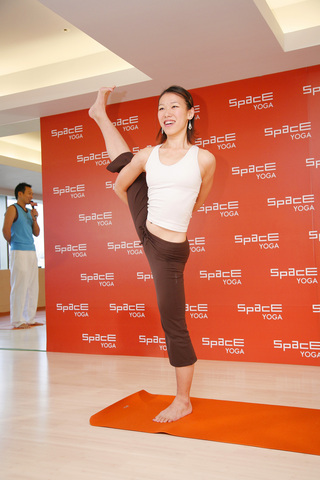
PHOTO COURTESY OF SPACE YOGA
According to Matthew Allison, Space began negotiations for some of these highly sought after celebrity teachers even before it opened in 2005. He said the aim is to develop the yoga community in Taiwan. "It is not about making money," Allison said of the workshop program, "but about building something." Space recently held a number of highly successful workshops under John Friend, the creator of Anusara yoga, and has scheduled visits by a number of other masters of various other styles taught by the center.
Allison said that bringing highly qualified teachers to Taiwan has not been easy, but the success of Space, and the strong community of students that it has built up, has made recruiting much easier. "Many teachers fear that in coming to Taiwan they may find themselves in a community in which their values are not supported," Allison said. Now that Space is firmly established, both in bricks and mortar in Taipei, as well as its slick Internet presence, potential teachers are much more willing to consider Taiwan as an option.
The increased willingness of US- and Canada-based teachers to come to Taiwan has proved a boon to Allison, who said that he has been astonished at the rapid growth in student numbers. The extension of the Anhe center has allowed the fitting of additional locker room facilities, as the original facilities proved insufficient for students from concurrent packed classes.
Having been the first center to introduce hot yoga and anusara, with its new facilities, Allison said that Space would now be better placed to introduce other forms of yoga. Speaking of his own experience, he said that he had gone through different forms of yoga at different times, and said that most people, in their development, would probably shift through a number of styles. "By offering different forms, we allow students to choose what best suits their needs," he said.
Allison himself, who worked as a senior music industry manager for Sony and EMI in Asia, said he began yoga as a way of dealing with knee problems during his mid-30s. Now, combining his business and marketing acumen with an ongoing interest in yoga, he has created what a Space spokesperson described as a boutique yoga studio. Atmosphere is just as important exercise, and while the rat race is kept outside the thick picture windows, it is certainly not forgotten. Plasma TVs (yoga programming) and WiFi are available for those taking a rest in the sparse comfort of the center's two lounge areas, and elegant lines of yoga wear and other paraphernalia are sold, though discreetly.

In late October of 1873 the government of Japan decided against sending a military expedition to Korea to force that nation to open trade relations. Across the government supporters of the expedition resigned immediately. The spectacle of revolt by disaffected samurai began to loom over Japanese politics. In January of 1874 disaffected samurai attacked a senior minister in Tokyo. A month later, a group of pro-Korea expedition and anti-foreign elements from Saga prefecture in Kyushu revolted, driven in part by high food prices stemming from poor harvests. Their leader, according to Edward Drea’s classic Japan’s Imperial Army, was a samurai
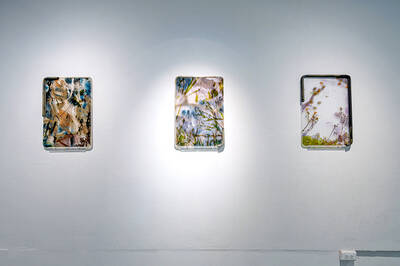
Located down a sideroad in old Wanhua District (萬華區), Waley Art (水谷藝術) has an established reputation for curating some of the more provocative indie art exhibitions in Taipei. And this month is no exception. Beyond the innocuous facade of a shophouse, the full three stories of the gallery space (including the basement) have been taken over by photographs, installation videos and abstract images courtesy of two creatives who hail from the opposite ends of the earth, Taiwan’s Hsu Yi-ting (許懿婷) and Germany’s Benjamin Janzen. “In 2019, I had an art residency in Europe,” Hsu says. “I met Benjamin in the lobby
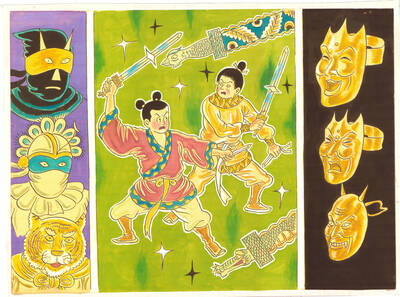
April 22 to April 28 The true identity of the mastermind behind the Demon Gang (魔鬼黨) was undoubtedly on the minds of countless schoolchildren in late 1958. In the days leading up to the big reveal, more than 10,000 guesses were sent to Ta Hwa Publishing Co (大華文化社) for a chance to win prizes. The smash success of the comic series Great Battle Against the Demon Gang (大戰魔鬼黨) came as a surprise to author Yeh Hung-chia (葉宏甲), who had long given up on his dream after being jailed for 10 months in 1947 over political cartoons. Protagonist

Peter Brighton was amazed when he found the giant jackfruit. He had been watching it grow on his farm in far north Queensland, and when it came time to pick it from the tree, it was so heavy it needed two people to do the job. “I was surprised when we cut it off and felt how heavy it was,” he says. “I grabbed it and my wife cut it — couldn’t do it by myself, it took two of us.” Weighing in at 45 kilograms, it is the heaviest jackfruit that Brighton has ever grown on his tropical fruit farm, located


 RSS
RSS