


For some years now a theatrical troupe called the Reduced Shakespeare Company has made its living performing all 37 of Shakespeare's plays in just over an hour and a half. It's a highbrow joke. In Civilization, Roger Osborne speeds through more than 40,000 years of Western history in just under 500 pages, minus bibli-
ography and index. This is definitely not a joke, although it comes close to being a stunt, an intellectual high-wire act that the author pulls off with deceptive ease.
Is anything missing? Apparently not. Socrates rates a long, considered look, but Osborne finds room for the lesser-known Cleisthenes. All the major rulers line up in good order, right down to British Prime Minister Tony Blair and US President George W. Bush. Battles and wars, scientists and inventors, artists and tycoons, all get their turn in a smoothly rolling narrative that embraces Michelangelo and Fats Domino, Galileo and Dolly the sheep, the steam engine and the McDonald's hamburger.

Civilization is not a recitation of greatest hits, or a checklist of events and dates. Osborne, with great skill, ties his disparate topics together into a coherent narrative, as absorbing as any novel, with felicitous turns of phrase, and tidy summations, on virtually every page. Theoretically it should be impossible to describe the life, thought and influence of Thomas Aquinas in less than two pages, but Osborne does it, showing no signs of strain. It would be hard to imagine a more readable general history of the West that covers so much ground so incisively.
But Osborne has profound doubts about his subject. His title might well have been followed by a question mark. At every point along the familiar trail of artistic achievement, scientific breakthrough and economic transformation, he stops to probe, often painfully, and to ask awkward questions. Greek philosophy, he suggests, may have planted the seeds of later disasters by equating abstraction — "teasing out the universals, the constants, the invariables from among the clamor and noise of the real world" — with clarity of thought.
Even the appearance of printed books carried unintended, sometimes undesirable consequences. "There had always been divisions in society," Osborne writes, "but in medieval times the divide between nobility, clergy and peasantry had still allowed access to spiritual wisdom and salvation to the lowest in society; the revival of a civilization of the written word placed most of the population outside its borders."
Even the Renaissance — "not so much a period of history as the repository of the myths we have created about western civilization" — undergoes a skeptical cross-examination. It was in 15th-century Florence that craftsmen proclaimed themselves artists, turning away from the mass audience that generations of their predecessors had spoken to and creating a permanent, pernicious division between low and high art.
Osborne moves in for the kill in his discussion of colonialism. His vague sense of unease with reason and progress as uncontested virtues culminates when he takes up the near-extermination of the native peoples of the Americas, a calamity that, for him, raises a disturbing thought. "We are drawn to wonder," he writes, "whether the western way of thinking and of organizing human affairs makes us incapable of gazing on, and perhaps even learning from, another culture without needing to dominate and destroy it and make it part of the western system."
The thoughts become darker as the centuries fly by. The armed nation state arises, concentrating power in the hands of small elites with conquest uppermost on their minds. The Industrial Revolution arrives with a deafening clamor, rending the social fabric. Scientific progress propels the nations of Europe, bristling with new armaments, into two wars of annihilation. Free-market economics in the postwar world spreads like a disease. As Osborne moves closer to the world we all inhabit, the rumblings grow louder, the criticism more pointed.
Osborne sees Western history as a series of transformations — social, philosophical and economic — that impel citizens rich and poor to look for new ways of organizing their world, the better to serve new desires and needs. His sympathies lie with the common folk, and with the pre-industrial past. His never-never land can be found in the early Middle Ages, "a period of diversity and mutual tolerance in which local culture, craftsmanship and scholarship could thrive within a continent-wide network, with few boundaries between nations, kingdoms, ethnic and religious orthodoxies, and little central control."
By contrast most of the developments since the Industrial Revolution have, in Osborne's view, led to stratified, intolerant, self-obsessed, materialistic societies dominated by corporations and, in their relations with the rest of the world, intent on imposing alien Western ideas like the nation state. In a grudging sort of way Osborne documents the growing prosperity of the West over the last two centuries, but never without noting, as he does in a discussion of the US in the 1920s, that under industrial capitalism "the cohesion of communities, customary arrangements, family loyalties must all be sacrificed to the continual churning need for better, cheaper, newer goods to be brought to market."
As he speeds through the history of the past 20 years, Osborne goes on something of a rant, teeing off against elitist art, abstract philosophy, the injection of moral categories into foreign policy, privatization of public industries and virtually everything else in sight, including and especially Western rationalism, a guiding light for 2,500 years.
"The fundamental western belief that there are rational ways of organizing the world which will bring benefit to all has been at the root of every human-made catastrophe that has overtaken us," he writes, "yet many of us still believe that we have a bounden duty to bring our simplistic, universalizing, 'progressive' systems of government, economics, education, policing, judiciary and morals to every part of every society on the planet."
Whew. Only at the end of the book does it become clear that Osborne has been engaged in a very strange project. While painstakingly reconstructing the imposing, intricate edifice of Western civilization, he has planted a series of explosive charges. And then, when the job is done, he lights the fuses and watches as the entire thing collapses into dust.

Last week Joseph Nye, the well-known China scholar, wrote on the Australian Strategic Policy Institute’s website about how war over Taiwan might be averted. He noted that years ago he was on a team that met with then-president Chen Shui-bian (陳水扁), “whose previous ‘unofficial’ visit to the US had caused a crisis in which China fired missiles into the sea and the US deployed carriers off the coast of Taiwan.” Yes, that’s right, mighty Chen caused that crisis all by himself. Neither the US nor the People’s Republic of China (PRC) exercised any agency. Nye then nostalgically invoked the comical specter

Relations between Taiwan and the Czech Republic have flourished in recent years. However, not everyone is pleased about the growing friendship between the two countries. Last month, an incident involving a Chinese diplomat tailing the car of vice president-elect Hsiao Bi-khim (蕭美琴) in Prague, drew public attention to the People’s Republic of China’s (PRC) operations to undermine Taiwan overseas. The trip was not Hsiao’s first visit to the Central European country. It was meant to be low-key, a chance to meet with local academics and politicians, until her police escort noticed a car was tailing her through the Czech capital. The
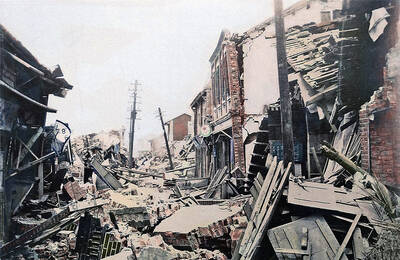
April 15 to April 21 Yang Kui (楊逵) was horrified as he drove past trucks, oxcarts and trolleys loaded with coffins on his way to Tuntzechiao (屯子腳), which he heard had been completely destroyed. The friend he came to check on was safe, but most residents were suffering in the town hit the hardest by the 7.1-magnitude Hsinchu-Taichung Earthquake on April 21, 1935. It remains the deadliest in Taiwan’s recorded history, claiming around 3,300 lives and injuring nearly 12,000. The disaster completely flattened roughly 18,000 houses and damaged countless more. The social activist and

Over the course of former President Ma Ying-jeou’s (馬英九) 11-day trip to China that included a meeting with Chinese Communist Party (CCP) leader Xi Jinping (習近平) a surprising number of people commented that the former president was now “irrelevant.” Upon reflection, it became apparent that these comments were coming from pro-Taiwan, pan-green supporters and they were expressing what they hoped was the case, rather than the reality. Ma’s ideology is so pro-China (read: deep blue) and controversial that many in his own Chinese Nationalist Party (KMT) hope he retires quickly, or at least refrains from speaking on some subjects. Regardless


 RSS
RSS