


Around this time of year, as the nights draw in and carol-singers don their hats and scarves, David Franks can count on receiving several enraged telephone calls and letters demanding to know why he has banned the people in Luton, just north of London, from celebrating Christmas. The exact circumstances in which the Liberal Democrat leader of Luton borough council came to outlaw centuries of Christian tradition are unclear, not least to David Franks, but the central facts are always the same. He and his fellow councillors have forcibly replaced Christmas with a "Harry Potter-themed" event called Luminos, to avoid offending minorities.
The Luton controversy recurs annually, but this year something in the tone of it has changed. According to Christian leaders, vigorously backed by right-wing newspapers, Franks is no longer a fringe figure, but one crusader in a fully fledged national war against Christmas. "The crazy gang who constitute the local council at Luton," as the commentator AN Wilson called them in the London Daily Mail last weekend, now have sympathizers across the country: at the council that erased all mention of Christmas from its Christmas cards, in the town that banned a generous millionaire from erecting his annual charity lights display, and in the Scottish hospital that refused to distribute a Christmas CD because it mentioned Jesus, to name just three. Almost 75 percent of British employers, according to a survey released this week, have banned Christmas decorations for fear of offending other faiths, and don't realize they have a legal obligation to celebrate Diwali and Eid, whether they like it or not.
"The dead hand of political correctness is throttling the life out of the festive spirit," thundered the Sun newspaper, announcing, like the Mail, a front-page campaign to defend Christmas. (In Birmingham, the paper noted despairingly, "Christmas has been rebranded as Winterval.") Spurred on by the former Archbishop of Canterbury, George Carey, and by the Christian Muslim Forum, which has launched a national battle against the de-Christianizing of Christmas, local leaders of three faiths wrote to Franks in Luton this week. They warned darkly of the "anger within religious communities" that might erupt if he did not "refrain from renaming the Christmas festival using another (non-religious) name".
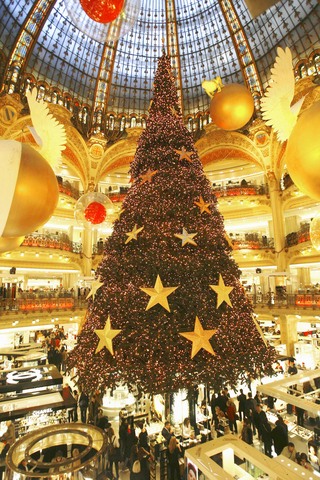
PHOTO: AFP
All of which might be reasonable, were it not for a few awkward facts. Luton does not have a festival called Luminos. It does not use any alternative name for Christmas. When it did, once, five years ago, hold something called Luminos one weekend in late November, the event didn't even replace the council's own Christmas celebrations, let alone forbid anyone else from doing anything. Similarly, Christmas is not called Winterval in Birmingham. The Royal Edinburgh Hospital for Sick Children never banned a Christmas CD for mentioning Jesus. And Chester council's "un-Christian" Christmas card says — as cards have done for decades — "Season's Greetings."
Religious clout
"We're not going to have a war, we're going to have the appearance of a war," says the cynical spin doctor in David Mamet's screenplay for the 1997 movie Wag The Dog, about an imaginary conflict created to whip up support for an ailing president. But he might equally have been talking about this year's war on Christmas — a war that tells us much about the growing politicization and sense of entitlement among religious groups in Britain, but which turns out to have been almost entirely invented.
The Campaign Against Political Correctness, headquartered in Kennington in south London, bases its pitch to potential members on the argument that Britain is approaching boiling-point in the backlash against misguided attempts to avoid offending minorities. "The difference now is that people are angry about it," says Philip Davies, a Conservative member of parliament, who is the campaign's parliamentary spokesman and a loud critic of the War on Christmas. "People used to laugh about it, but that's changed... they're angry with white, middle-class liberal do-gooders with some kind of guilt complex and too much time on their hands."
Judging by the Sun's Christmas defense campaign (headline: "Kick 'em in the baubles!"), they are particularly angry in the village of Sonning, near Reading, where "a court banned a millionaire from putting up his annual charity light display outside his home." As with so many aspects of the PC war on Christmas, trying to find the truth about Sonning's frustrated philanthropist feels like chasing a shadow across a misty field: the factual basis for the controversy continually evades your grasp, then evaporates entirely.
The facts are as follows: in recent years, Vic Moszczynski's "annual charity light display" involved 20,000 lights, covering his home, and supplemented with large illuminated snowmen and amplifiers emitting Christmas songs into the street. (The term "housebling" started appearing on the Internet in 2004 to describe just such gaudy displays). The local Wokingham district council eventually won an injunction against him, citing neighbor complaints, traffic snarl-ups, increased levels of crime, and a ?7,400 (NT$467,500) bill for policing Moszczynski's neighborhood. Not that he has actually been banned from putting up a display: it was still there this year, a little more restrained but still prominent, and featuring a snow machine. Indeed, so ineffectively was Moszczynski banned from celebrating the festive season that he was the guest of honor at a shopping precinct in nearby Reading town center last month — to switch on the Christmas lights.
Of course, to dismantle the myth of a full-scale War on Christmas, it isn't necessary to prove that no low-level council functionary has ever once misguidedly tried to avoid offence by eliminating references to religion. That's what seems to have happened in Lambeth, south London, last year, when the council's monthly newsletter, Lambeth Life, referred to some Christmas light displays as "winter lights" — the council swiftly accepted it was an error — and also in High Wycombe, just west of London, where a member of the library staff refused to display an A4 poster for a carol service in 2003 because of a rule excluding religious or political posters from a notice board.
More frequently, though, there's even less truth to the allegations than that. The Christmas CD allegedly banned at the Royal Edinburgh Hospital for Sick Children, for example, was not only not banned — it was actually made available at a hospital carol service. (The examples are never-ending: when the London Daily Express screamed "Now Christ Is Banned" on its front page last winter, it was in response to news that the letters "BC" had been removed from some exhibits at the Cheddar Gorge Museum, in the west of England, in line with modern curatorial practice.)
"There's something very complicated going on here," says Terry Sanderson, president of the National Secular Society. "It has to do with the contest between Christianity and Islam: Christians are becoming very alarmed about the progress they see Islam making in this country, and they fear their own festivals will be overwhelmed. I was doing a phone-in the other day, and everybody who rang in was saying, "They're banning Christmas!" So I said: "Who? Where? Who's standing outside a church saying you can't go in? Who's coming and knocking on your door at 6am and asking if there's a nativity set in your house?" It's quite dangerous, "I think, to incite this kind of resentment against a perceived enemy."
This year, though, the defenders of Christmas aren't only invoking the fear that nebulous Muslim forces might be about to obliterate Britain's traditional religion. Simultaneously, they have also aligned themselves with Muslim groups, arguing that the real enemy is secularization. It's a position well-crafted for the historical moment, and for the currently fashionable notion of Britain as comprised of groups defined above all by their faith (even though barely 10 percent of us regularly attend any kind of religious service). "Any repetition of public bodies or local authorities renaming Christmas, so as not to offend other faith communities, will tend, as in the past, to backfire on the Muslim community in particular," the Christian Muslim Forum warned in a letter to councils last month.
Christmas rebranded
Perhaps the most notorious of the anti-Christmas rebrandings is Winterval, in Birmingham, and when you telephone the Birmingham city council press office to ask about it, you are met first of all with a silence that might seasonably be described as frosty. "We get this every year," a press officer sighs, eventually. "It just depends how many rogue journalists you get in any given year. We tell them it's bollocks, but it doesn't seem to make much difference."
According to an official statement from the council, Winterval — which ran in 1997 and 1998, and never since — was a promotional campaign to drive business into Birmingham's newly regenerated town center. It began in early November and finished in January. During the part of that period traditionally celebrated as Christmas, "there was a banner saying Merry Christmas across the front of the council house, Christmas lights, Christmas trees in the main civil squares, regular carol-singing sessions by school choirs, and the Lord Mayor sent a Christmas card with a traditional Christmas scene wishing everyone a Merry Christmas."
None of that, though, was enough to prevent a protest movement at the time, whose members included the then Bishop of Oxford as well as two members of UB40. The leader of the anti-Winterval campaign, Ken White, fulfilled a key requirement of all such disputes: the people of Birmingham, he declared, were the victims of "political correctness gone mad."
Then, last year, the War on Christmas received a massive boost when it exploded on to the American political landscape, thanks primarily to two Fox News anchormen, John Gibson and Bill O'Reilly. Gibson had a vested interest, having just published a book entitled The War On Christmas: How The Liberal Plot To Ban The Sacred Christian Holiday Is Worse Than You Thought. (A note in the interests of full disclosure: O'Reilly, as I enjoy telling people whenever possible, accused me of "spout[ing] incredible nonsense" earlier this year after I wrote a story for the London Guardian newspaper about a speech in which he invited al-Qaeda to attack the liberal stronghold of San Francisco; previously, he had speculated that the Guardian "might be edited by Osama bin Laden.")
The American War on Christmas, like the British one, relied on a grab-bag of tenuous stories that crumbled on closer analysis. O'Reilly was forced to apologize on air for suggesting that a school district in Texas had banned red-and-green clothing. Meanwhile, Gibson railed against the decision to call the Capitol's Christmas tree a "Holiday tree" — even though, by the time his book was published, the decision had been reversed.
This week's survey by the employment law firm Peninsula, suggesting that 74 percent of British employers have banned Christmas decorations for fear of offending non-Christians, seems similarly beset with problems. Even the Christian Muslim Forum accepts that the key question — "Do you admit to banning Christmas decorations because you are worried about offending other faiths?" — seems pointedly phrased, and several follow-up questions seem designed to steer respondents in an anti-Christmas direction. Even if the fear is real, one might reasonably attribute it precisely to the newspapers' provocative campaigns against the alleged War on Christmas. (After all — as everyone involved in the argument agrees — it's not as if there's any track record of anybody actually taking legal action because they were offended.) Finally, the survey asks: "Are you aware of your legal requirement to celebrate all faiths?" But according to the UK industrial conciliation service Acas, there is no such obligation.
The Christian Muslim Forum's letter to councils did not provide any examples of the purported de-Christianisation of Christmas, and Julian Bond, the group's director of management and communication, seems equally reluctant to do so. "There have been incidents," he says. "I was looking them up on the Internet the other day. There was one from a hospital in Scotland, where they'd received some CDs of Christmas carols, and some obviously mentioned the baby Jesus, and the hospital said it wasn't appropriate." But, he concedes, "it does all seem to have been more prevalent in previous years. It does seem to have disappeared this year." Does the forum plan to compile a list of examples of the war being waged on Christmas? "We haven't published anything like that," Bond says. "It's difficult to get hold of."
He goes on: "You know, we were in Birmingham for a meeting the other day, and there's a big Merry Christmas banner in the middle of New Street." So is anybody at all trying to abolish Christmas this year? "I haven't come across any examples of anyone doing it this year," he replies. "No."
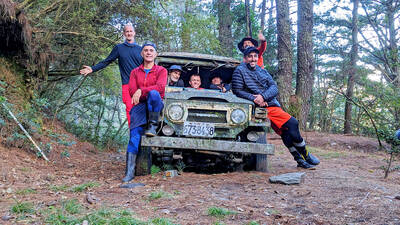
The year was 1991. A Toyota Land Cruiser set out on a 67km journey up the Junda Forest Road (郡大林道) toward an old loggers’ camp, at which point the hikers inside would get out and begin their ascent of Jade Mountain (玉山). Little did they know, they would be the last group of hikers to ever enjoy this shortcut into the mountains. An approaching typhoon soon wiped out the road behind them, trapping the vehicle on the mountain and forever changing the approach to Jade Mountain. THE CONTEMPORARY ROUTE Nowadays, the approach to Jade Mountain from the north side takes an
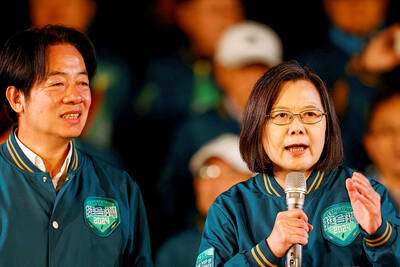
Last week Joseph Nye, the well-known China scholar, wrote on the Australian Strategic Policy Institute’s website about how war over Taiwan might be averted. He noted that years ago he was on a team that met with then-president Chen Shui-bian (陳水扁), “whose previous ‘unofficial’ visit to the US had caused a crisis in which China fired missiles into the sea and the US deployed carriers off the coast of Taiwan.” Yes, that’s right, mighty Chen caused that crisis all by himself. Neither the US nor the People’s Republic of China (PRC) exercised any agency. Nye then nostalgically invoked the comical specter
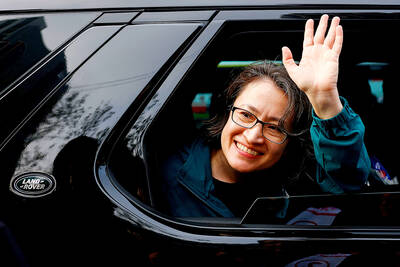
Relations between Taiwan and the Czech Republic have flourished in recent years. However, not everyone is pleased about the growing friendship between the two countries. Last month, an incident involving a Chinese diplomat tailing the car of vice president-elect Hsiao Bi-khim (蕭美琴) in Prague, drew public attention to the People’s Republic of China’s (PRC) operations to undermine Taiwan overseas. The trip was not Hsiao’s first visit to the Central European country. It was meant to be low-key, a chance to meet with local academics and politicians, until her police escort noticed a car was tailing her through the Czech capital. The
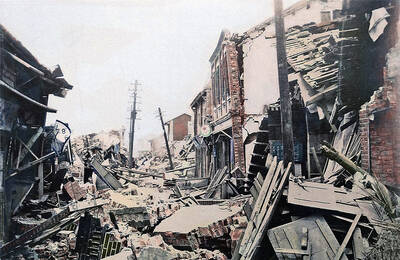
April 15 to April 21 Yang Kui (楊逵) was horrified as he drove past trucks, oxcarts and trolleys loaded with coffins on his way to Tuntzechiao (屯子腳), which he heard had been completely destroyed. The friend he came to check on was safe, but most residents were suffering in the town hit the hardest by the 7.1-magnitude Hsinchu-Taichung Earthquake on April 21, 1935. It remains the deadliest in Taiwan’s recorded history, claiming around 3,300 lives and injuring nearly 12,000. The disaster completely flattened roughly 18,000 houses and damaged countless more. The social activist and


 RSS
RSS