


The cars, the girls, the locales, the eye-popping gadgets — for a generation of fans, James Bond embodied the quintessence of British savoir-faire: the civil servant with a license to kill, the secret agent who saved civilization from a series of nefarious villains while staying in the world's fanciest hotels and romancing a bevy of beauteous babes.
In the entertaining and very funny new book The Man Who Saved Britain, Simon Winder — publishing director at Penguin — gives us a rollicking tour through Bondland, even as he artfully deconstructs the appeal of Agent 007. His central argument is that Bond arrived to uphold the British ego at the very moment when Britain's planet-spanning empire was breaking up and the once-great power was trying to come to terms with its diminished post-World War II role.
While Britain was coping in the 1950s and 1960s with unemployment, inflation, strikes, and demoralization, and making the humbling transition from empire to welfare state, "a solitary Englishman" — who embodied the old-fashioned belief that a single individual could save the day through sheer guts and expertise — was almost single-handedly maintaining "the country's reputation."
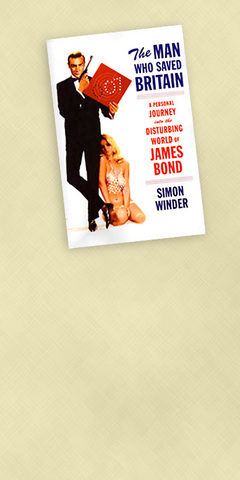
While "the magic, the romance and the often squalid reality of dominion over the world which had animated millions of emigrants, sailors, soldiers, traders, journalists for so many generations came to an absolute, unrecoverable, bewildering end," Winder writes, somewhere on the globe, in a luxury hotel, one man was secretly "slipping a .25 Beretta automatic into his chamois-leather shoulder holster, examining his rather cruel mouth in the bathroom mirror, putting on his dinner jacket and going out into the night to save their world."
Winder's thesis is hardly an original one — academics and journalists alike have made similar arguments many times before — but he explicates it with uncommon wit and elan, joining the pantheon of scholars and well-known authors (including Umberto Eco, Kingsley Amis, and Philip Larkin) who have found a multiplicity of literary and philosophic meanings in Ian Fleming's debonair creation.
An anomalous melange of cultural history, memoir, and criticism, The Man Who Saved Britain is at times repetitious and overly discursive, but it vividly evokes the bleak, gray world that Britons inhabited in the postwar years, a world in which Bond's international travels and casino visits "must have seemed derangedly heady to the book's first readers." And it expertly captures the knowing blend of nostalgia, sophistication, and plain absurdity that made the Bond books (and later the movies) such a hit in the 1950s and 1960s.
Curiously, the book contains no pictures of Bond or his nemeses or his gizmos: certainly a missed opportunity given the wealth of images from some 20 movies that span more than four decades.
Winder examines the roots the Bond books had in "Imperial Leather" pulp fiction (like H. Rider Haggard's King Solomon's Mines) and works by writers like John Buchan, Graham Greene, and Eric Ambler. He provides a lively sketch of Fleming's wartime service, which helped inspire the novels. And he pelts the reader with a small hailstorm of Bond trivia. Like the fact that Barry Nelson played an American spy called Jimmy Bond in a 1954 television adaptation of Casino Royale. Or his observation that the famous Bond theme "began life as a sitar-backed song" from an abortive musical based on V.S. Naipaul's novel A House for Mr. Biswas. In addition, Winder provides some very tart assessments of the Bond movies, from the early Sean Connery films through the increasingly ridiculous ones starring Roger Moore, Timothy Dalton, and Pierce Brosnan.
Cleverly using his own Bond-mania to underscore the hold that 007 exerted over male Britons of a certain age, Winder recalls preparing for his first real job as a bookseller abroad: rushing to a gentlemen's clothing store called Tropiccadilly, which specialized in "late imperial nonsense" like "bewildering hats" and "devastating tropical weight sand-drill suits," to purchase Bond-inspired gear.
Thinking back now, he writes, "a tiny voice says, 'You looked like a moron,"' but at the time, he adds, "I felt great and hardly noticed the gap between Bond's own sex-and-murder-themed foreign travels and my own mission to sell disturbingly out-of-date computer textbooks to Cameroon schools." The young Winder also did his best to emulate Bond's self-possessed knowledge of "where to go, whom to tip, how to behave" as he "hailed airport taxis, stalked into lobbies, inspected hotel suites, erratically tipped ('It will do very well — keep this'), ordered drinks."
In real life, James Bond would be in his 80s now, but he is one of those literary characters like Peter Pan who never age and never change. Just as the books and movies follow a familiar formula, so Bond himself, as Winder writes, is at his most reassuring when "like a hamster with his wheel, he performs the same narrow set of functions over and over — the scenario, the seduction, the foiling of the plot, the killing of the villains."
For Winder, Bond, like the queen, remains a curious "fossil remnant" of an imperial attitude that has long since vanished from the rest of Britain.
"The queen must presumably spend some part of the day," he writes, "moping about how her dad had been king-emperor, had the allegiance of a quarter of the planet and had been treated in some quarters as a god, whereas she has to wander around the streets expressing interest in the lives of ladies holding plastic flags with ice cream dripping down their fronts. Bond shows no such introspection or reskilling. It is a very odd aspect of contemporary Britain that a country which is almost unrecognizable from the one which nurtured Fleming (aside, of course, from the occasional survival, such as a seemingly unstoppable urge to despoil Iraq) should still, for so much of the world, remain the country of James Bond."

In late October of 1873 the government of Japan decided against sending a military expedition to Korea to force that nation to open trade relations. Across the government supporters of the expedition resigned immediately. The spectacle of revolt by disaffected samurai began to loom over Japanese politics. In January of 1874 disaffected samurai attacked a senior minister in Tokyo. A month later, a group of pro-Korea expedition and anti-foreign elements from Saga prefecture in Kyushu revolted, driven in part by high food prices stemming from poor harvests. Their leader, according to Edward Drea’s classic Japan’s Imperial Army, was a samurai

Located down a sideroad in old Wanhua District (萬華區), Waley Art (水谷藝術) has an established reputation for curating some of the more provocative indie art exhibitions in Taipei. And this month is no exception. Beyond the innocuous facade of a shophouse, the full three stories of the gallery space (including the basement) have been taken over by photographs, installation videos and abstract images courtesy of two creatives who hail from the opposite ends of the earth, Taiwan’s Hsu Yi-ting (許懿婷) and Germany’s Benjamin Janzen. “In 2019, I had an art residency in Europe,” Hsu says. “I met Benjamin in the lobby
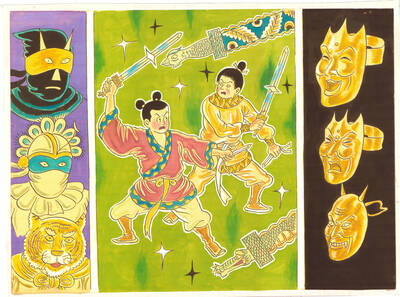
April 22 to April 28 The true identity of the mastermind behind the Demon Gang (魔鬼黨) was undoubtedly on the minds of countless schoolchildren in late 1958. In the days leading up to the big reveal, more than 10,000 guesses were sent to Ta Hwa Publishing Co (大華文化社) for a chance to win prizes. The smash success of the comic series Great Battle Against the Demon Gang (大戰魔鬼黨) came as a surprise to author Yeh Hung-chia (葉宏甲), who had long given up on his dream after being jailed for 10 months in 1947 over political cartoons. Protagonist

Peter Brighton was amazed when he found the giant jackfruit. He had been watching it grow on his farm in far north Queensland, and when it came time to pick it from the tree, it was so heavy it needed two people to do the job. “I was surprised when we cut it off and felt how heavy it was,” he says. “I grabbed it and my wife cut it — couldn’t do it by myself, it took two of us.” Weighing in at 45 kilograms, it is the heaviest jackfruit that Brighton has ever grown on his tropical fruit farm, located


 RSS
RSS