


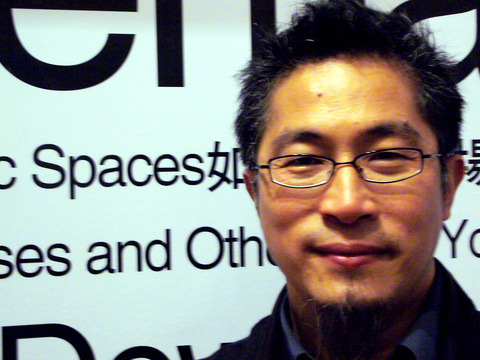
The common perception of a curator is a highly educated, distinguished man in a three-piece suit, smoking a pipe and leafing through old archive photos of ancient masters. Though Manray Hsu (徐文瑞) has a PhD in philosophy from Columbia University and wears a button down shirt, the independent curator who is based in Taipei and Berlin rarely spends time looking through boxes in the archives of old museums.
Like many contemporary artists, Hsu is concerned with how art affects our daily lives and creates a dialogue within the global and local contexts. This notion shapes his entire outlook on the art he chooses for exhibits, such as Naked Life, currently running at the Museum of Contemporary Art, Taipei (MOCA).
Hsu differentiates between independent curators from institutional curators in two ways. First, he points out that independent curators don't work in or have an ongoing collaboration with any particular museum. Instead, they spend time moving from one museum or biennial to another picking and choosing projects that are most suited to their aesthetic vision. The corollary to this is that independent curators are also intellectually independent.
PHOTOS: NOAH BUCHAN, TAIPEI TIMES
"Freelance curators have [the] freedom … to develop ideas and projects in [their] own way. If you work in an institution you are more limited as to what you can do and what you can not do," he said.
Hsu also says that working independently enables the curator to collaborate closely with artists, which normally wouldn't be the case working inside an institution. "For me, independent means that I'm also more in contact with artists and those people in the field."
Collaborating with artists and working in the "field" has only become common in the past few decades. Until the 1970s, curators were predominately trained in art history, which had a tremendous influence on what hung on the walls of museums. "You still have an exhibition, but you don't rely on art history anymore. You can still do it, but art history is not the only framework. So you need to have people who can provide a smaller framework but still much bigger than the individual artwork. That's the curator's job. Framework providers," he said.
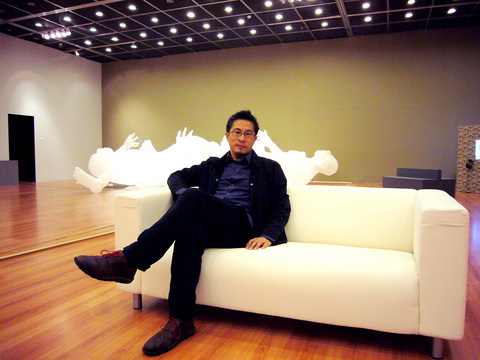
For Hsu, creating the proper framework for an exhibit necessarily involves a lot of travel because he seeks input from international artists.
"My job relies on my traveling. But an important part of this issue is contemporary culture, [which is] a global culture. There is no simple big narrative that can allow you to say, okay, I know the whole art world. So you need to have people from different parts of the world who can bring their perspective and their experience into the field. And normally these people are curators and theorists," he said.
Hsu's global perspective is readily apparent with the current lineup of artists exhibiting at MOCA who hail from as far a field as Iraq and as close to home as Japan. "[By] traveling, I've built my own conceptual network and this is another thing I bring into the art world," Hsu said.
According to Hsu, his extensive travels combined with a global outlook and a desire to directly cultivate talent fosters greater trust between the curator and artists because the latter are working directly with an individual, rather than an institution. The curator can then have a clearer picture of what the artist is trying to achieve because both sides are working together.
How art is classified according to culture is an important issue to Hsu who believes stereotypes of what a particular culture will produce need to be broken down.
One common notion that Hsu wants to rid the art world of is the idea that an artist's work is inseparable from their nationality.
"Just because this artist is from Iraq, then everything he does has to do with Iraq — this, for me, doesn't really make sense," he said. "When a Western artist exhibits in a professional exhibition, normally the exhibition will not mention the locality [where the ideas are formed] and I feel this is more questionable."
"Some artists are really conscious of their local history and some artists work on more formalistic issues inside art history so the idea of locality [is] relevant to artists in different ways, no matter if it is Western [or] Eastern."
The relevance of national history, borders and educational background is, Hsu believes, becoming less important. The question facing institutions is: can they react quickly enough?
Part of reacting to and participating in the social environment — whether global or local — involves formulating theories that help people understand the processes of change. For the biennial held earlier this year in Liverpool, Hsu developed an idea that shows how art can rejuvenate public spaces. Known as "archipuncture" it reveals how artwork in the public realm is connected to the energy flow of the city through its placement at particular points.
"Archipuncture for me ... provide[s] a perspective of how art can be related to the urban condition. Instead of just something that you look at … art also brings new energy flows to the place where it is exhibited. And this kind of new energy can be related to the health of the city," he said. Hsu makes it clear that this idea can be applied to any city throughout the world.
The exhibit at MOCA, in a similar manner to the 2006 Liverpool Biennial, involves both a global and local perspective. The title of the exhibit is meant to explore the contemporary mode of existence where anti-terrorism, border control and the gradual erosion of due process has stripped many citizens of their political rights and legal protections. The concepts embodied in Naked Life should have particular resonance for Taiwanese because of the country's forty-year history of martial law.
Naked Life is an attempt to raise awareness of global issues in a local context that moves beyond the cynicism of the polarizing politics that Hsu claims pervades Taiwan .
In late October of 1873 the government of Japan decided against sending a military expedition to Korea to force that nation to open trade relations. Across the government supporters of the expedition resigned immediately. The spectacle of revolt by disaffected samurai began to loom over Japanese politics. In January of 1874 disaffected samurai attacked a senior minister in Tokyo. A month later, a group of pro-Korea expedition and anti-foreign elements from Saga prefecture in Kyushu revolted, driven in part by high food prices stemming from poor harvests. Their leader, according to Edward Drea’s classic Japan’s Imperial Army, was a samurai
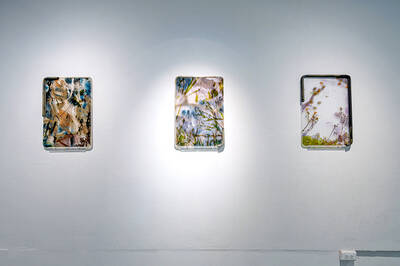
Located down a sideroad in old Wanhua District (萬華區), Waley Art (水谷藝術) has an established reputation for curating some of the more provocative indie art exhibitions in Taipei. And this month is no exception. Beyond the innocuous facade of a shophouse, the full three stories of the gallery space (including the basement) have been taken over by photographs, installation videos and abstract images courtesy of two creatives who hail from the opposite ends of the earth, Taiwan’s Hsu Yi-ting (許懿婷) and Germany’s Benjamin Janzen. “In 2019, I had an art residency in Europe,” Hsu says. “I met Benjamin in the lobby
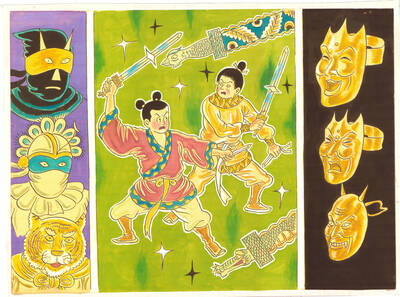
April 22 to April 28 The true identity of the mastermind behind the Demon Gang (魔鬼黨) was undoubtedly on the minds of countless schoolchildren in late 1958. In the days leading up to the big reveal, more than 10,000 guesses were sent to Ta Hwa Publishing Co (大華文化社) for a chance to win prizes. The smash success of the comic series Great Battle Against the Demon Gang (大戰魔鬼黨) came as a surprise to author Yeh Hung-chia (葉宏甲), who had long given up on his dream after being jailed for 10 months in 1947 over political cartoons. Protagonist

Peter Brighton was amazed when he found the giant jackfruit. He had been watching it grow on his farm in far north Queensland, and when it came time to pick it from the tree, it was so heavy it needed two people to do the job. “I was surprised when we cut it off and felt how heavy it was,” he says. “I grabbed it and my wife cut it — couldn’t do it by myself, it took two of us.” Weighing in at 45 kilograms, it is the heaviest jackfruit that Brighton has ever grown on his tropical fruit farm, located


 RSS
RSS