


In an era of music careers created in the democratic nowhere of MySpace, where the members of hot bands dress as if they were office temps, the days of the rock show as spectacle and the rock star as circus star are unquestionably numbered.
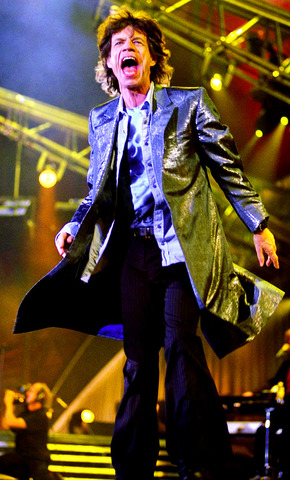
Yet arena rock, at least, still has a certifiable god in Mick Jagger. And, as the Rolling Stones blew through this honky-tonk beachfront city last week on the last leg of its Bigger Bang tour, Jagger gave a performance that was a master class in the genre.
As lithe as a boy, Jagger seems to defy age. At least he does below the waist. Grooved and sunken, his weather-beaten face betrays every second of his 63 years, and this makes it all the more startling when he prances and postures like some curious and gorgeous superannuated Pan.
PHOTOS: AGENCIES
It is Jagger's persona that a Stones show is built upon, and Jagger who inspires fans to travel great distances, blow the rent money on tickets and follow the Stones to the ends of the earth.
The music draws them, too, of course, but there are few sights in entertainment as compelling as Jagger's almost vaudevillian brio, his eccentric presentation and his achingly singular style.
"Mick Jagger has been living on the style edge since 1966," said Joe Levy, the executive editor of Rolling Stone magazine. "The edge keeps moving, and so does he."
Even a cursory trip through the archives of fashion makes clear that whenever designers as unalike as Roberto Cavalli and Tommy Hilfiger invoked some emblematic rock star, or rocker "icon," or rocker "rebel," Jagger was the point of reference.
Bowie was stylish. Bryan Ferry looked good in a suit. But it was Jagger who preened himself in a Mephistopheles cloak at Altamont; wore Ossie Clark jumpsuits split to the navel; and who appeared in a flounced neoclassical Grecian-style jacket to read Shelley at a concert after Brian Jones' death.
It was Jagger who flaunted billowing trousers designed by Giorgio Sant'Angelo, "mad things, beautiful things," as Tony King, Jagger's media coordinator for four decades, said last week. "From the start, the Stones had kind of their own look," King explained before heading from Manhattan to New Jersey for the Bigger Bang show. "They were very much not the Beatles, four guys wearing the same suits."

In truth, the Stones dressed identically in their very earliest incarnation, wearing the matching suits that were the boy-band uniform of the British Invasion. That they ditched these in favor of dressing as rowdies or dandies or rough trade or women probably owes more to Jagger, a lifelong clotheshorse, than to any other member of the band.
"It was in 1969, when the Stones made Gimme Shelter, when all of a sudden there became a need to have a look for a tour," King said.
It was also about that time when Jagger and his bandmates began affecting eyeliner and the dangling earrings that would eventually provide Johnny Depp with the visual cues for the character Jack Sparrow, his Pirates of the Caribbean homage to Keith Richards-as-dandy, a characterization that helped make a multimillion-US dollar franchise out of a dull cinematic cartoon.
Even as far back as 1975, when Karen Durbin wrote a Village Voice cover article about the Rolling Stones, she was not alone in pointing out the gender games Jagger was already playing through clothes. "He was very, very androgynous," said Durbin, now a film critic for Elle magazine, and so avid a fan she claims to have seen the Stones 22 times. "But he was also simultaneously a little scary, a little hard and indisputably masculine."
Jagger's onstage dualities were not accidental, said Durbin. "It was all deliberate."
Nowadays, of course, gender blur is a karaoke setting in the music business. At some point everyone in a band has put on eyeliner, except perhaps the girls.
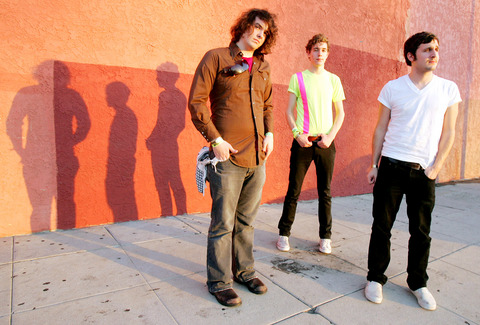
And while groups as unalike as the Libertines, say, or the Scissor Sisters, or the Strokes or the Killers or the Hives, or My Chemical Romance continue to pay homage, not always ironic, to the rock star as dandified satyr, the much greater shift in the music business is away from Rolling Stones-style theatricality and toward something more neutral, amateurish and anonymous.
"We would never get all costumed up," Mitch DeRosier, a musician with the indie band Born Ruffians, said by phone last week from Portland, Oregon, where the group was on tour with Hot Chip. "I don't go out of my way that much."
Talk to a member of almost any band created in the emo era, and one would hear more or less the same thing. "I like the Rolling Stones, and I'm a huge fan of their music," said Seth Olinsky, a musician in the exuberantly frumpy Brooklyn-based indie band Akron/Family. "But the sexy-strut dude is not the image I choose to be important to me."
As an expression of style, grunge has been quoted so liberally by now that it rates a mile marker on the timeline of fashion. Yet compared with the look lately favored by young bands, grunge has come to seem almost baroque.
And as that has happened, so has Jagger's form of personal display been refined to the extent that he is like an essence of rock star: skinny jeans and cropped jackets by the Balenciaga designer Nicolas Ghesquiere; tight glittering T-shirts by the Dior designer Hedi Slimane.
"In mainstream rock, you no longer see guys willing to take these fashion risks," said Dan Peres, the editor of Details, a magazine whose editorial mission basically descends from Jagger's robust sartorial and social experiments. "In this day and age, where if you have a great MySpace page you can go further than acts with labels promoting them and sell tonnes of albums without even having a label," said Peres, "no one wants to make a style statement that would alienate anyone."
No one wants to go onstage, as Jagger did each time the band played Sympathy for the Devil on the Bigger Bang tour — which ends this weekend in Vancouver — in a coat and matching fedora designed by Miuccia Prada and made entirely of feathers, perhaps because no one without his history could wear a coat of cock feathers and not seem like a joke.
"Very early on we did the same thing" young bands are now doing, Jagger explained in an interview this week. "We wore clothes very similar to what we wore offstage because we didn't have any money and that was the look."
It wasn't until the end of the 1960s, when the Rolling Stones were playing 50,000-seat arenas, that the band began, he said, to wear more "eye-catching" stuff.
"If I was starting out now, I would dress down but still hope to have some distinctive way of dressing down," he said.
"It doesn't matter if you're starting out or you're doing it for years," Jagger said. "There's no point in having a huge dress-up if you're playing a 500-seat club. And if you're playing for 50,000 people, there's no point in wearing rags."

In late October of 1873 the government of Japan decided against sending a military expedition to Korea to force that nation to open trade relations. Across the government supporters of the expedition resigned immediately. The spectacle of revolt by disaffected samurai began to loom over Japanese politics. In January of 1874 disaffected samurai attacked a senior minister in Tokyo. A month later, a group of pro-Korea expedition and anti-foreign elements from Saga prefecture in Kyushu revolted, driven in part by high food prices stemming from poor harvests. Their leader, according to Edward Drea’s classic Japan’s Imperial Army, was a samurai

Located down a sideroad in old Wanhua District (萬華區), Waley Art (水谷藝術) has an established reputation for curating some of the more provocative indie art exhibitions in Taipei. And this month is no exception. Beyond the innocuous facade of a shophouse, the full three stories of the gallery space (including the basement) have been taken over by photographs, installation videos and abstract images courtesy of two creatives who hail from the opposite ends of the earth, Taiwan’s Hsu Yi-ting (許懿婷) and Germany’s Benjamin Janzen. “In 2019, I had an art residency in Europe,” Hsu says. “I met Benjamin in the lobby
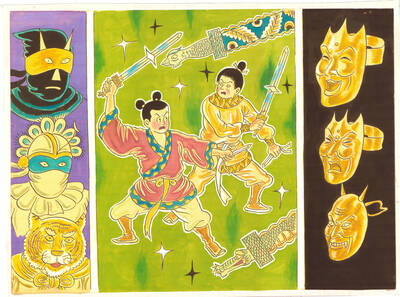
April 22 to April 28 The true identity of the mastermind behind the Demon Gang (魔鬼黨) was undoubtedly on the minds of countless schoolchildren in late 1958. In the days leading up to the big reveal, more than 10,000 guesses were sent to Ta Hwa Publishing Co (大華文化社) for a chance to win prizes. The smash success of the comic series Great Battle Against the Demon Gang (大戰魔鬼黨) came as a surprise to author Yeh Hung-chia (葉宏甲), who had long given up on his dream after being jailed for 10 months in 1947 over political cartoons. Protagonist

A fossil jawbone found by a British girl and her father on a beach in Somerset, England belongs to a gigantic marine reptile dating to 202 million years ago that appears to have been among the largest animals ever on Earth. Researchers said on Wednesday the bone, called a surangular, was from a type of ocean-going reptile called an ichthyosaur. Based on its dimensions compared to the same bone in closely related ichthyosaurs, the researchers estimated that the Triassic Period creature, which they named Ichthyotitan severnensis, was between 22-26 meters long. That would make it perhaps the largest-known marine reptile and would


 RSS
RSS