


For Sandy Chang (張芝華), a crisis became the opportunity of a lifetime. When the Internet boom evaporated in 2001, she lost her marketing job in California and her relationship headed south. At the end of her rope emotionally and financially, Chang sought the help of a hypnotherapist.
"At the time I had very low self-esteem," Chang explained last week. "She [my hypnotherapist] said I was a natural healer. She said I could be a hypnotherapist."
Intrigued, Chang began studying how hypnotherapy can help people change by programming the subconscious. Three years ago, she returned to Taiwan and quickly acquired a roster of high-profile clients, including a famous actress she cured of a fear of thunderstorms.
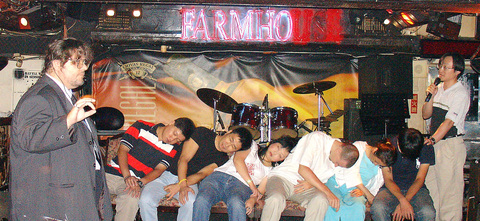
PHOTO COURTESY OF BRIAN DAVID PHILLIPS
It wasn't long before the Apple Daily newspaper and several cable news stations featured her in reports, and now Chang is one of the most well-known members of what by international standards is an unusually active hypnosis community.
"Taiwan has the highest concentration of [National Guild of Hypnotists]-certified instructors," said Elliot Chen (陳一德), an instructor for the US-based National Guild of Hypnotists, one of the world's largest hypnosis organizations. There are more than 100 NGH-certified instructors in Taiwan, he said, compared with 14 in California, 30 in New York State and 16 in the UK. Altogether, the National Guild of Hypnotists claims 1,000 members in Taiwan, a larger proportion of the population than its 9,000 US members. "A lot of my students are doctors, lawyers, and professors," Chen said. "They do not want to teach hypnosis for life. They just want to learn more [about] hypnosis or share the wisdom of mind-body spiritual healing."
Hypnosis is a state of enhanced relaxation and heightened imagination in which a person's critical faculty is bypassed, allowing the deeper parts of the mind to become accessible and open to suggestion. This state may be self-induced, and hypnotists say something similar happens when you "zone out" on the commute to work or engage in intense meditation.
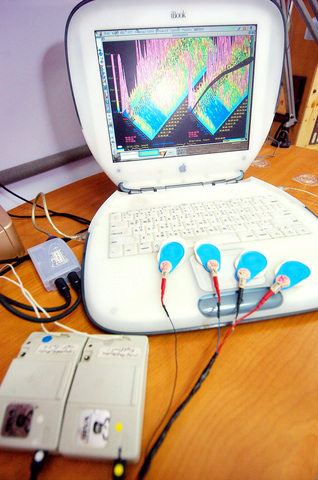
PHOTO: WANG MIN-WEI, TAIPEI TIMES
But many consider hypnosis to be a pseudo-science, and misconceptions abound. In Western countries the use of hypnosis as a form of entertainment — notably in stage shows where audiences are induced to perform odd tasks such as barking like dogs or channeling past lives — has made it harder for hypnotherapists to gain acceptance of their practice. In Taiwan, however, the opposite has occurred.
It started in 1994 with the "Hypnosis Typhoon" (催眠颱風), the media storm that followed the arrival of stage hypnotists Martin St. James and Tom Silver. St. James, from Australia, presented himself as a straight-up entertainer, while Silver, an American who also practices hypnotherapy, billed himself as "bringing the science of hypnotherapy to Taiwan."
Silver said he did a half-hour segment for around 10 weeks on variety show Super Sunday, set a world record for mass hypnotism — 3,800 people — and hypnotized celebrities, including Coco Lee (李文), who imagined that in a past life she had been a 17th-century English aristocrat in a billowy white dress.
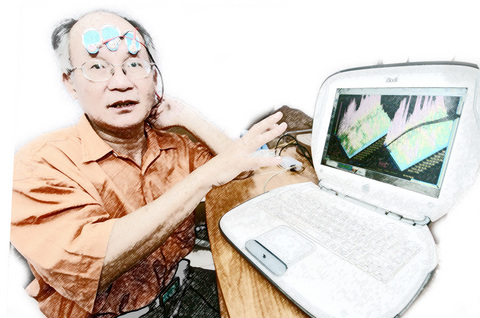
PHOTO: WANG MIN-WEI, TAIPEI TIMES
"The phones were ringing off the hook," said Silver, who was interviewed by phone from California. The hype surrounding his show was so intense that it created a backlash. When Silver left the country to renew his visa, media speculated he had fled after planting suggestions in the minds of his television audience. A member of Silver's stage crew went into a trance while witnessing him hypnotize a celebrity and began exhibiting symptoms of multiple-personality disorder. "We solved the problem but the show was cancelled," Silver said. "So we ended up doing a lot of lectures."
Such exploits attracted the attention of government officials, who in 1996 enlisted Silver and his interpreter Timothy Huang (黃大一) to hypnotize potential witnesses in a corruption case. Huang, who himself went on to become a hypnotherapist, confirmed this account and says he has since helped with other investigations.
One of the applications that hooked Taiwan on hypnosis was the idea that it could be used to access memories from previous lives, said Hsu Ming (徐明), a former basketball star and film actor-turned promoter who brought Silver to Taipei. He said the practice, known as past-life regression, fits with the country's Buddhist and Taoist traditions.
Two years before Hsu Ming brought Silver to Taiwan, the book Many Lives, Many Masters by US author Brian Weiss sold half a million copies in Taiwan. "In the States it was just a normal book," Hsu Ming said, but it was popular in Taiwan because "people believe [here] hypnosis can take you back to your previous life to [explain] what's going on in this life."
Hsu became interested in hypnosis himself, went on to host a regular television series on Star World and is now chairman of Chinese Hypnosis Association (中華催眠協會). In addition to running a private practice, he currently helps athletes on Taiwan's Olympic team and teaches self-hypnosis to large classes of police officers to help them improve sleep and deal with trauma.
Though several hypnotherapists interviewed for this story feel past-life regressions can have therapeutic value, even if they personally do not believe in reincarnation, Hsu does not offer this service. "Why do you have to spend your money to make a daydream," he tells potential clients. "You're wasting your money and my time."
For Hsu, hypnosis is about helping the mind concentrate, which aids the production of hormones that block the conscious mind and help the body relax. "Hypnosis is a very strange state because your muscles relax but your mind is wide awake," he said. "We are switching the body system when you relax and your mind is peaceful. Your body will create a lot of good hormones … and it is much easier to pick up positive emotional memor[ies]," which are then harnessed to program the subconscious.
Hypnosis has been recognized as a clinical technique by both the American Medical Association and British Medical Association since the late 1950s. In medical circles it is deemed suitable for helping with stress, pain and phobias. Studies suggest it is more effective for smoking cessation than other forms of treatment.
There is, however, an important distinction between relying solely on hypnotherapy and using it in conjunction with other forms of medical treatment. And debates abound concerning the usefulness and verifiability of certain techniques. Many people can guide you into a trance state, but knowing what to do when a trance is achieved is what counts.
Brian David Philips, a professor of English at National Chengchi University (國立政治大學) who also practices hypnotherapy, said he does not work with clients on health issues without a doctor's referral.
He defines hypnosis as "consensual guided intensified imaginative involvement … to bypass the critical factor of the conscious mind" so a client can establish what he calls "appropriate selective thinking" and is open to suggestions. A hypnotherapist acts as a guide in a collaborative process, Phillips said, and cannot make you do something that goes against your values.
Phillips, who also teaches hypnosis classes and regularly performs stage shows in the Taipei area, calls this the "therapeutic hypnotic contract." "I say I'm the hypnotist and I know how to guide you to enter this state. I ask if you are willing to be guided. Part of my deal is I assure you that, when I give you suggestions, they will be appropriate for your needs and what you want … . If either of us breaks that covenant, then the session's going to fail."
In an e-mail exchange, Phillips said one of his greatest successes was helping a young man become a better swimmer. "I had him bring in some short videos of the movements he needed work on so that he could enter trance and then … identify with [it] as if he could feel what he saw on the screen. After the process his arms were sore, as if he had been practicing instead of watching the videos. His improvement was near immediate."
Clients commonly seek Phillips' help for stress relief and relaxation. An advantage of hypnotherapy in comparison with other forms of "talk" therapy, Phillips said, is that for certain targeted areas hypnotherapy can accomplish in a few sessions what other forms of therapy might take months or years to accomplish.
But individual hypnotherapy sessions can be expensive. The Taipei-based hypnotherapists interviewed for this story charge NT$3,000 to NT$6,000 per visit. By comparison, licensed, English-speaking counselors at the Community Services Center in Tianmu bill clients on a sliding scale based on income. A session there can cost as little as NT$800 per hour.
And unlike psychology and psychotherapy, there is no accredited university-level training for hypnotherapy. While the hypnotherapists interviewed for this story possess years of practical experience and hone their craft through continuing education courses and seminars, many hypnotherapy trainers certify students after only a few hours of classroom study.
"There are a lot of people practicing what I call 'voodoo hypnotherapy,'" Silver said. At some schools in the US, he added, admission standards are so low that "anyone can crawl in there as long as you can breathe and hold your hand to sign a document." The problem is that many trainers and schools offer faster routes to certification, and thus potential income. "I almost feel bad calling myself a hypnotherapist," Silver said, "because it almost means nothing."
The result in Taiwan, local hypnotherapists say, is an over-saturated market that has caused many practitioners to seek opportunities in China. "Quality control in hypnotherapy is very low," Sandy Chang said. "The danger degree is even more than psychotherapy because you deal with people's unconscious minds."
Chang, who teaches and certifies hypnotherapists, said no one would take her course if it lasted a year. Hers runs for eight days, while others only last two or three, and she requires students to complete internship and research phases before she certifies them.
"Even programs that do last a year aren't necessarily better," Phillips wrote. "Anyone can learn to guide another into trance. The art of the skill is learning how to best utilize the trance … . This often simply takes experience but it really requires guided instruction with plenty of practice within the classroom where there are willing volunteers and an instructor who is looking out for the interests of the students and their trance partners."
Timothy Huang, who has a doctorate in chemistry, compares hypnotherapy to alchemy, itself not a science but an essential precursor to the Scientific Revolution. Though hypnosis has been used in a clinical setting for centuries, hypnotherapy is still more art than science.
"How can we be sure that the reply from the subject is really from their memory, not from their willingness or hyper-suggestibility," Huang said in a phone interview Sunday. "We really don't know."
He uses a brainwave machine with a personal computer to show clients they have entered a hypnotic state. "If a reply is from his memory there won't be any strong beta wave activity, but if he is making up the story then we can see some beta waves coming up," he said. (When brain waves are measured, the beta frequency indicates a person is in an alert waking state.)
However, Huang cautions that this method has yet to be validated, a task for which other hypnotherapists say much more advanced brain imaging machines, which are currently too expensive for private practice, may be needed. "It's more or less … an empirical formula," Huang said, but acknowledged that much work remains to be done.

Last week Joseph Nye, the well-known China scholar, wrote on the Australian Strategic Policy Institute’s website about how war over Taiwan might be averted. He noted that years ago he was on a team that met with then-president Chen Shui-bian (陳水扁), “whose previous ‘unofficial’ visit to the US had caused a crisis in which China fired missiles into the sea and the US deployed carriers off the coast of Taiwan.” Yes, that’s right, mighty Chen caused that crisis all by himself. Neither the US nor the People’s Republic of China (PRC) exercised any agency. Nye then nostalgically invoked the comical specter
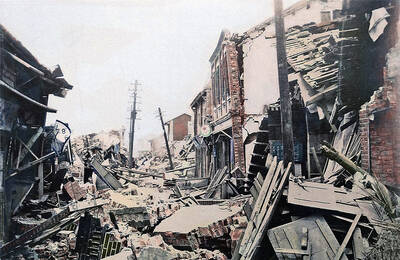
April 15 to April 21 Yang Kui (楊逵) was horrified as he drove past trucks, oxcarts and trolleys loaded with coffins on his way to Tuntzechiao (屯子腳), which he heard had been completely destroyed. The friend he came to check on was safe, but most residents were suffering in the town hit the hardest by the 7.1-magnitude Hsinchu-Taichung Earthquake on April 21, 1935. It remains the deadliest in Taiwan’s recorded history, claiming around 3,300 lives and injuring nearly 12,000. The disaster completely flattened roughly 18,000 houses and damaged countless more. The social activist and

Over the course of former President Ma Ying-jeou’s (馬英九) 11-day trip to China that included a meeting with Chinese Communist Party (CCP) leader Xi Jinping (習近平) a surprising number of people commented that the former president was now “irrelevant.” Upon reflection, it became apparent that these comments were coming from pro-Taiwan, pan-green supporters and they were expressing what they hoped was the case, rather than the reality. Ma’s ideology is so pro-China (read: deep blue) and controversial that many in his own Chinese Nationalist Party (KMT) hope he retires quickly, or at least refrains from speaking on some subjects. Regardless

Approaching her mid-30s, Xiong Yidan reckons that most of her friends are on to their second or even third babies. But Xiong has more than a dozen. There is Lucky, the street dog from Bangkok who jumped into a taxi with her and never left. There is Sophie and Ben, sibling geese, who honk from morning to night. Boop and Pan, both goats, are romantically involved. Dumpling the hedgehog enjoys a belly rub from time to time. The list goes on. Xiong nurtures her brood from her 8,000 square meter farm in Chiang Dao, a mountainous district in northern Thailand’s


 RSS
RSS