


From the late 1930s through the 1950s, the words "Peer's Daughter" were regularly lodged in British tabloid headlines above the startling doings of one or another of the Mitford sisters, daughters of the less startling, but equally eccentric, Lord and Lady Redesdale.
The papers announced that Unity Mitford, a close and doting member of Hitler's intimate circle, had shot herself upon the outbreak of the war, and was being repatriated. (Two years later she died of a brain injury.) They recorded the imprisonment of the beautiful pro-Nazi Diana, along with her saturnine husband, Oswald Mosley, leader of Britain's Fascists.
They registered a drastic swing of the Mitford political compass when Jessica, 17 and an impassioned leftist, eloped to Spain with Esmond Romilly, Winston Churchill's nephew, to join the republican side in the Civil War. Anthony Eden, the foreign secretary, had a destroyer take them right back. The bit about "not who you are, but who you know" was meaningless in their particular England. Who you were was who you knew.
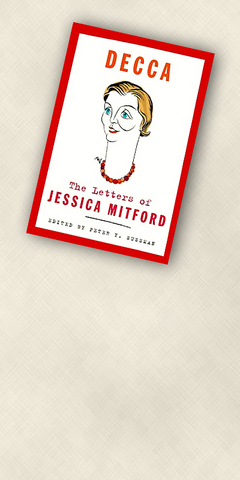
Such public Mitford extremes were not really separate from the private ones, attached to an upbringing for which odd would be the blandest understatement. Both are amply reflected in Decca: The Letters of Jessica Mitford. If the first could hold grim consequences (with an undertone of comic absurdity), the second, for all their absurd comedy, held an undertone of chill.
Nancy Mitford, seemingly more conventional, recorded her family's extravagances in a series of engaging, nonfictional fictions. (Jessica's memoir, Hons and Rebels, was a kind of fictional nonfiction.) Nancy put a name on it all: "The private Mitford cosmic joke."
It was as if the childhood nursery, whimsically feral, with its private language and unsupervised, faintly Lord of the Flies air — the parents' eccentric interventions were the odd comets traversing a child-run solar system — had stayed with them as they grew up.
They went out into the world, unchastened and retaining a little of the private language and a good deal more of the private thinking. L.P. Hartley wrote, "The past is another country; they do things differently there." The Mitfords towed that other country and all of its differences along behind them.
Even the quieter ones did some towing. Deborah has been recalled declaring as a child that she intended to become a duchess, and she did, by a circuitous if not (we presume) magical route. She married the Duke of Devonshire's younger son; he became heir when his older brother died in the war, then duke himself.
It was Jessica, known as Decca, who traveled farthest and freest. She and her family severed the towline. (Years later, Lord Redesdale wrote in his will "except Jessica" for each bequest to his children.) It would be a temporary severing, though the part-frayed ends still chafed.
Decca migrated with Esmond to the US, where they lived a happy mix of mild bohemianism and social butterflying. Among their close friends was Katharine Graham, who would inherit the Washington Post. When Esmond returned to Britain as a fighter pilot and was killed, Decca worked for a fashionable dress shop, and later for the wartime Office of Price Control.
Moving to San Francisco with her daughter, Constancia, she married a radical lawyer, Robert Treuhaft, joined the Communist Party and began decades of civil rights activism. This continued even after she left the party in 1958, because she found it had gone not wrong, but stodgy. After writing the hugely successful Hons and Rebel and The American Way of Death, a witty and devastating look at the funeral industry, she found herself a celebrity and, to her astonishment, wealthy.
All this, and a great deal more, is contained in Decca, a 744-page collection of letters, painstakingly and usefully edited by Peter Y. Sussman, a journalist and friend who has contributed lengthy biographical accounts between sections.
The letters are a treasure. Decca lived and battled by a pen that was as graceful and witty as it was sharp. Teeth were her means of propulsion, her wings; and the marks they left were singularly fine and even to be prized. She was, consummately, a happy warrior; in her letters, as in her books, she gets at her targets — the funeral directors, fat-farmers, prison establishment, writing programs — with their own words. There is no insult like a mirror's.
Only a few letters battle directly; most report the details to friends. Her activism, though, is only one subject in a collection that deals with virtually every part of her life: her husbands, her children, her writing, her publishers and, more and more as the years pass, the Mitfords.
Each one gets her own treatment. Early on, there was a touching reconciliation with her mother, and as the years pass, this becomes warmer and more solid, though after Lady Redesdale's death, Decca can't resist noting to a friend one of her mother's diary entries: "Heifer born today. Mabel (a servant) two weeks holiday. Decca married. Tea with Fuehrer." (The Redesdales were visiting Unity in Germany.)
If Decca has forgiven her mother her one-time Hitler sympathies, has nothing but tenderness for the deluded and disabled Unity, is cautiously affectionate with Nancy and warm though prickly with Deborah, she is unbending about Diana's steely and unrepentant Fascist history. Visiting London with her son, Benjamin Treuhaft, who is half Jewish, she notes Diana's offer of a meeting: "I thought better not, as I didn't want Benj turned into a lampshade."

Last week Joseph Nye, the well-known China scholar, wrote on the Australian Strategic Policy Institute’s website about how war over Taiwan might be averted. He noted that years ago he was on a team that met with then-president Chen Shui-bian (陳水扁), “whose previous ‘unofficial’ visit to the US had caused a crisis in which China fired missiles into the sea and the US deployed carriers off the coast of Taiwan.” Yes, that’s right, mighty Chen caused that crisis all by himself. Neither the US nor the People’s Republic of China (PRC) exercised any agency. Nye then nostalgically invoked the comical specter
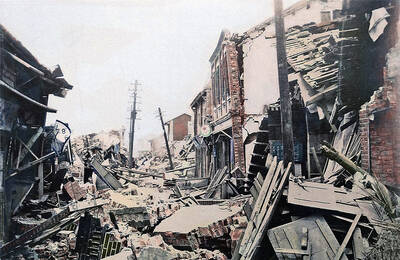
April 15 to April 21 Yang Kui (楊逵) was horrified as he drove past trucks, oxcarts and trolleys loaded with coffins on his way to Tuntzechiao (屯子腳), which he heard had been completely destroyed. The friend he came to check on was safe, but most residents were suffering in the town hit the hardest by the 7.1-magnitude Hsinchu-Taichung Earthquake on April 21, 1935. It remains the deadliest in Taiwan’s recorded history, claiming around 3,300 lives and injuring nearly 12,000. The disaster completely flattened roughly 18,000 houses and damaged countless more. The social activist and

Over the course of former President Ma Ying-jeou’s (馬英九) 11-day trip to China that included a meeting with Chinese Communist Party (CCP) leader Xi Jinping (習近平) a surprising number of people commented that the former president was now “irrelevant.” Upon reflection, it became apparent that these comments were coming from pro-Taiwan, pan-green supporters and they were expressing what they hoped was the case, rather than the reality. Ma’s ideology is so pro-China (read: deep blue) and controversial that many in his own Chinese Nationalist Party (KMT) hope he retires quickly, or at least refrains from speaking on some subjects. Regardless

Approaching her mid-30s, Xiong Yidan reckons that most of her friends are on to their second or even third babies. But Xiong has more than a dozen. There is Lucky, the street dog from Bangkok who jumped into a taxi with her and never left. There is Sophie and Ben, sibling geese, who honk from morning to night. Boop and Pan, both goats, are romantically involved. Dumpling the hedgehog enjoys a belly rub from time to time. The list goes on. Xiong nurtures her brood from her 8,000 square meter farm in Chiang Dao, a mountainous district in northern Thailand’s


 RSS
RSS